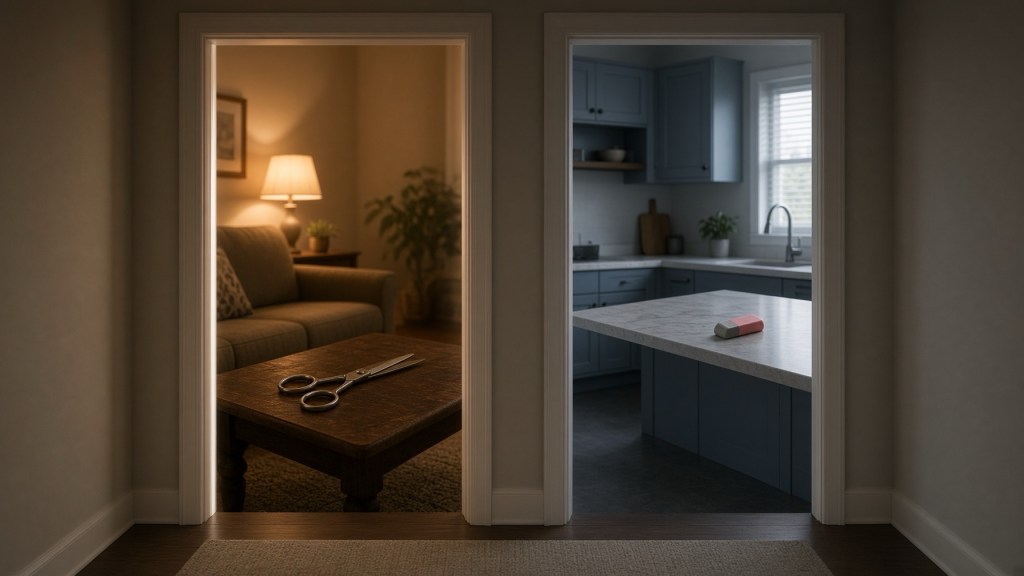
You stand up in the living room to fetch the scissors. By the time you reach the kitchen, the scissors are gone from your head and you are left holding nothing but a vague sense of purpose. Most people have a name for this and a theory to go with it: the doorway did it. The story has circulated for more than a decade and it is a good one, because it matches an experience nearly everyone has had. Psychologists describe a mechanism behind it. The mind files experience in scenes, and a doorway marks the end of one scene and the start of the next, so whatever belonged to the old scene becomes harder to reach.
After reading the original experiments, a news digest and a magazine account of them, five other studies that tested the effect or its cousins, a meta-analysis of if-then planning for remembering to act, and a book chapter on the evidence behind those plans, my verdict is a surface resemblance only, for now. The lab effect is real in some studies, small, and absent in others. It was measured as a slip in recognizing an object you were carrying, which is a different thing from forgetting an errand. What does hold up is that a short if-then plan helps people remember to do things. The proposal is a trial that tests the doorway claim directly on errands and then tests whether a plan tied to the doorway beats a plan that is not.
Scientific Foundation
Begin with the original work. Gabriel Radvansky, Sabine Krawietz and Andrea Tamplin at the University of Notre Dame ran three experiments in which people carried objects from table to table and were then quizzed on what they held or had just put down. In the opening experiment, 55 participants moved through a virtual environment of 55 rooms on small monitors. Room sizes were varied so that the distance walked was the same whether or not a doorway was crossed. Error rates on probes asking whether a given object was the one they held were .12 without a doorway and .19 with one for objects that really were held, and .07 against .22 for objects that were not [1].
The next experiment moved to a real laboratory with three rooms and 60 participants, who carried six objects per trial and did a three-digit arithmetic distractor before each test. The errors were higher overall, .23 without a doorway and .28 with one for held objects, a difference with a reported probability of .02, and .18 against .21 for objects not held, a difference of .06 that did not clear the usual threshold. The final experiment used a large virtual environment with 48 participants and tested whether the context explanation could account for the effect. If forgetting occurred because the original room was no longer around to cue memory, then going back to it should have helped. It did not. Errors rose with the number of new rooms entered, from .11 with no shift to .14 after one shift, .16 after a return to the original room and .20 after a double shift through two new rooms, so the count of new rooms mattered more than the count of doorways [1].
The authors explain this with what they call the event horizon model, which has three parts. Doorways act as event boundaries, so the old event model loses availability. Objects currently carried are foregrounded, and so are easier to reach than objects put down. And a carried object comes to be linked to two rooms after a shift, so two event models compete at retrieval. They describe the model as adequately accounting for the data, not as proved, and note several oddities in their own results, including weak negative-probe effects in the final experiment and one cell that did not fit the model’s prediction [1]. A news digest from the British Psychological Society and a magazine account repeat the story with fewer details. The magazine piece reports no sample sizes and no replication problems, and says the effect appeared on both a 66-inch flat screen and a 17-inch monitor, and with real objects hidden in shoeboxes [2][3].
Another study found the effect again. Seel and colleagues at Durham University had 44 analyzable participants walk a 55-room virtual environment, and asked whether the drop in memory after a doorway was a loss of recollection or of familiarity. Error rates were about 12 to 14 percent after a doorway against 9 to 10 percent without, and responses were slower after a doorway, for example about 3,482 milliseconds against 3,208 for objects that had been held. The share of correct answers that came with a feeling of remembering fell from 83.6 to 78.0 percent, and answers based on mere knowing rose from 14.2 to 19.0 percent. The authors read this as a loss of recollection with familiarity left intact. Their paper has limits that its authors name, including a sample cut by motion sickness, marginal results for the knowing responses, an interpretation they call speculative, and some statistics reported inconsistently, so exact values should be checked against the full paper [5].
One attempt did not reproduce it cleanly. McFadyen, Nolan, Pinocy, Buteri and Baumann, at the University of Queensland and Bond University, ran four experiments with 126 analyzed participants. Two used virtual reality headsets, with 29 and 45 participants moving objects between rooms. The other two used a real hallway, with 26 participants watching a video of a hallway walk shot from the walker’s viewpoint and 26 walking it themselves, with and without curtains as boundaries, and trying to recall the grid positions of butterflies. In the earlier headset experiment, doorways had no significant effect on sensitivity, and statistical comparisons favored no effect by a factor of about 3.6 to 3.9, though hit rates were near ceiling at about 95 percent. In the later one, with a counting task adding mental load, sensitivity was lower after doorways, 1.315 against 1.569, but the change came from more false alarms to wrong probes and not from fewer hits, so people did not forget what they held so much as say yes too often. In the two hallway experiments, accuracy differed by about 0.4 percent and the statistics favored no effect. The authors conclude that the effect is more nuanced than originally thought. They list limits of their own: ceiling effects, passive movement in the headset tasks, a spatial test that differs from the original recognition probes, curtains that may not have worked as boundaries, a mostly female sample in the last experiment, and many participants lost to motion sickness [4].
Do boundaries only hurt? Evidence from other tasks says no, and that matters for how the idea is used. Logie and Donaldson ran four small experiments with 62 participants in total, in which people studied 40 words in a virtual environment, either all in one room or split into groups. Splitting raised recall from 0.31 to 0.47 in an experiment with doorways and gaps, from 0.28 to 0.38 with only corridor turns and no walls, and from 0.30 to 0.41 with only pauses between groups in the same room. So a doorway was not needed for the benefit. Groups of 5 words per location gave 0.45 recall and groups of 10 gave 0.33. The samples were between 11 and 20 per experiment, and the segmented condition always came after the unsegmented one, so practice or fatigue could contribute [6]. In another study, with 21 young and 20 older adults, people looked longer at slides that marked their own boundaries between steps of an everyday activity, 1,677 milliseconds against 1,506, and the benefit depended on how familiar the activity was [7].
The same pattern shows up at a larger scale. In studies of viewers’ memory of television series, events were confused more often with other events in the same episode or season than with events across a boundary, by 5 to 7 percentage points for two long-running shows, and by 17 percent for a new series tested a day after its finale, falling to about 9 percent after three months. The authors read the fading as segmentation weakening with time, though viewing schedules and story structure cannot be separated from real gaps between viewing sessions [10].
Now the remedy side, which is better supported than the problem. An if-then plan states a situation and a response, such as when I reach the front door, I will take the letters. A meta-analysis of 36 comparisons found that such plans improved remembering to act in healthy young adults by an effect of 0.445 on a standard scale, 0.590 for a combined verbal and imagery form, and 0.680 for older adults, with a small slowing of the ongoing task in young adults of 0.224. The abstract does not say how many studies or people were included, and it states no limitations [8]. A broader chapter cites a larger meta-analysis of 94 studies with over 8,000 participants, with an effect of .65 for plans over simple intentions to act. It also says many studies did not include a control that spelled out the then-part as a goal, so the benefit may partly reflect extra information about how to act, and it describes a brain-imaging study in which plans improved responses to targets without costing performance on the ongoing task [9]. That last finding sits uneasily with the slowing found in the other review, and I cannot resolve the difference from what I read.
Cross-Domain Connection
Put the findings together and the doorway story looks half right. It is right that memory is organized in scenes, since several studies using different tasks find that boundaries change what is easy to reach [1][5][6][7][10]. It is not established that this makes people forget errands. The lab tasks asked people to say whether an object was the one they held or the one they had just set down. That is memory for the present state of the world. An errand is a promise about the future, and psychologists call remembering it prospective memory. I found no study in this set that tested whether crossing a doorway makes an intention more likely to slip.
The shape of the gap is easy to picture. The mind is like a stagehand who changes the set between scenes, and the lab studies show that the stagehand sometimes moves a prop from a hand to a shelf. Whether the stagehand also tears up the note that says what you came for is a separate question. The mixed results make the claim harder to rely on: one study found it in a real room by five percentage points [1], one found it in a virtual room and then a clearer signature in how people experienced the memory [5], and one found it mostly as a bias to say yes under mental load [4].
The following is my own proposal and is not an existing program. I will call it the door cue. The idea is to turn the boundary from a hazard into a trigger. When you set off on an errand, you form a plan tied to the doorway you are about to cross: when I am in the doorway, I will say aloud what I came for. The reasoning is that if-then plans work by tying an action to a situation that the mind will meet anyway [8][9], and a doorway is a situation you are certain to meet. A further part is a token. The model says objects currently held are foregrounded [1], so a person might carry a small token of the errand in hand, such as the empty envelope or the old battery, as a way of keeping the intention foregrounded. Both parts are hypotheses. I found no study that tests a plan tied to a doorway or a carried token for errands.
The segmentation findings also suggest a use in the other direction, again as my hypothesis. If splitting material into groups of about five per location raised recall in a small experiment [6], then a person learning a list, such as a set of steps or names, might try studying a few items in each of several rooms and not all in one chair. That is a long way from a tested study method, and the experiments I read used word lists in a virtual environment, so I offer it only as a question worth asking.
What Remains Undemonstrated
The central gap is that nobody I found has tested forgetting of an errand across a doorway. Every doorway study I read used object recognition, and every one used a laboratory or a virtual setup, most with seated keyboard navigation or headsets that made many participants sick [1][4][5]. The digest says only dozens of participants for the virtual study, and the magazine account gives no sample sizes [2][3]. The cleanest failure to reproduce used four experiments with 126 analyzed people, so it is a real challenge to the effect but not a final word, given its own listed limits [4].
The effect that does appear is small. In the real-room experiment the difference was five percentage points, and in the Durham study it was about three to four points [1][5]. A difference like that could matter little for someone who forgets scissors once a week. It could also mean that the everyday forgetting that people notice has other causes, which is my reading and not a finding: an interruption, a new thought, a phone, or an intention that was never strongly formed to begin with. The doorway may be a convenient culprit because it is where we notice the lapse, a bit like blaming the traffic light for the accident that happened to occur there.
The remedy evidence has limits too. The meta-analysis of plans and prospective memory does not report how many studies or participants it covers or any limitations [8]. The larger summary does not report heterogeneity or publication bias in the text I read, and it notes that many studies lacked a control that spelled out the then-part [9]. Neither covers a plan tied to a doorway. And the two reviews disagree on whether plans slow the ongoing task [8][9].
The trial I propose is a staged experiment followed by a field diary. In the staged part, recruit adults and give each an errand in one room, such as fetch an item from another room, with a short distracting task before they set off. Each person does it twice in randomized order: once where the destination lies through a doorway, and once in a room of the same distance with no doorway. Measure whether the errand is completed, how long it takes and whether the person reports having forgotten. Then assign people to four arms: no plan, a generic plan to remember, a doorway-linked if-then plan, and the doorway plan plus a carried token. In the field part, ask participants to log forgotten errands for four weeks and compare the arms. What would prove the idea wrong is no more errand failures after a doorway than after the same distance in a room, a doorway-linked plan that does no better than a generic plan, or a field diary that shows no difference between arms.
Why It Matters
Forgotten errands are small, but they add up. Time spent walking back to the room, tasks left undone, and the low hum of feeling absent-minded all come from the same place. For older adults and for people with demanding jobs, a lapse in remembering to act can be a nuisance or a risk, and the plan literature suggests that a few seconds of preparation help [8][9]. If the doorway claim is wrong, a lot of people are blaming the wrong thing. If it is right, the cheapest fix is to use the door itself as a reminder.
There is a broader reason to care. The doorway story is a clear case of a result that went from a laboratory finding to a household belief faster than the evidence allowed. The original experiments were interesting and well designed, and the later ones are mixed [1][4][5]. A public story that says doorways wipe memory can be corrected without dismissing the science: the mind does seem to file experience in scenes, and the open question is how much that costs in ordinary life.
Human Dimension
The moment of standing in a kitchen with no idea why you came is one of the few experiences nearly every adult shares and nearly everyone finds a little funny and a little frightening. It is funny because it is harmless, and a little frightening because it hints at the day when it will not be. A person who has learned to say aloud what they came for, or to carry the empty envelope, is doing something tender for a future self: leaving a small note where the future self is sure to look. The research does not yet say whether the doorway is the villain. It does say that a note left in the right place is worth the effort.
Sources
- Radvansky, Krawietz and Tamplin, “Walking through doorways causes forgetting: Further explorations,” Quarterly Journal of Experimental Psychology, 2011 (three experiments with 55, 60 and 48 participants; error rates reported, not forgetting rates; authors list limitations including ambiguous reaction times and one deviating cell; I read a summary produced by the fetch tool), https://nowiknow.com/wp-content/uploads/2012/01/Radvansky-Krawietz-Tamplin-2011-QJEP-1.pdf
- Christian Jarrett, British Psychological Society Research Digest, “How walking through a doorway increases forgetting,” November 2, 2011 (news digest of the Notre Dame studies; gives no exact sample sizes beyond dozens for the virtual study; no explicit limitations; I read a summary produced by the fetch tool), https://www.bps.org.uk/research-digest/how-walking-through-doorway-increases-forgetting
- Scientific American, “Why Walking through a Doorway Makes You Forget” (magazine account of the Notre Dame experiments; no sample sizes, error rates or replication problems mentioned; I read a summary produced by the fetch tool), https://www.scientificamerican.com/article/why-walking-through-doorway-makes-you-forget/
- McFadyen, Nolan, Pinocy, Buteri and Baumann, “Doorways do not always cause forgetting: a multimodal investigation,” BMC Psychology, 2021 (four experiments with 126 analyzed participants in virtual reality and a real hallway; the authors list ceiling effects, passive movement, a different memory test, a mostly female sample in one experiment and heavy loss to motion sickness; a caption and the text disagree on one sample size; I read a summary produced by the fetch tool of the preprint at University College London), https://discovery-pp.ucl.ac.uk/10123784/1/s40359-021-00536-3.pdf
- Seel, Easton, McGregor, Buckley and Eacott, “Walking Through Doorways Differentially Affects Recall and Familiarity” (Durham University repository; 44 analyzed participants in a 55-room virtual environment; the authors call parts of their theory speculative; some statistics are reported inconsistently; the journal and year were not captured; I read a summary produced by the fetch tool), https://durham-repository.worktribe.com/OutputFile/1325094
- Logie and Donaldson, “Do Doorways Really Matter: Investigating Memory Benefits of Event Segmentation in a Virtual Learning Environment” (four experiments with 62 participants in total, 11 to 20 per experiment; segmented condition always came after the unsegmented one; the document was truncated at the end; I read a summary produced by the fetch tool), https://research-repository.st-andrews.ac.uk/bitstream/handle/10023/26002/DD_AAM_DoDoorwaysReallyMatter.pdf?sequence=1
- Smith, Newberry and Bailey, Cognition, 2020 (21 young and 20 older adults watching slideshows of everyday activities; links between encoding and memory are correlational; I read a summary produced by the fetch tool), https://www.k-state.edu/psych/research/bailey/smith-newberry-bailey2020.pdf
- Chen and colleagues, 2015, Psychiatry Research, meta-analysis of implementation intentions and prospective memory (36 comparisons; the number of studies and participants is not in the abstract; no limitations stated in the abstract; I read a summary produced by the fetch tool of the record at the Hong Kong Polytechnic University), https://research.polyu.edu.hk/en/publications/the-effect-of-implementation-intention-on-prospective-memory-a-sy/
- Gollwitzer and colleagues, chapter on planning and goal striving, hosted by the Leibniz Centre for European Economic Research (summarizes a meta-analysis of 94 studies and over 8,000 participants with an effect of .65; notes many studies lacked a control spelling out the then-part; the chapter’s author list and title were not captured; I read a summary produced by the fetch tool), https://www.zew.de/fileadmin/FTP/veranstaltungen/NCS_Konferenz/paper/Gollwitzer.pdf
- Yousif, Lee, Sherman and Papafragou, “Event representation at the scale of ordinary experience,” Cognition, 2024 (studies of viewers’ memory for events in three television series; narrative structure cannot be separated from real-world gaps between viewing sessions; attrition at later time points; I read a summary produced by the fetch tool), https://par.nsf.gov/servlets/purl/10568241
Idea originated at artificialideas.org. Article researched and written by Claude Sonnet 5.5. Published at artificialideas.org.

