
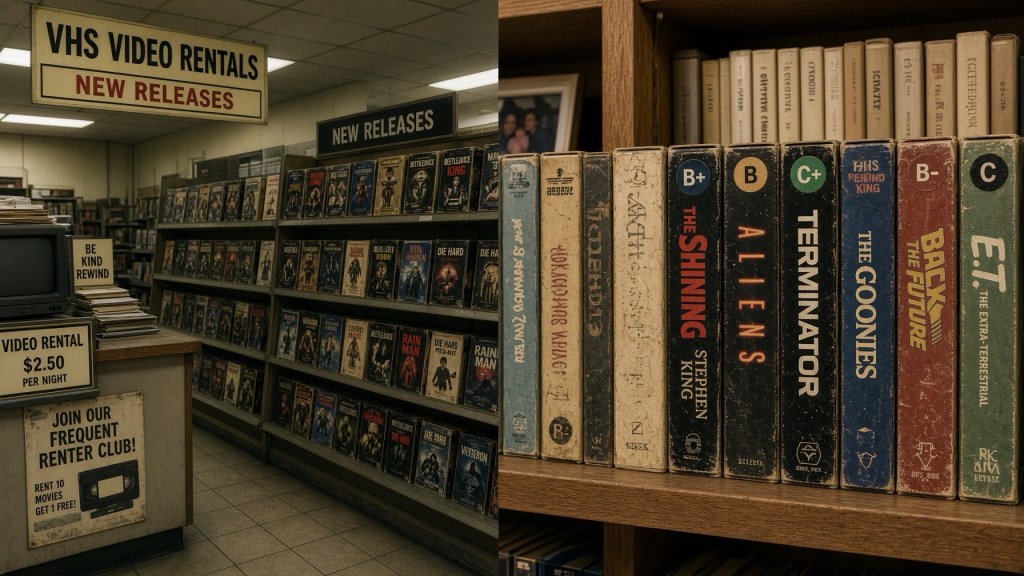
On a Thursday in June 2022, in a salesroom in Dallas, a sealed copy of Back to the Future on VHS sold for $75,000. It had belonged to Tom Wilson, the actor who played Biff, and it was graded near-mint by a company that authenticates collectibles. It was one of 260 tapes in the first auction Heritage Auctions had ever devoted to the format, which drew 598 bidders and brought in $584,750 [21]. A few weeks later, a seller in Canada who said he had moved about 3,000 tapes on eBay over twenty years told a reporter that most tapes were nearly worthless and that buyers were lucky to get $5 each [25]. Both statements were true on the same day, about the same plastic cassette, and the distance between them is the subject of this article.
VHS is a strange object to tell a story about, because for most of its life nobody thought of it as an object. It was a way of getting a film into a living room, and then a way of returning it by Sunday night. It was never the best picture, and for a long time it was not even the only choice. Yet it carried most of a generation’s idea of what watching a film at home meant, and it left behind a layered legacy: the rental stores that rose and vanished, the sell-through libraries of the 1990s that sit in attics, the thrift-store bins, the graded and sealed tapes that sell like art, and a small group of labels, shops and, now and then, a major studio that still make and sell new tapes today.
This article follows that arc from the format war of the 1970s to the present. It looks at why VHS won, how the rental business grew up around an unresolved legal question, how the studios learned to sell tapes to the public, and how the format ended in the mainstream. The second half is about what came after: how collectors sort tapes into raw and graded, what the auction records actually show, how prices boomed, slumped and recovered, what physical stores and boutique labels still do with the format, and how long the tapes themselves are likely to last.
First, a warning about the numbers
Home video is an industry with plenty of statistics and very little agreement about them. A few examples will show what to expect. The best-selling VHS tape of all time is usually said to be The Lion King, but I found three different totals for it: more than 25 million units from a trade report in 2003 [14], 32 million from a list that gives no source [15], and more than 55 million copies worldwide in a world-records entry dated August 1997 [13]. The first rental store is said to have opened in 1977, but sources disagree about what to count as a store. The last major Hollywood film released on VHS is said to be A History of Violence, but the claim passes through a chain of articles that cite one another [17][18].
I have tried to give each figure with its source and its caveat, and to say when two sources conflict. Prices are a special case. News reports tell us what a handful of famous tapes sold for at auction, which are by definition the highest prices, and they tell us almost nothing about the typical tape. I found no independent price index for VHS, and I say so again where it matters.
Many of the sources are summaries produced by an automated fetch tool, not full-text reads, and I note this in the source list. Dates and amounts were checked against more than one source wherever I could manage it.
Before the cassette
Home video recording did not begin with VHS. Magnetic video formats had been professional tools since the late 1950s [31], and Sony’s Betamax grew out of one of these, the professional U-matic format, and took its name from the shape the tape makes as it winds around the recorder’s drum, which resembles the Greek letter beta [1].
Sony launched Betamax in 1975. In the United States the first console models appeared in the fall of that year at $2,495 for a full cabinet, and a tabletop deck followed in spring 1976 for $1,400 [4]. That was a lot of money. The machine was sold on a simple promise, which was that people could record a television program and watch it when it suited them. Sony’s cassettes held one hour, matching the length of a typical television hour [1].
The competitor arrived a year later. JVC, a Japanese company working with its parent Matsushita, introduced VHS in 1976 with a two-hour cassette [1]. RCA, which sold the American consumer a great many televisions, began selling a VHS-based machine, the SelectaVision VBT200, in October 1977 for $1,000 [4]. Sources differ on the exact date VHS reached the United States, and one popular reference cites a 1977 arrival without settling the question [2], so I treat 1977 as the year it became a serious American product.
Two cassettes, one winner
The format war that followed has become a business-school parable, and like most parables it has been simplified. The facts are these. Betamax had a head start and a slight advantage in picture sharpness. One account gives it about 250 lines of horizontal resolution at its best speed, against about 240 for VHS, and notes that a slower Betamax speed gave up the difference [2]. A technical gap that small was not likely to matter to someone watching a broadcast on a tube television.
What did matter was how much would fit on a tape. Betamax was designed around the one-hour television program. VHS launched with two hours, and in 1977 a four-hour long-play mode arrived on machines built for RCA, which was enough to record a full American football game [1][3]. Sony responded with a slower Beta speed, but sources disagree on how many hours it gave, with one saying two and another three [1][3], and the slower speed also lowered the picture quality that was Beta’s selling point. At the time that choice was made, Sony had judged the market to be about recording television, and the American viewer turned out to want longer tapes [1].
Licensing was the other advantage. JVC allowed many manufacturers to build VHS machines, including RCA, Magnavox, Zenith, Quasar, Mitsubishi, Panasonic, Hitachi and Sharp, which put VHS machines in more stores at more prices [2][3]. Sony kept Betamax largely to itself. A format with many sellers tends to attract the rest of the market, in the way a language spoken in many countries attracts more learners than one spoken in a single village.
The numbers show how quickly the balance turned. Betamax held the entire market in 1975, when VHS did not yet exist [2]. By 1980 VHS had about 60 percent of the North American market, by 1981 Beta had fallen to about 25 percent of United States VCR sales, and by 1987 VHS had about 90 percent [2]. Betamax production peaked in 1984 at 2.3 million units worldwide [4]. Sony itself began making VHS recorders in 1988, according to a trade report cited in a reference article, although that article admits the date is approximate [2]. Sony ended Betamax recorder production in 2002 after about 18 million units over 27 years [4], and reports from 2016 say it stopped selling Betamax tapes in 2015 [19].
One popular explanation deserves a note, because it appears in nearly every retelling. It says VHS won because adult films were available on it and not on Betamax. A 2026 article in The Skeptic argues that this is a myth. Betamax carried adult titles, Sony did not control what was released on its format, and the early VCR buyers wanted recorders more than they wanted pre-recorded tapes, so the pornography story does not fit the period when the format war was decided [3]. A reference article reports that the founder of one adult-film company said in the 1980s that his company pushed VHS harder, and also records a dissenting view that attributes the win to openness [2]. The evidence for the pornography explanation amounts to recollections from interested parties. What I find more persuasive is the combination the sources keep returning to: more hours on the tape, more manufacturers building the machine, and then the market pull of a larger library.
The fear in Hollywood, and the court that settled it
While the machines sold, the film studios were frightened. Their fear was not about the format war but about the machines themselves. A tape recorder in every house meant that anyone could copy a broadcast film, and the studios compared the threat to the damage they believed television had done to cinema attendance [8]. In 1982 Jack Valenti, then president of the Motion Picture Association, told Congress that the VCR was to the American film producer and the American public what a serial killer is to a woman alone at home, a line that has been quoted ever since [9].
Universal and Disney had sued Sony years earlier [8], arguing that selling a machine that could record films off the air made Sony responsible for copyright infringement. In early 1984 the Supreme Court ruled for Sony, holding in effect that recording a television program to watch later, called time-shifting, was not infringement [9]. The ruling mattered for two reasons. It made the home VCR legal, and it protected a business that did not yet exist at scale, which was the sale of machines to people who would use them for more than the studios liked.
A separate legal question mattered even more to the shops. Under the first-sale doctrine in United States copyright law, someone who buys a copy of a work can lend, resell or rent that copy without the copyright owner’s permission. If that applied to videotapes, anyone could buy a tape and rent it out, and the studios would earn nothing from the rental. In March 1982 legislation was proposed to give copyright holders exclusive rental rights, and in October 1983 video stores closed for several hours as a protest. By February 1984 the bill had died after objections from video retailers and their customers [5]. The industry’s central business had survived by inertia, not by a clear victory, and the studios responded by finding ways to share in it.
Selling films to people who owned a machine
The opening problem the new machines created was a simple one. Someone who had just paid $1,000 for a recorder wanted something to put in it, and the major studios, busy being afraid, did not offer anything. The man who saw the opening was Andre Blay, whose company, Magnetic Video, had been founded in the late 1960s [6][7]. In 1977, after most studios ignored his letter and MGM said it was not interested, he persuaded 20th Century Fox to license films for home sale [6][8]. The terms, as one account gives them, were a $300,000 advance, a minimum of $500,000 per year, and a royalty of $7.50 for each film sold [8]. Fox offered 50 titles from a catalog of 100, all released before 1973 and already shown on television. The list included Patton, MAS*H, The King and I and The Day the Earth Stood Still [6][7].
Blay then did something unusual for the time and sold the tapes directly. He spent $65,000 on a full-page advertisement in TV Guide to start a mail-order Video Club of America, and by November 1977 the club was selling theatrical films to consumers at $49.95 a tape [4][8]. The club grew fast. One account says it had sold a quarter of a million tapes by the end of 1978 and was producing 30,000 a week [8]. Fox bought the club in late 1978 and the whole company in 1979, and sources differ slightly on which date belongs to which purchase [7][8]. The point of the story is that the earliest pre-recorded films sold on tape were sold to individuals, at prices that would look steep today, and in both formats at once [7].
The same winter, a different business model appeared on the other side of the country. In December 1977 a man named George Atkinson opened what is widely cited as the first video rental store, in Los Angeles [4]. He bought tapes from Magnetic Video and charged $50 for an annual membership, $100 for a lifetime one, and $10 a day for a rental [7]. This is the point where the history of home video forks. A $50 tape was a luxury, but a $10 rental, or later a $2 one, was an evening out. Owning a film on tape was an indulgence for a few people. Renting one was a habit for millions.
The studios were alarmed again, and they experimented with ways of getting paid. In December 1980 Disney announced its entry into home video with an authorized rental plan, in which retailers would pay a flat fee for each cassette and could rent it as often as they liked for 13 weeks, with sell-through copies sold separately [5]. In January 1981 Columbia tried two-tier pricing, with red cassettes for rental and black for sale, enforced by contracts with retailers [5]. The Video Software Dealers Association formed in November 1981 to defend the shops’ right to rent [5]. In the summer of 1982 Paramount priced Star Trek II: The Wrath of Khan at $39.95, the first major theatrical title priced for direct sale to consumers [4][5]. None of these experiments settled the question. The first-sale doctrine held, and the shops kept renting.
The Friday night rental
Between the mid-1980s and the early 2000s, the video store became an everyday American institution. Its growth is easiest to see in a handful of numbers. In 1983 VCRs were in fewer than 10 percent of American television households. By 1985, with 11 million machines sold that year, the share was almost 30 percent [4][5]. In the early 2000s about 94 percent of American homes had one [11]. As the machines spread, spending followed. In 1985, the first year with industry statistics, Americans spent $2.55 billion renting tapes, across about 1.1 billion rentals at an average price of $2.38, and another $773 million buying them [5]. In 1986 the combined total of $4.38 billion passed the $3.78 billion earned by the theatrical box office. In 1988 rentals alone, at $5.15 billion, passed it [4][5]. Home video, in other words, became a bigger business than cinemas within three years of the first year anyone counted.
The shops themselves went through several waves. The Video Station chain had 500 stores by July 1984 [5]. On October 19, 1985, David Cook opened the first Blockbuster in Dallas, with about 8,000 VHS tapes and 2,000 Betamax tapes [10]. Cook left in April 1987, two months after H. Wayne Huizenga bought a 60 percent stake in what was then a chain of 19 stores. By June 1987 the chain had 67 stores after it bought a 28-store competitor, and by the end of 1988 it was the top video retailer in the country, with revenue of about $200 million and more than 500 stores. In 1989 it passed 1,000 stores and began expanding abroad [5]. Viacom bought Blockbuster in 1994 for $8.4 billion [10]. Other chains grew alongside it. Movie Gallery was formed in Alabama in 1985, and the first Hollywood Video opened in Portland, Oregon in October 1988 [5].
At the industry’s high point the country had roughly 31,000 video rental outlets in 1990, falling to about 27,000 by 1996, according to the Video Software Dealers Association [11]. Employment in the sector rose from 54,000 jobs in 1983 to about 167,800 in 2000, mostly at minimum wage [11]. Blockbuster’s own peak came later and was global: more than 9,000 stores worldwide in 2004, about half of them in the United States, with over 84,000 employees [10].
Behind the stores was a financing trick that is easy to overlook. In 1988 a company called Rentrak pioneered revenue sharing, leasing tapes to stores for an upfront fee and a share of the rental income, and in 1998 the major studios began direct revenue-sharing deals with the big retailers [4][5]. My reading, which the sources do not state, is that this is why a late-1990s Blockbuster could stock a wall of new releases that a 1980s corner shop could not afford. It was also an early sign that the studios were gaining control of a business they had tried and failed to prevent.
Two smaller facts show how the shops entered daily life. In June 1985 The Cotton Club became the first release with Macrovision, a signal added to tapes to make copies unwatchable [5]. And in November 1988 the Video Privacy Protection Act became law, restricting disclosure of what customers had rented or bought [5]. By then renting a tape had become something people thought of as private.
The tape you bought
For most of the 1980s the studios made their money from rentals. A new film could cost a buyer as much as $89.95 a tape [12], which is why almost nobody but a rental shop bought one. The change came when studios realized that a lower price could turn a tape from a rental item into something a family bought and kept. Disney moved first with animation. On October 29, 1985, it launched its animated classics line with Pinocchio, priced at $79.95 and soon cut to $29.95, backed by a $7 million campaign, and it sold 1.7 million copies [5]. The Pinocchio line was followed by a long run of classics at about $29.95, which ended in early 1994 with 20 titles [16]. When Disney re-released Pinocchio on March 26, 1993, it sold 13.5 million copies [16].
The other studios followed. In 1987 Paramount released Top Gun at $26.95, the lowest price for a major Hollywood title up to that point, and partnered with Pepsi so that the tape opened with a single jet-themed Diet Pepsi advertisement in place of the usual trailers. The release broke records for advance orders and sales [12]. A year later MCA released E.T. at $24.95, with a $5 Pepsi coupon bringing the effective price to $19.95 [12]. The two releases set what the trade now calls the sell-through price, a point at which the public bought films it would previously have rented.
Sell-through grew until it rivaled the rental. By 2000 consumers spent $8.6 billion buying video, and for the first time it passed the theatrical box office of $7.7 billion [4]. A trade report for 2001 gives $7 billion on rentals and $4.9 billion on purchases [9]. Other sources give different totals for the same year, which depends on what is counted and who is counting [11].
The best-selling tapes were mostly animated films from Disney, seven of the ten on one list. A list of the top ten, which cites no source, puts The Lion King at 32 million, Aladdin at 30 million, Snow White at 28 million, Titanic at 25 million and Jurassic Park at 24 million [15]. Because those figures come with no stated origin, I treat them as rough. The Lion King’s total is the best example of the problem. A 2003 trade report calls the 1995 tape the top-selling video of all time at more than 25 million [14], while a Guinness World Records entry credits the film with more than 55 million copies worldwide, a record dated August 1997, before the film reached DVD, and notes that 20 million were sold in the first six days [13]. The record’s date suggests, though the entry does not say, that it counts tape. I cannot reconcile these totals, but they agree on the main point, which is that for a few years in the 1990s a children’s film was the best-selling video object in the world.
A different panic in Britain
The story in the United Kingdom followed the same machines and a different law. Home video arrived in Britain in the 1970s, and no legislation specifically covered the content of tapes. The major distributors were slow to enter the market, so low-budget horror and exploitation films, some of which the film board had refused for cinema, filled the shelves. Many tapes were never submitted for classification because of a gap in the law [20].
The press and a campaigning group led by Mary Whitehouse turned these tapes into a national scandal. The term video nasty was applied to the films, a newspaper campaign linked them to youth violence, and in June 1983 the Director of Public Prosecutions published a list of titles that could be seized. Seventy-two titles appeared on the list at one time or another, and 39 were successfully prosecuted under the obscenity law [20]. The page I read notes that later claims linking particular crimes to the films were speculative at best [20].
The result was the Video Recordings Act 1984, which took effect on September 1, 1985. It required that videos be classified by the British Board of Film Classification, made supplying unclassified videos a criminal offense, and made it an offense to supply 15 or 18-rated videos to underage people [20]. For collectors the consequence is a distinctive kind of object: pre-certification tapes, issued in Britain from about 1978 until classification took hold in late 1985, many of them uncut versions that would have been trimmed under the board’s rules. Most can be bought cheaply, and some rare titles reportedly sell for more than £500 [40]. They are a reminder that a format can be shaped by a country’s fears as well as its taste, and that the collecting cultures later built on each side of the Atlantic are not the same.
The long goodbye
The end of VHS was gradual, and it had several dates. The DVD format was agreed in December 1995 and launched in the United States in March 1997 with Bonnie and Clyde, The Mask and Twister [4]. Players were expensive at first. By 2001 about a quarter of American homes had one, DVDs accounted for about 17 percent of rentals, and Blockbuster planned to cut its VHS inventory by about a quarter to make room [11]. In 2002 DVD sales passed VHS sales for the first time [9].
The rental market crossed over a year later. In the week of March 16, 2003, DVD rentals earned $80 million against $78 million for VHS, and in the week of June 15 more DVDs than tapes were rented, 28.2 million to 27.3 million. For the full year 2003, spending on DVD rentals of $4.38 billion passed VHS at $3.82 billion, and in 2004 DVD rental turns of 1.75 billion were more than double the 842 million for tape [4]. Those figures come from an industry timeline and use rental turns, meaning the number of times a copy was rented, so they measure activity and not the number of discs on shelves.
Studios stopped making new tapes in 2006, give or take. The claim most often repeated is that David Cronenberg’s A History of Violence was the last major Hollywood film released on VHS in the United States [17]. I could not trace the claim to a primary source. One article attributes it to the Los Angeles Times and does not give a release date for the tape. Another list names nine other films from the same period, and cites no sources [18]. The same article that repeats the claim also says the last truckload of tapes left a warehouse in Florida by the end of 2008, without naming a company [17]. I would put it this way: the major studios largely finished with VHS during 2006, and a few releases and stock continued after that, but nobody I could find has documented a single last title. A collector’s guide dates the first major film release since the end to Alien: Romulus in 2024 and calls it the first since 2007 [41], which does not match the 2006 claim exactly and shows how loosely the word last gets used.
The hardware ended later. In July 2016 the Japanese company Funai, whose machines were sold under brands that included Sanyo, stopped making VCRs at its Chinese factory. At its peak the company sold about 15 million units a year, and in 2015 it sold about 750,000, mostly in North America. The reason it gave was a drop in sales and trouble finding a part that its supplier had stopped making. The report adds that a Gallup poll then found 58 percent of Americans still had a VCR at home, and that Funai received calls from Japanese owners who had never moved their wedding recordings to another medium [19]. The format had outlived its industry because people kept things on it that mattered.
Blockbuster’s decline followed the tape’s. By 2002 the chain had nearly 8,000 stores and lost $240 million on $5.2 billion of revenue in 2001 [11]. It filed for bankruptcy in 2010, and in 2011 Dish Network bought it with its remaining 1,700 stores [10]. By April 2017 only 10 stores were left [10]. The one in Bend, Oregon, became a tourist attraction, and by August 2022 it no longer rented VHS tapes at all, only DVDs, at $4 each with late fees capped at $10 [35].
Collecting before it was a market
Collecting began long before anyone put a price on it. Families kept favorites and recordings of their own lives. Rental stores sold off worn copies. And a small group of enthusiasts treated certain tapes as the only way to see certain films, which is still the most durable reason to collect any format. The modern market sorts tapes into several kinds, and the distinctions are worth setting out, because the headlines mix them.
The largest kind is the raw tape: opened, played, shelved, handed down or donated. The overwhelming majority of the tapes ever made belong here, and they are worth very little. The Canadian eBay seller quoted earlier said buyers were lucky to get $5 each, and his experience of 3,000 tapes over twenty years is the ordinary one [25]. An appraisal site that declined to publish a price range for old Disney tapes offered three recent auction results as context: an Aladdin deluxe collector’s edition at $10, a 1991 Fantasia at $15 and a Beauty and the Beast deluxe set at $20, a median of $15. The site stressed that these records were context and not an estimate for any particular tape, and that asking prices and anecdotes create false precision [29].
That bears on one of the most persistent beliefs in the field, which is that old Disney tapes are worth thousands. The trigger is usually a Black Diamond edition from Disney’s classics lines. The fact-checking site Snopes, as summarized in a reference article, rated the claim that Black Diamond tapes are worth thousands as mostly false, and Heritage Auctions is quoted there as saying that only Disney tapes made before 1985 hold significant value for most collectors [16]. A mass-market tape is hard to price for the simple reason that its edition was enormous. When 13.5 million copies of a single re-release were sold [16], scarcity is the one property it cannot have.
The ex-rental tape comes into view here, which has a different appeal. Rental copies were handled heavily and many were sold off when stores closed, so they often carry stickers, cut boxes and wear. In my reading, some collectors prize them for exactly that reason, since they were what a neighborhood actually watched. A grading company’s rules show how the market classifies them: Beckett accepts clamshell and hard clamshell cases of the rental type and a list of big-box formats, including single-tape big boxes from CBS/Fox, Fox Box, 20th Century-Fox, MGM/UA and Warner, but it does not accept double-tape big boxes, horror big boxes, triple packs or deluxe collector’s sets [28]. Those exclusions are themselves a map of the market: the formats a grader will not accept are often the ones whose cases are too varied or fragile to grade consistently.
The kind that attracts most of the money is the factory-sealed tape, still in its original wrap. For a sealed tape the cassette inside is almost irrelevant, because the collector is buying an unopened moment from the year it was made. One guide notes that the interior of the cassette does not affect the grade, but that plastic parts weaken and break over time and paper cases deteriorate with poor storage [27].
What collectors say they are doing
The best single guide to the collector’s side of the hobby that I found is the VHS Bible, a free downloadable guide published by a dealer called LE Collectibles, with Christopher Donaldson as a key contributor [41]. It describes itself as an information hub for VHS and Beta collecting, and it is worth reading for the attitude as much as the facts. Its authors treat the hunt as the point of the hobby, and their advice is to collect what you like, which they call the safest way to play. A GoCollect post by the same circle says much the same, and adds that a tape does not need to be a grail to be someone’s treasure [48]. Both are written by people who deal in tapes, so the enthusiasm should be read alongside their interest in selling them.
The guide lists ways that collectors organize themselves, and the list is a useful map of motives. Some collect a genre, with horror the largest, including obscure titles. Some collect poster art, or the work of one director, with David Lynch given as an example. Some collect an actor’s early appearances, such as Leonardo DiCaprio in Critters 3. Some collect promotional tapes, advance copies and screeners. Others chase labels known for scarcity, such as Magnetic Video and Warner Communications, whose early tapes were made in small numbers [41]. The sealed-versus-open gap can be large: the guide puts an early Superman Beta in the range of $15,000 to $40,000 sealed, against about $100 for a complete open copy [41].
What makes one sealed tape worth more than another
Even among sealed tapes, value varies by orders of magnitude, and the main variable is which version of the tape it is. A 2021 article on sealed VHS as an alternative asset gave an example that has stuck with me: there were 14 versions of Star Wars on VHS between 1984 and 1992, and the right one could be worth $15,000 while the wrong one was worth $500 [26]. Telling the versions apart takes knowledge. First-press tapes often carry no label saying so, and a copyright date within a year or two of the film’s release is a common indicator. The same article points out that a sealed Ferris Bueller’s Day Off dated 1992 is a later pressing, while the first press is from 1986 [26]. The sealed shrink-wrap itself carries information, and collectors refer to watermarks, a printed pattern on the wrap that differs by studio and period. At the 2022 Heritage sale, catalog descriptions of the highest-priced tapes mentioned them, such as the MCA Home Video watermark on a Jaws tape and the Warner Home Video watermark on The Goonies [21].This is the part of the market that behaves like a market in rare coins or comics. Pressing, condition and the wrap’s authenticity decide the price, and a lot of the argument in collecting circles is about those details. Beckett’s grading rules evaluate the box for cuts, tears, holes, rubs, scuffs, indentations, soiling, debris, discoloration, bends, warps and stickers, with allowances for tapes made before 1985. The wrap gets its own review of type, tightness, uniformity, clarity, texture, overlap separation and heat-seal splits, and non-factory stickers can lower the score [28].
The VHS Bible gives the most detailed vocabulary I found for what collectors are looking at, and it is worth setting out because the headline prices turn on these details [41]. Box types are named: the window box, an early Magnetic Video case with a cutout showing the tape; the slipcase, the most common, from which the tape slides out the bottom; the gatefold, which opens like a book and locks like a gate; the side loader and the full enclosure; the clamshell; the book box; the oversized big box; and a Paramount long box gatefold that the guide says was made for only three to six months in 1979. Seals have their own types, including the flatback, the LRB seal that runs along the left, right and bottom, the sticker seal, and the dog bone seal at a slipcase opening. Small factory-cut vent holes release pressure under the wrap and are treated as a factory marker.
Watermarks are ink logos or words printed on the wrap to discourage bootlegging and resealing. The guide says they first appeared in 1978 and 1979, and it classes them by placement, such as front, side, back, double stack, wraparound and bottom. Color helps date a print: white CBS/Fox marks come before blue ones. It also lists first prints that should not carry any watermark, among them Gremlins from Warner Home Video in 1985, so the absence of a mark does not by itself prove a reseal [41]. Stickers can point either way: the guide treats a Pizza Hut sticker on Teenage Mutant Ninja Turtles and a Subway sticker on Terminator 2 as signs of a first print, and a 19.99 sticker on A Nightmare on Elm Street as a sign of a later one [41]. The guide’s advice on reseals is that a third-party price sticker cannot sit under a true factory wrap, that damage under undamaged plastic is suspicious, and that on a clamshell a moved sticker seal or leftover adhesive gives the game away. It also says it knows of no factory shrink-sealed VHS, so by its reasoning shrink-wrap on a tape is itself a reason for doubt [41].
Slabs, grades and the problem of trust
By the early 2020s, the question of how to verify a sealed tape had produced a small grading industry. The services take in a tape, inspect the box and the wrap, assign a grade and encase the tape in a sealed plastic holder, in the manner of graded trading cards. A July 2022 article called VHS grading barely two years old and named several companies: Video Game Authority, which also graded action figures and video games, VHSDNA, which says its acrylic cases block 99 percent of ultraviolet light and are hand-sealed with a tamper-proof serial sticker, and Investment Grading Services, which describes inspecting cases under different lights and by touch. It also reported that Beckett had announced a move into VHS grading [27]. A listing for a CGC Home Video service appeared in my searches, but I could not open the page, so I cannot describe how it works. At the Heritage sale, a Rambo tape was graded by IGS, and the Back to the Future lot’s caption lists VGA [21]. A February 2023 report said sealed tapes had been graded by IGS or by the Collectible Grading Authority [23].
The best-documented grading rules are Beckett’s. The box gets a grade from 0.5 to 10 that combines four subgrades, which are corners, edges, flaps and gloss. The seal gets a separate letter grade from D to A++. A 9.8 is labeled Gem Mint, a 9.0 Near Mint minus and a 7.5 Excellent. Labels are colored by grade, gold for 9.0 and above, silver for 8.0 to 8.5 and red for 7.5 and below. Sealed tapes are not required, and open tapes that match their label and slipcover are accepted and marked as pre-viewed. The company also says non-authentic reseals are charged the full submission price [28]. The last point is the heart of the matter. A reseal is a tape that was opened and wrapped again, and a grading company that charges for finding one is acknowledging that the practice exists.
Trust in the grades is a reasonable worry. The 2021 article about alternative assets quoted a grader as saying that he was 85 to 90 percent sure the collecting community had already seen what was out there, and that large storage finds of sealed first-edition tapes were not likely [26]. That is a claim about supply, made by someone who sells a service to the people buying, and it should be read that way. The same article noted a controversy at a video-game grading company over insiders having their own games graded there [26]. VHS grading is a young business with few outside checks, and a slab is only as reliable as the people who sealed it.
The auction that made the news
The event that turned sealed VHS from a hobby into a headline was Heritage Auctions’ first VHS sale in Dallas in June 2022. The Back to the Future tape was the top lot at $75,000. Its caption lists VGA 80 plus, near mint, and the auction house described it as the highest price ever paid at auction for a sealed, graded VHS tape. Part II sold for $16,250, Part III for $13,750 and the 1990 trilogy set for $10,000. A near-mint-plus VHS of The Goonies with a white Warner Home Video watermark sold for $50,000, a near-mint Beta copy of the same film for $13,750, a mint 1983 Jaws for $32,500, a near-mint first release of Ghostbusters for $23,750, a graded First Blood for $22,500, a near-mint 1984 Star Wars for $22,500, The Empire Strikes Back for $12,500 and a Diet Pepsi promotional copy of Top Gun for $17,500 [21].
Taken together the sale brought in $584,750 for 260 tapes, which is an average of about $2,250 a tape. The average hides everything, because the top lots were so far above the median that no single lot stands for the whole. The seller of the top lot was a celebrity, which matters: the tape came with a story, and the auction house’s own executive said it hoped the sale would encourage more well-known owners to consign collections [22].
Further sales followed, though the details I found are thinner. In February 2023 three factory-sealed Rocky tapes that had been bought for $60 each on Christmas Day 1982 sold together for $53,750 at Heritage, which one report described as the only known factory-sealed copies [23][24]. The same consignment director predicted that a sealed first-release Raiders of the Lost Ark would bring about $20,000 at a later sale [24]. Earlier, in August 2021, an early sealed Star Wars tape reportedly sold for $12,000 and a sealed Return of the Jedi for $7,026 in the week of one report, drawn from eBay [26]. A July 2022 article quoted a Heritage official saying that a few titles from the 1977 Fox slate with Magnetic Video, including MAS*H, Patton and The Sound of Music, might eventually reach six or seven figures [25]. I treat that as a hope and not a result.
Boom, bubble and a recovery
A single auction can mislead about direction, so it helps to ask what happened to prices afterward. The honest answer is that 2022 looks like a temporary high, followed by a hangover and then a recovery, but the evidence for the shape is thin.
The VHS Bible tells the story in three steps. It calls 2021 a gold rush in which sealed and graded tapes entered the spotlight, crowds of buyers, many of them speculators, flooded auction houses and eBay, and growth ran ahead of knowledge. It blames irresponsible graders and an early influx of counterfeits. A bubble followed, and the guide says newer grading companies cushioned the pop and that the collapse removed pure flippers and many bad actors. It names CGC, Rewind and Beckett as the three graders it trusts, and it describes the hobby in May 2025 as growing at a steadier, organic pace with a strong high end [41]. The 2022 peak was real at the top: the same guide lists a sealed 1982 Star Wars first print at $114,000 at Goldin Auctions in 2022 and calls it the most expensive VHS ever sold. It gives no month, so I cannot say whether that sale came before or after Heritage’s June event, and Heritage’s description of a record for its $75,000 Back to the Future should be read as true on that day only [41]. A GoCollect writer had warned in May 2022 that it was too early to tell how graded tapes would perform, and expected wild swings [48].
Reports from 2026 point back upward. A March 2026 article on graded tapes said that unopened tapes in good condition often sell for three or even four figures, especially childhood favorites from the 1980s and 1990s, and credited nostalgia and professional grading for the recovery [42]. A November 2026 guide to Pokémon tapes, discussed next, described a six-tape sale at $85,000 in October [43]. I want to be careful about what this proves. I found no price series, no list of sold prices by month, and no count of graded tapes, so I cannot measure how far prices fell after 2022 or how far they have risen since. Two news-style articles and a collector’s guide are consistent with a renewed climb, but a few headline sales are what a thin market produces in any year.
When the hot tape is a cartoon
The most striking recent subset is Pokémon. The animated series reached North American home video in volumes, 26 of them between December 1998 and January 2001, with red spines on volumes 1 through 17 and yellow spines on 18 through 26. A November 2026 collector’s guide says early volumes, complete sets and original packaging are the most sought after, along with promotional items such as a Toys R Us promo, preview copies and holiday gift packs that held three sealed tapes and a carrying case [43]. The same guide reports that six sealed, professionally graded early tapes sold together for $85,000 in October 2026, and it names I Choose You! Pikachu!, Charizard!! and Poke-Friends among them, with CGC grades of 9.6 and 9.8 and seal grades of A+. It calls that an exceptional private sale and not a typical price [43].
The caveats matter. That is one source, a collector blog, and it does not name the seller, the buyer or the venue, so I treat the figure as a report and not a verified record. The same guide warns that some shrink-wrapped Pokémon tapes have been resealed, and that Pioneer watermarks and packaging seams are clues and not proof. It also says the two feature films, Pokemon: The First Movie and Pokemon the Movie 2000, were widely distributed, so ordinary copies are not rare [43].
My own reading, labeled as such, is that this subset follows the money that built the card market. When CGC first said in 2022 that it wanted to grade VHS, the trade press explained the move by comparing tapes to Pokémon cards and comic books [47]. The grading firms, the buyers and the nostalgia for the late 1990s are partly the same, so a hot card brand pulls its adjacent objects upward. I hold that as a hypothesis. It would be weakened if the buyers of graded Pokémon tapes turned out to be mostly newcomers to the card hobby, which I could not check.
How to read the headlines
Everything above is a record of specific sales that someone thought worth reporting. Several cautions follow.
Survivorship is the caution to keep in mind most. A news report says a tape sold for $75,000. It does not say how many sealed tapes of ordinary titles sat unsold or sold for less than the cost of grading. The July 2022 article that listed the Heritage prices also noted that most tapes are nearly worthless, and quoted a veteran collector who criticized marketing built on fear of missing out [25]. An asking price is not a sale. The appraisal site I cited makes the point itself, and declines to turn a handful of results into a range [29].
Then there is the absence of a record. Comics and coins have price guides built over decades from thousands of verified sales. I found no equivalent for VHS beyond the top-sales lists in a collector’s guide [41], no population count of how many sealed copies of a given pressing have been graded, and no price series that follows a single title through time. What exists instead is a set of one-off results from different sellers, different graders and different years. A 2022 guide to VHS grading as an investment says it is unclear whether new television shows or movies will raise or lower VHS values, and that its author’s own stored tape came out blank [27]. The honest summary is that the top of the market is real, in the sense that people paid those prices, and that the market beneath it is thin and untracked.
Finally, consider what the money is paying for. A person who spends $75,000 on a sealed tape is not buying a film, since the film is available for a few dollars on a later format. The buyer is purchasing a verified object from a particular year in a particular state, much as a buyer of a first printing of a book is buying the printing. That is an old logic, and it is the reason the sealed tape is the part of the market where condition and authenticity matter most.
I will add a modest proposal of my own, labeled as such. The thing the market lacks is a registry of pressings: a public list, kept by an independent group, that records for each title which pressings exist, how they can be told apart, and how many sealed examples the graders have seen. It would not tell anyone what a tape is worth. It would make the difference between the $15,000 Star Wars and the $500 one checkable by a buyer who is not an expert. The closest thing I found is the VHS Bible, a free guide that lists distributors, watermark types and known first prints [41]. It helps a buyer identify a pressing, but it is not a count of how many sealed copies exist, and the graders themselves are not well placed to run a registry, because they profit from the sale of graded examples.
A fragile thing
Whatever a sealed tape is worth, the tapes people actually watched were always aging. Magnetic tape stores its picture in a thin layer of magnetized particles on a plastic ribbon, and heat, humidity, dust and repeated playing wear it down. Kodak, cited by one consumer-technology article, estimates that VHS tapes degrade about 10 to 20 percent over a span of 10 to 25 years, which is an estimate and not a prediction for any particular tape [30]. One writer in the collecting press reported that a tape of his own that he had stored away came out blank [27].
The tape is only half of the problem, because a tape needs a machine. The National Film and Sound Archive of Australia runs a campaign called Deadline 2025, warning that magnetic audiovisual heritage will be lost if it is not digitized. Its stated reasons are that playback machines and their parts are disappearing, that the technicians who can repair them are disappearing too, and that tape formats are predicted to deteriorate. The page does not mention VHS by name, and it adds that some formats may last 50 years or more in good storage conditions, so it describes a general risk to magnetic media and not a date certain for the cassettes in anyone’s attic [31]. The Funai story carries the same message in a more personal form: the last manufacturer stopped because it could not find a part, while owners were still calling about wedding recordings [19]. A tape and its player age as a pair, like a lock and its key.
Libraries of tape are therefore also libraries at risk. Scarecrow Video in Seattle counts 14,676 titles that are available only on VHS [33]. Vidiots in Los Angeles holds a rare collection of 11,000 tapes, of which about 250 had been digitized at the time of the Washington Post report [32]. An archive of films that exist on no other format is the strongest argument for treating the format as more than a fashion. A disc that is easy to buy is easy to replace. A tape that is the only copy is not.
New tapes for an old machine
Mainstream studio releases on VHS ended in the mid-2000s, though a few major studios have made one-off exceptions that I describe below. A small stream of new tapes never quite stopped, and since the early 2020s it has become a visible niche. The people who make them are boutique labels and independent producers, concentrated in horror and cult cinema, and their releases are short runs sold directly to fans.
A few examples show the scale. Witter Entertainment, working with a fan site called Broke Horror Fan, sells officially licensed VHS editions of the horror film Terrifier 2 in three versions: a clamshell at $30, a book-style big box with a red cassette at $45, and a big box with an orange cassette at $50. The film is cropped to the 4:3 shape of a tube television [36]. The label Lunchmeat has released a documentary about the actor Robert Englund in an edition of 50 copies worldwide at $30, duplicated in NTSC on black cassettes in a slipcase [37]. Another Lunchmeat release, Scarlet Fry’s Horrorama, was offered at $29.99 as a first edition of 50 copies, with shipping set for the end of April or early May 2026 [38]. A Bloody Disgusting headline reports that Return to Silent Hill is the first Silent Hill film to get an official VHS release; I could not open the page and so can give no details [39].
Two releases from large studios show that the majors have not entirely abandoned the format. In October 2024 the director Fede Alvarez announced at a Beyond Fest screening in Los Angeles that Alien: Romulus would come out on VHS. The limited-edition tape was released on December 3, 2024, the same day as the 4K, Blu-ray and DVD editions, in a vintage-style sleeve with artwork by Matt Ferguson and with the film presented in 4:3. The report I read gives no price and no edition size, and it does not claim that the tape was the first from a major studio in years [44]. The VHS Bible’s timeline does make that claim, calling it the first major film VHS release since 2007 [41].
The Blair Witch Project followed in 2026. Lionsgate announced a Be Kind, Rewind edition on VHS for October 13, 2026, sold through its online store, with the film restored from the original Hi8 videotape and 16mm elements [45][46]. One report describes a restored 2024 theatrical cut, another a revitalized original theatrical cut, and the Blu-ray edition is described as carrying three cuts, a poster and a 104-page booklet [46]. The VHS edition’s price is $29.99, but no edition size appears in the articles I read. However, at the time of publication, 292 tapes are still available from Lionsgate’s online store. The film is a fitting case, because it was shot on the very kind of consumer video it now returns to.
Both are sold as limited objects beside a disc edition. They are not a return of mass production. They show the same instinct that drives the 50-copy boutique runs, with a bigger company behind it.
Fifty copies, the size of the boutique runs, is a very small number. A run of that size is closer to a zine than to a product, and the buyers are as likely to be collectors of the object as viewers of the film. A Washington Post feature from December 2023 describes a community of enthusiasts who call themselves tapeheads, and it suggests that bringing back VCR manufacturing or new studio releases on tape would need a high-profile champion [32].
That last point deserves attention. A revival of a physical format can only be as large as its hardware supply, and the VCR supply ended in 2016 [19]. The new tapes are played on machines made decades ago and sold secondhand, which is a reminder that the revival, unlike the vinyl one, has no new factory behind it. I did not find any report of new VCRs in production.
Where you can still rent or buy one
The Blockbuster in Bend, Oregon is the best-known surviving chain store, and by August 2022 it rented only DVDs, at $4 each [35]. The VHS survives elsewhere, in independent stores that kept their stock when everyone else threw theirs away.
Scarecrow Video in Seattle was founded in 1988. The page I read gives its collection as more than 156,000 titles as of 2026. It became a nonprofit in 2014, has offered DVD rental by mail since 2021, and in January 2026 bought its property for $5.5 million [33]. In Portland, Movie Madness advertised 90,000 titles on its marquee in a 2016 report and kept a few VHS tapes [34]. In Los Angeles, Vidiots reopened in June 2023 with a 271-seat theater, a 60,000-title library and the rare tape collection mentioned above. Be Kind Video in Burbank opened in late 2022, and Whammy! Analog Media in Echo Park and Beyond Video in Baltimore are also named in the Washington Post report [32].
Several of these places, Scarecrow and Vidiots among them, run as nonprofits or hybrids with a theater or a mail service, which suggests that they sell a place as much as a product. Online marketplaces carry most of the volume, as the eBay sellers quoted above show [25][26], but the physical stores supply something the marketplaces cannot, which is a person who can say what to watch next. I found no census of stores that carry VHS, and I have left out several shops that appeared in secondhand lists but that I could not confirm.
What the evidence leaves open
A history like this one rests on a pile of sources of uneven quality, and it is worth saying which conclusions are firm. The format war’s outcome is well documented in its main outlines: VHS offered longer recording time, licensed its format widely, and gained market share quickly between 1980 and 1987 [1][2][3]. The rental and sell-through numbers come from industry timelines and trade sources, and they agree on the major turning points even where they differ on totals [4][5][9][11]. The collecting market is the least solid part. It is made of individual sales, a young grading industry and a small group of enthusiasts who disagree about what they are doing [25][27].
The central claim I would defend is that VHS won mostly because of tape length and open licensing, and not because of picture quality or the content of its library. What would prove this wrong is evidence that a version of Betamax with equal recording time and equal manufacturer support still lost, or contemporary consumer surveys that named something else as the reason people chose VHS. The sources I read do not contain either, and the explanation I find most persuasive is an inference from timelines, not a measured result.
Several questions remain open, and I would like to see them answered. How many sealed copies of a given pressing exist, and how many have been graded? How common are reseals, and do graders catch them? How many new VHS titles are produced in a year, and in what edition sizes? How many stores in the United States still stock VHS tapes? Which films exist only on tape, and which of them are at risk? One of these, the last, has a partial answer in the Scarecrow count of 14,676 tape-only items [33]. A national list of tape-only titles, built from many stores and archives, would give preservation work a priority order, and I found no report of one.
Why it matters
One reason is cultural. For about thirty years, VHS was how most people met films at home, and the habits it created, from the weekend rental to the shelf of favorites, shaped what viewers expected of every format afterward. The streaming services that replaced it kept the convenience and gave up the ownership, and the collectors who buy tapes today are partly responding to that trade.
Another is practical. A sealed tape sold for $75,000 will make news, but the tapes that matter for knowledge are the ordinary ones that hold local television, home recordings and films that were never reissued. Those are aging on the same schedule, and the machines that play them are going the same way [19][31].
A further reason is economic and cautionary. The collector market for sealed tapes shows how fast a hobby can become an asset class, and how little the people who buy into it may know about what they are holding. Without a price record, a registry of pressings or independent checks on grading, the market rewards insiders and leaves newcomers to guess [26][27].
A final reason is the scale of the contrast, and it is worth spelling out as arithmetic. The Lion King tape sold somewhere between 25 million and more than 55 million copies, depending on which source one trusts [13][14]. A current boutique release is made in an edition of 50 [37][38]. Even on the low estimate, the ratio is half a million to one. The same physical object, a plastic shell around a ribbon of oxide, has gone from being the most mass-produced piece of home entertainment of its time to something closer to a handmade print. That transformation is not unique to VHS, since vinyl records and film cameras followed the same path, but VHS is an unusually clean example because its mass production ended so recently and so completely [17][19].
My own reading, which the sources do not state, is that the format’s afterlife depends on a trade between convenience and constraint. A tape cannot be skipped through, so a viewer who loads one has already decided to watch it. A rental store shelf, or a collector’s shelf, can hold only so many boxes, so someone chose which ones. Streaming removed both limits, and the return of tapes among a small group of viewers looks to me like a deliberate choice to bring those limits back. I hold this as a hypothesis about motive, not a finding. It could be tested by asking buyers of new tapes why they buy them, and a survey in which most answered that they simply wanted the cheapest way to see the film would show that I am wrong.
Human dimension
Many rented tapes carried a sticker asking the renter to be kind and rewind, and most people did, because the person at the counter would know. It was a small contract between strangers, kept alive by a shared object. The tape itself was a little unreliable: lines that rolled up the screen when the tracking drifted, a picture that softened with every copy, a quiet click when the cassette ended. People who grew up with it remember those flaws with affection, and the collectors paying thousands for a sealed copy are partly paying for the chance to hold a time that has been closed in plastic. The more ordinary pleasure is the one the small stores keep alive. You walk down a row of boxes, pick one you have never heard of, and take it home to find out.
Sources
- heise online, “50 years of video recorders: Sony’s Betamax as a successful failure” (article on Betamax’s 1975 launch, derivation from U-matic, and why it lost; I read a summary produced by the fetch tool), https://heise.de/-10437388
- Wikipedia, “Videotape format war” (general reference; its dates for the US launch of VHS are unresolved and its Sony 1988 date is approximate, as the article itself says; I read a summary produced by the fetch tool), https://en.wikipedia.org/wiki/Videotape_format_war
- Mike Hall, “Adult movies were not the reason Betamax really lost the video wars,” The Skeptic (July 6, 2026; opinion and argument rather than a study; I read a summary produced by the fetch tool), https://www.skeptic.org.uk/?p=54610
- Entertainment Merchants Association, industry history timeline 1975 to 2006 (trade association timeline of VCR, rental, sell-through and DVD milestones; the page covers only through December 2006; I read a summary produced by the fetch tool), https://www.entmerch.org/industry_history.html
- Entertainment Merchants Association, industry history 1980 to 1989 (trade association timeline of the 1980s; the page gives a Hollywood Video store count that appears to contain an error, which I do not use; I read a summary produced by the fetch tool), https://www.entmerch.org/industry/1980—1989.html
- Sound and Vision, “RIP: Home Video Pioneer Andre Blay” (obituary; I read a summary produced by the fetch tool), https://www.soundandvision.com/content/rip-home-video-pioneer-andre-blay
- Wikipedia, “Magnetic Video” (general reference; I read a summary produced by the fetch tool), https://en.wikipedia.org/wiki/Magnetic_Video
- University of Michigan, “Video in the Home” (course page on the early home video business, including the Fox deal and club figures; the page does not cover rental store history; I read a summary produced by the fetch tool), https://public.websites.umich.edu/~evideo/video_store.html
- Sound and Vision, “Flashback 1984: Supreme Court Upholds Right to Tape” (magazine feature; the summary I read did not state the vote or the exact decision date), https://soundandvision.com/content/flashback-1984-supreme-court-upholds-right-tape
- Sound and Vision, “The Last Blockbuster” (magazine feature on the Bend, Oregon store and Blockbuster’s history; I read a summary produced by the fetch tool), https://www.soundandvision.com/content/last-blockbuster
- Encyclopedia.com, “Industry Profiles: Video Tape Rental” (reference article with trade figures from the early 2000s; the revenue totals differ between its own sources; I read a summary produced by the fetch tool), https://encyclopedia.com/economics/economics-magazines/industry-profiles-video-tape-rental
- We Are The Mighty, “How Top Gun and Pepsi changed the home video market” (history feature; no unit sales are given; I read a summary produced by the fetch tool), https://www.wearethemighty.com/mighty-movies/how-top-gun-and-pepsi-changed-the-home-video-market/
- Guinness World Records, “Best selling video film” (record entry for The Lion King, dated August 1997; the entry does not state the format, so the tape inference is mine), https://www.guinnessworldrecords.com/world-records/66893-best-selling-video-film
- Home Media Magazine, “Studio heralds Lion King DVD debut” (2003 trade report; does not say whether the 25 million figure is US-only), https://www.homemediamagazine.com/news/studio-heralds-ilion-kingi-dvd-debut-5355
- Far Out Magazine, “The 10 best-selling VHS tapes of all time” (list article that cites no sources for its figures), https://faroutmagazine.co.uk/the-10-best-selling-vhs-tapes/
- Wikiwand, “Disney Classics” (mirror of a Wikipedia article on Disney’s home video lines, including the 1993 Pinocchio figure and a note on Snopes; the table of Black Diamond titles was empty in the text I read), https://www.wikiwand.com/en/articles/Disney_Classics
- Slashfilm, “David Cronenberg’s A History of Violence marked the end of VHS” (article attributing the last-major-release claim to the Los Angeles Times; secondhand, with no release date for the tape), https://www.slashfilm.com/807084/david-cronenbergs-a-history-of-violence-marked-the-end-of-vhs
- Legacybox, “What were the last 10 movies made on VHS?” (blog post by a digitization company with a commercial interest; cites no sources), https://legacybox.com/blogs/analog/what-were-the-last-10-movies-made-on-vhs
- Phys.org, report on Funai ending VCR production (July 2016; news agency copy; I read a summary produced by the fetch tool), https://phys.org/news/2016-07-era-vcr-factory-line.pdf
- Wikipedia, “Video nasty” (general reference; the page has an unreconciled second list of 82 titles and unverified claims about later crimes, neither of which I use; I read a summary produced by the fetch tool), https://en.wikipedia.org/wiki/Video_nasty
- ArtDaily, “Heritage’s first VHS event sets auction record with $75,000 sale of actor Tom Wilson’s Back to the Future” (June 2022; press release reprint with lot prices; I read a summary produced by the fetch tool), https://artdaily.com/news/147183/Heritage-s-first-VHS-event-sets-auction-record-with–75-000-sale-of-actor-Tom-Wilson-s–Back-to-the-Future-
- KSL, “VHS copy of Back to the Future sells for $75K, setting new auction record” (June 19, 2022; news report), https://www.ksl.com/article/news/entertainment/vhs-copy-of-back-to-the-future-sells-for-75k-setting-new-auction-record/50425566
- Chris Carter, “Could your old VHS be worth $25k?” MoneyWeek (February 24, 2023; the article’s two valuations of the Rocky tapes are not reconciled), https://moneyweek.com/investments/605724/the-boom-in-old-videos
- Robb Report, report on the sale of three sealed Rocky VHS tapes (the year is not given in the text I read, and I place the sale in February 2023 from source 23), https://robbreport.com/lifestyle/news/vhs-tapes-resale-value-auction-1234830373/
- Hürriyet Daily News, “VHS tapes trigger a new collecting frenzy” (July 9, 2022; news feature relying on anecdote and quoted opinion, with no market data), https://www.hurriyetdailynews.com/vhs-tapes-trigger-a-new-collecting-frenzy-175184
- Action Network, “Sealed VHS tapes: the next alternative asset class” (September 2021; feature, with grader’s claims about supply that are the seller’s own), https://www.actionnetwork.com/news/sealed-vhs-tapes-next-alternative-asset-class
- GoCollect, “VHS grading: the newer frontier” (July 19, 2022; blog post by a freelancer, with an explicit disclaimer that investment advice is his own), https://gocollect.com/blog/vhs-grading-the-newer-frontier
- Beckett Grading Services, VHS submission page (grader’s own rules and scales; the fee table was not readable in what I saw), https://www.beckett.com/vhs-submit
- Appraisily, “Disney VHS Value: Black Diamond Editions, Sealed Tapes, Variants and Condition” (appraisal-site guide that declines to publish price ranges; its three auction results are context only), https://appraisily.com/articles/value-of-old-disney-vhs/
- BGR, “How long will your old VHS tapes last?” (consumer-technology article that cites a Kodak estimate; I read a summary produced by the fetch tool), https://www.bgr.com/2243937/how-long-old-vhs-tapes-last/
- National Film and Sound Archive of Australia, “Deadline 2025” (archive’s preservation page; covers magnetic media generally, not VHS specifically; Australian context), https://www.nfsa.gov.au/preservation/deadline-2025
- The Washington Post, as reprinted by The Spokesman-Review, “With VHS and video stores, tapeheads are fueling an analog revival” (December 19, 2023; feature; I read a summary produced by the fetch tool), https://spokesman.com/stories/2023/dec/19/with-vhs-and-video-stores-tapeheads-are-fueling-an
- Wikipedia, “Scarecrow Video” (general reference with figures current as of 2026; I read a summary produced by the fetch tool), https://en.wikipedia.org/wiki/Scarecrow_Video
- KATU News, “Yep, you can still rent VHS tapes in Portland” (March 7, 2016; local news report; no VHS-specific count given), https://katu.com/news/local/yep-you-can-still-rent-vhs-tapes-in-portland
- NewsNation, “A blast from the past: See inside the last remaining Blockbuster” (August 14, 2022; news report), https://digital-release.newsnationnow.com/business/last-remaining-blockbuster/
- Bloody Disgusting, “Terrifier 2 slashes back onto VHS with clamshell, big box, Art Crispies variants” (genre news site; the year is not stated in the text I read; edition sizes not given), https://bloody-disgusting.com/home-video/3950543/terrifier-2-slashes-back-onto-vhs-with-clamshell-big-box-art-crispies-variants/
- Bloody Disgusting, “Hollywood Dreams and Nightmares: The Robert Englund Story slashes into VHS from Lunchmeat” (genre news site; the year is not stated in the text I read), https://bloody-disgusting.com/home-video/3809971/hollywood-dreams-nightmares-the-robert-englund-story-slashes-into-vhs-from-lunchmeat/
- Lunchmeat, product page for Scarlet Fry’s Horrorama VHS (the label’s own sales page; shipping window stated as end of April or early May 2026), https://lunchmeatvhs.com/products/scarlet-fry-s-horrorama-vhs
- Bloody Disgusting, headline “Return to Silent Hill is now the first Silent Hill movie to get an official VHS release” (I saw the headline in a search listing and could not open the page, so I cite only that the report exists), https://bloody-disgusting.com/home-video/3966113/return-to-silent-hill-is-now-the-first-silent-hill-movie-to-get-an-official-vhs-release/
- Wikipedia, “Pre-certification video” (general reference on UK tapes issued before the 1984 Act; I read a summary produced by the fetch tool), https://en.wikipedia.org/wiki/Pre-certification_video
- LE Collectibles, The VHS Bible (free collectors’ guide with contributors named on the site; covers the hobby’s history and timeline, box types, seals, watermarks, stickers, grading and top-sales lists; published by a dealer, so it is a stakeholder source; the market statements run through May 2025; I read the web page, not the separate PDF, which I could not open), https://www.vhsbible.com/
- ScreenCrush, “Graded VHS Tapes That Sold for Shocking Amounts of Money” (March 18, 2026; list article; I read a summary produced by the fetch tool, which did not show individual prices), https://screencrush.com/most-valuable-graded-vhs/
- Geek Vibes Nation, “What Pokemon VHS Tapes Are Worth Money? A Collector’s Guide” (November 2, 2026; collector blog; the $85,000 figure is a single unsourced report that the article itself calls exceptional; I read a summary produced by the fetch tool), https://geekvibesnation.com/what-pokemon-vhs-tapes-are-worth-money
- AV Club, “Hell yeah, Alien: Romulus is coming out on VHS” (October 2024; news report; no price or edition size given; I read a summary produced by the fetch tool), https://avclub.com/alien-romulus-vhs-release
- Dread Central, “Lionsgate Bringing The Blair Witch Project to VHS with Be Kind, Rewind Edition” (2026; news report; no price or edition size given; I read a summary produced by the fetch tool), https://www.dreadcentral.com/news/583836/lionsgate-bringing-the-blair-witch-project-to-vhs-with-be-kind-rewind-edition/
- Horror Obsessive, “Blair Witch Project finally comes home to VHS” (August 5, 2026; news report; I read a summary produced by the fetch tool), https://horrorobsessive.com/2026/08/05/blair-witch-project-finally-comes-home-to-vhs/
- Tom’s Guide France, article on CGC planning to grade VHS tapes like Pokemon cards (May 17, 2022; French-language; I read a summary produced by the fetch tool), https://www.tomsguide.fr/les-cassettes-vhs-bientot-gradees-comme-les-cartes-pokemon/
- Josh Robbins, “Is it Too Late to Invest in VHS? Here’s the Answer,” GoCollect (May 11, 2022; blog post with an explicit disclaimer that the investment advice is the writer’s own; I read a summary produced by the fetch tool), https://gocollect.com/blog/is-it-too-late-to-invest-in-vhs-heres-the-answer/
Idea originated at artificialideas.org. First draft by Grok; second draft researched, rewritten and extended by Claude Sonnet 5.5. Published at artificialideas.org.

