
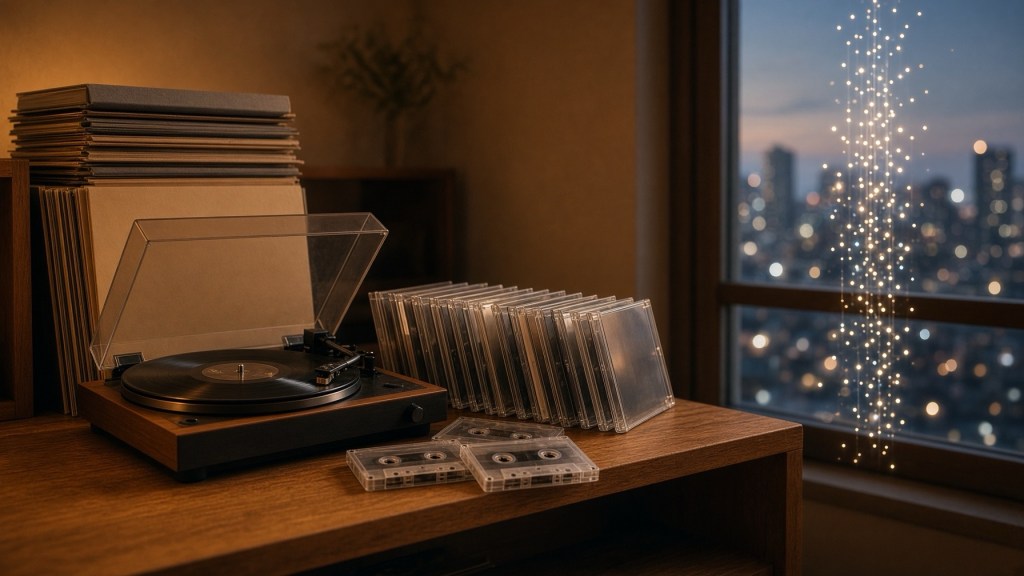
On Saturday, April 18, 2026, more than 300 independent record shops across the UK and Ireland opened their doors to lines of people waiting for a few hundred limited releases. The trade body for entertainment retailers later said sales were up 25 percent on the year before, the biggest Record Store Day the country had seen [15]. In the United States, the Billboard chart for the week that included it was topped by a four-LP clear-vinyl set of a Pink Floyd concert recorded in 1975, with a bundle of soundtrack and pop titles close behind [16]. None of this should be happening, by the logic that has governed music for two decades. Every song ever recorded can be summoned for about thirteen dollars a month, which is what a standard US Spotify plan costs after a February 2026 increase [22]. Why would anyone queue for a plastic disc?
The answer is not a simple “nostalgia”, and it is not a simple “streaming is failing” either. Streaming is doing fine: it brought in more than $22 billion worldwide in 2025, close to 70 percent of all recorded-music revenue, and paid subscriptions passed 837 million accounts [1]. Physical formats are growing alongside it in several of the biggest markets, on a much smaller base, and shrinking in at least one, Germany, in patterns that differ sharply from one country to the next. What looks like one revival is really several different markets wearing the same clothes. In the United States it is largely a vinyl story with a surprising CD sequel. In Britain it is vinyl catching up with the compact disc. In Japan it is something else again: a market where, in the idol and group-pop world, the disc can double as a ticket, a ballot and a keepsake that happens to contain a song.
This article tries to map that terrain: where physical music is bought new and where it is hunted down second-hand, how it compares with streaming, and what might become of the CD, the LP and the cassette over the next decade. It leans on industry reports, trade-press accounts and company announcements, nearly all of them secondary. I did not have access to the underlying data files, and where figures from different sources disagree, which happens more than a tidy narrative would like, I say so. The final section is speculation, and I label it as such.
First, a warning about the numbers
The statistics in this field look authoritative and are quietly incompatible. Before any country gets its turn, it is worth knowing why.
The International Federation of the Phonographic Industry, or IFPI, reports revenue at the wholesale level for the whole world. The Recording Industry Association of America, or RIAA, reports the value and number of units its member labels ship to retailers, net of returns. That is not what shoppers pay at the till, and it is not what shoppers actually bought: a record shipped to a store in March and still sitting on a shelf in June counts as a sale in March. Luminate, the data company behind the Billboard charts, counts a different thing again, sales at retail and online, with some small independent shops estimated rather than measured [4].
The gap between those methods is not a rounding error. In the first half of 2026, the RIAA reported US vinyl units up 20.9 percent to 26.5 million and CD units up 45.7 percent to 17.5 million. Luminate’s mid-year report put vinyl up only 2.4 percent to 21.8 million and CDs up 16 percent to 16.3 million [4][5]. Both can be right. One analyst-style account offers possible explanations, among them stock building in the distribution chain and multiple versions of the same album sold to the same fan, but notes that neither organization has said that is what happened, so I treat those as guesses [4].
Japan is worse. Whether physical products are “half” the market, two-thirds of it, or a bit under 40 percent depends on whose definitions you use, and I give all three figures in the Japan section. The UK has a milder version of the same problem: revenue figures from the BPI and from a retailer-side source differ by a point or two [6][7]. I use the BPI for money and say so when I do not.
Last, a caution about my own sources. Several of the 2026 figures come from news accounts of reports, not the reports themselves. Where I could not confirm a number, such as the full-year 2025 US cassette count, I leave it out.
The shape of the whole: a small thing growing inside a big one
Start with the world. IFPI’s 2025 report has global recorded-music revenue at $31.7 billion, up 6.4 percent, an eleventh straight year of growth. Physical revenue rose 8 percent and returned to growth, and vinyl rose 13.7 percent, its nineteenth consecutive annual rise [1]. The summary I read says physical growth outpaced digital growth for only the second time on record, with a return to growth in Japan doing much of the lifting. Asia accounted for 45.1 percent of the world’s physical revenue; China grew 20.1 percent, and Latin America was the fastest-growing region overall at 17.1 percent [1]. I could not find the dollar value of global physical revenue in the pieces I read, so I will not quote one.
Scale matters here, and the simplest way to feel it is the United States in the first half of 2026. Total recorded music revenue was about $5.97 billion. Streaming took about $4.89 billion of it, around 82 percent. Physical formats took $731.5 million, which is about 12 percent by my arithmetic, up 25.9 percent from the same half a year earlier [4]. Think of the music business as a river, with streaming the main channel and physical a side stream that has widened. The side stream is growing fast. It is still a side stream.
That is the context for everything below. Nobody serious is arguing that the LP will replace the playlist. The question is what the side stream is made of, who is standing in it, and how long it will run.
How the shelf got here
It helps to remember how far the format fell. A 2022 explainer put worldwide vinyl sales above 500 million units around 1980. CDs overtook records in the late 1980s, and by the early 1990s vinyl production had nearly stopped [18]. The climb back began around 2006, when the RIAA counted about 1 million vinyl records sold in the United States; by 2022 the figure was more than 41 million, the highest since 1988 [26]. Today it sits near 47 million [2][3]. The record did not so much return as get reintroduced, like a species put back into a habitat that had changed while it was away.
The habitat did change. Streaming took over the job of everyday listening, which left the physical product free to be something else. The revival also needed machinery: new record presses became available from several manufacturers in 2016, and big-box chains such as Target and Walmart started stocking vinyl in the early 2010s, which a pressing-plant chief credits with taking the format to mainstream shoppers [26]. Much of what follows is the story of what happened when a format that had lost its practical purpose found a social one.
The United States: a vinyl boom that learned to live with CDs
For almost two decades, vinyl has been the main character in American physical music. In 2025, RIAA figures show vinyl revenue reaching about $1.04 billion, up 9.3 percent from roughly $954 million the year before, with units rising from 43.4 million to 46.8 million [2]. That works out to a rise of close to 8 percent in units by my arithmetic. Luminate counted slightly differently and reported 47.9 million vinyl units, up 8.6 percent, with physical albums as a whole up 6.5 percent while digital download albums fell 15.9 percent [3]. Total physical revenue was roughly $1.38 billion, up 5 percent [2].
Notice the arithmetic of price. Revenue rose slightly faster than units, which suggests the typical record cost a little more. A CNN piece in late 2025 put the average retail price of a new vinyl record at about $33, with limited editions reaching $70 [20]. A 2022 estimate put a record that listed at $8.98 in 1982 at about $26.63 in then-current money, so a $33 average is dearer than the old days, though not wildly so [18]. What changed is less the sticker than the role of the object: where a 1982 buyer expected a record to be the way music was heard, a 2026 buyer is often paying for the way music is owned.
The CD tells a more twisty story. The RIAA recorded full-year 2025 CD shipments falling 11.6 percent to 29.5 million units and revenue slipping 7.8 percent to $312.4 million [5]. A reader looking at those numbers in January could have been forgiven for drafting the format’s obituary. Then the first half of 2026 arrived and the RIAA reported CD units up 45.7 percent and revenue up 58.6 percent to $171.1 million. Luminate’s own count was up 16 percent, to 16.3 million units, and the same report found that CD sales still grew 6.7 percent after K-pop titles were removed [4][5]. The two counts disagree on size, as discussed above, but they agree on direction.
What is pushing CDs? K-pop is part of it. Luminate’s US data showed BTS’s album ARIRANG leading CD sales with 567,000 copies [5]. K-pop albums arrive as small boxes with photo cards, posters and a code or two, and fans commonly buy more than one version. In that sense the album is closer to a trading-card pack than to an LP. But Luminate’s finding that growth persisted without them means the revival is wider than that. Mass-market retailers also gained ground: their share of physical album sales rose from 23.3 percent to 28.7 percent in the half, according to the account of the RIAA report [4], which hints at shoppers picking up discs in big stores rather than only seeking them out.
It would be easy to say Americans are rediscovering the CD, but my own guess, which no source I found tests, is that the disc is being rediscovered by people who never entirely lost it. Fans of pop, K-pop and soundtrack titles may have kept buying throughout, while the casual browser who once wandered a music aisle faded away. If the fans are growing in number and the browser has not returned, you would see a market far smaller than in 2005 that is nonetheless rising.
Who buys these records, and why, gets its own section further down. One number is worth planting here, because it changes how the sales figures should be read: Futuresource Consulting’s analyst estimated that around 40 percent of American record buyers own no turntable [20]. For a good share of the market, the LP is something other than a listening device.
Cassettes complete the picture, thinly. The last full-year US figure I can source is Luminate’s count for 2022: 440,000 cassettes, up 28 percent from 343,000, with the top seller a movie soundtrack at 17,000 copies [23]. For the first half of 2026 the RIAA reports a combined “other physical” group, which includes cassettes along with other formats, at 1.6 million units, up 73.4 percent [4]. That figure is not a cassette count, so I do not read it as one. What I can say is that the tape is small, growing from a low base, and that the movie soundtrack lesson of 2022 is worth remembering: the format sells when a title feels like a souvenir.
The United Kingdom: vinyl closing in on the compact disc
Britain’s version is the cleanest picture of a format changing places. The BPI put UK recorded-music revenue for 2025 at £1.57 billion, up 5 percent. Streaming brought in £1.07 billion, up 4.6 percent, and physical formats £278.0 million, up 12.8 percent. Within that, vinyl earned £174.7 million, up 19.9 percent, while CDs earned £99.6 million, up 3.1 percent [6]. Do the division and vinyl is now about 63 percent of physical revenue, and physical about 18 percent of the whole market, on my arithmetic.
The unit counts tell a more interesting story than the money. Vinyl albums sold about 7.6 million copies, up 13.3 percent [7], a figure the Official Charts’ year-end piece rounds to 7.5 million [8]. CDs sold 9.7 million, down 7.6 percent [5]. So revenue from CDs rose while the number of discs fell, which suggests each disc was earning more, perhaps through deluxe editions and pricier versions, though I found no source that says so directly. Mixing a BPI revenue figure with unit counts from other bodies is a hazard, so I will not push that arithmetic further than that.
One piece of arithmetic I will offer, labeled as arithmetic and not as forecast: if vinyl keeps growing at 13 percent and CDs keep shrinking at 7.6 percent, the two lines cross during 2027. Trends rarely hold that obediently, but the direction is clear enough that Britain looks likely to join the United States, where vinyl units already passed CDs in 2025, at 46.8 million against 29.5 million shipped by the RIAA’s count [2][5]. Another retailer-side source reports 17.6 million vinyl and CD units combined, up 1.4 percent, and a physical share of music revenue of 15 percent, the highest since 2021 [7]. That source’s revenue changes differ from the BPI’s, a gap I could not reconcile, so for money I rely on the BPI.
Taylor Swift’s The Life of a Showgirl shows how star power concentrates the market. In the UK it sold more than 147,000 vinyl albums and around 226,000 CDs [6]. Notice the second figure. In a country supposedly turning to vinyl, the biggest album of the year sold half again as many CDs as records. Fans choose the format that suits the occasion and the wallet, and a great many of them still choose the cheaper disc.
Cassettes sell on a different logic. Official Charts counted 164,000 UK cassettes in 2025, up 53 percent after a slight dip in 2024. The best-selling cassette album was the soundtrack to Robbie Williams’s film Better Man, with 21,400 copies, followed by Dave’s The Boy Who Played the Harp at 15,800 and Central Cee’s Can’t Rush Greatness at 9,500 [8]. For scale, vinyl sold roughly forty-five times as many albums. A soundtrack topping the tape chart echoes the American data, where a superhero film soundtrack led in 2022 [23]. Tape, it seems, sells best when it is a souvenir.
Record Store Day plays a particular role here. The UK and Ireland event on April 18, 2026 featured around 500 limited releases at more than 300 independent shops, and ERA’s chief executive Kim Bayley framed shops as cultural hubs that draw different generations together and help revive town centres [15]. A Brighton shop reported its highest ever in-store sales for the days after the event, and a London shop owner described the day as “busier than ever” [15]. These are the testimonies of retailers talking about their own busiest day, so read them as encouraging color, not as a market measurement.
Japan: when a CD is a ticket
Ask what a compact disc is in Tokyo and you may hear an answer that would puzzle a Londoner. It is a ticket, sometimes. It is a ballot paper, sometimes. It is a photo card in a plastic sleeve, and, somewhere beneath all that, a piece of music.
Japan is the world’s second-largest recorded-music market, behind the United States. IFPI recorded growth of 8.9 percent there in 2025, a return to growth that helped lift the entire global physical figure [1][11]. Unlike the American and British booms, Japan’s physical business never left. It was always large, and the question the data raises is how large, because the answer depends on what you count.
Take the Oricon figures first. This Japanese measurement company put the total 2025 music market at about ¥641.1 billion, up 6.7 percent, of which physical “soft” products brought in about ¥250.8 billion (up 6.3 percent) and digital ¥390.3 billion (up 7.0 percent). Physical units numbered about 72.1 million, up 1.1 percent [10]. That makes physical about 39 percent of the market by retail value, and digital the larger piece.
Now the RIAJ, the producers’ association. Its latest figures that I could access cover calendar 2024, and they are production values for physical products and sales values for digital, so they are not strictly comparable. Audio CDs came to ¥140.2 billion (up 1 percent), analog records ¥7.9 billion (up 26 percent), music videos on DVD and Blu-ray ¥56.2 billion (down 25 percent) and streaming ¥113.2 billion (up 7 percent). Physical audio together was ¥149.0 billion against ¥123.3 billion for all digital music [9]. On those numbers, physical audio is about 55 percent of the audio total, or about 62 percent if music videos are included, again by my arithmetic. A third account says physical formats made up roughly two-thirds of Japanese recording revenue in recent years, attributing that to the data company Soundcharts, while its own headline says “still half physical” [11].
Three definitions, then, give about 39 percent, about 55 to 62 percent, and about two-thirds. None is wrong. They answer different questions: the Oricon figure measures what consumers spent, the RIAJ figures measure what producers shipped, and the headline “half” lies between. The honest summary is that physical is a larger share of Japanese music spending than anywhere in the West, but how much larger depends on which ledger you open.
Why? The popular explanation points to idol and group culture. One account I read says idol CD singles are sold bundled with event tickets, photo cards and voting rights, so fans routinely buy several copies of one disc [11]. That bundling turns a disc from a listening device into an entry pass, and it explains why a country with excellent streaming services keeps producing so many plastic discs. I would add a caution that is my own: the bundling story explains the volume of discs, but I found no source that measures how much of Japan’s physical total actually comes from bundled idol releases, so the size of that effect remains unquantified here. A common claim, which I could not confirm, is that Oricon’s charts have historically favored physical sales; the only description of the chart I found says its combined singles ranking counts physical, download and streaming sales together [11], so I leave that claim aside.
Pricing is another place where Japan’s disc market departs from the Western one. Japanese competition law generally bars a maker from dictating what a shop charges, but copyrighted goods such as books, magazines, newspapers and music CDs are exceptions, so a label may set a CD’s retail price [31][32]. The industry body RIAJ calls this a unique Japanese system of price designation by record companies, says it has not produced a dramatic fall in prices, and puts a full-priced new album at about ¥2,500 to ¥3,000 [29][30]. Singles sit on a lower rung of the same ladder. A retailer’s explainer from 2003 put the typical CD single at around $10, against $20 to $35 for an album, and described singles as short discs of three or four songs, often a B-side plus karaoke versions of the lead track [33]. Those sources are old, and I found no recent price survey and no figure for how many CDs are actually sold at fixed prices today, so read the tiers as the traditional pattern, not a current measurement. My own reading is that a stable ladder with one price for albums and another for singles makes it easy for a fan to budget for several copies of the same single, which fits the idol bundling described above.
Foreign albums reach Japan in editions of their own. Most Western music sold there is pressed and distributed domestically, and the Japanese edition usually carries one or more tracks missing from the overseas release, such as exclusive songs, remixes, demos or singles that never had a physical release. It also normally adds liner notes, translated lyrics and the paper obi strip that marks it as Japanese [35]. The usual explanation is economic: making CDs in Japan costs considerably more than abroad, so importing can be cheaper for Japanese shoppers, and the extra tracks are an inducement to buy the local pressing instead [34][35]. One account puts the cost gap at up to 30 to 40 percent, a figure the reference page takes from a 2018 article [35]. A 2022 music-press explainer gives two examples. The standard CD of Paul McCartney’s McCartney III has 11 tracks and four special editions each add a different bonus track, while the Japanese CD includes all four. Trivium’s Japanese edition adds two live tracks that are not on any streaming service [34]. Collectors value these editions both for the content and for the Japan connection [35]. The evidence is thinner than the practice is famous, though: it comes mostly from music-press and blog sources, and I found no study of how well the strategy works.
The disc is also not the whole story. Analog records rose to 3.15 million units in 2024, up 17 percent, and ¥7.9 billion in value, the first time above ¥7 billion since 1989, growing far faster than the CD’s 1 percent that year [9]. That is small next to the CD’s ¥140 billion, a ratio of about eighteen to one, but it is a very old format climbing in a country that never stopped pressing it.
Then there is the second-hand trade, where Japan matters to collectors everywhere. Tokyo has 93 record shops, which by some counts is the most of any national capital, and Tower Records in Shibuya refurbished its record floor in February 2024, nearly doubling it [12]. Tourists, helped by a weak yen, hunt for used records, and the trade has become partly an export business. A Japan Times account reprinted by the Tokyo government says Japanese jazz from the 1970s and 1980s sells quickly in London but sits on shelves in Tokyo, and that well-kept second-hand records mean many rare pressings survive in good condition [12]. The same account mentions the paper strip called an obi, wrapped around Japanese pressings, as part of their appeal, and says a single record shipped abroad from Japan can cost at least ¥3,600 in postage [12]. Resellers have raised prices, which has frustrated some Japanese collectors [12]. Discogs, the collectors’ marketplace, noted that its East and Southeast Asia lists favored Beethoven, Mozart, Miles Davis, John Coltrane and the Japanese singer Tatsuro Yamashita [14], a taste profile unlike the pop-heavy lists of the West.
Elsewhere: the revival is not universal
It would be comforting to report that the same pattern shows up everywhere. It does not, and the cleanest counterexample is one of Europe’s biggest music markets.
Germany’s recorded-music revenue grew 2.3 percent in 2025 to about €2.42 billion, a sharp slowdown from 7.2 percent the year before. Streaming brought in 84.4 percent of it. Physical revenue fell 5.9 percent to €345 million, 14.2 percent of the total and down by more than two-thirds since 2015. CDs, still the largest physical format, earned about €175 million, down 11.3 percent. Vinyl revenue grew only 2.8 percent, though its share of physical revenue rose from 40.5 to 44.2 percent because the CD was shrinking faster [24]. The report I read contrasts that flat vinyl result with a much bigger jump in Britain [24]. One reasonable reading is that the revival may be more concentrated, in the United States, Britain, Japan and a few other places, than the global figures suggest. Why Germany differs I could not establish, and I will not guess beyond noting that the sources I read do not explain it.
Australia sits on the other side of the ledger. ARIA’s figures for 2025 show CD revenue up 29.6 percent to A$21 million, the best result since 2021, and total physical revenue up 11 percent to A$67.9 million [5]. At the regional level, IFPI has Asia growing 10.9 percent in 2025 with China up 20.1 percent, Europe up 5.6 percent, and Latin America up 17.1 percent [1]. Those are all-format growth rates, not physical ones, so they say little by themselves about discs. Discogs’ year-end lists add color: Latin American collectors ranked Pink Floyd’s At Pompeii and Chico Buarque’s Dois above Taylor Swift’s latest, and Nordic collectors put albums by the Hellacopters and Ghost above her [14]. Taste, in other words, is local.
South Korea deserves its own paragraph, because K-pop is invoked so often to explain the CD’s strength in the West. Korean customs data show album exports reached a record US$301.7 million in 2025, up 3.4 percent. Japan was the largest destination at $80.6 million, down 10.2 percent, while China, up 16.6 percent to $69.7 million, regained second place from the United States at $64 million [25]. At the same time, the Circle Chart’s count of total K-pop album sales, at home and abroad, was about 93.5 million copies in 2025, down from about 120 million in 2023 and the second annual decline in a row [25]. Put the two facts together and you get a mixed picture: record export value, falling copies sold, and an American slice that is real but a fraction of the whole. So K-pop packaging is a plausible contributor to the US CD jump, and Luminate’s non-K-pop figure shows it is not the whole explanation, but I would not describe K-pop as an engine of unstoppable growth [5][25].
Who is actually buying
Market totals describe a crowd; the people in it describe motives. The CNN story that gathers the survey data also gathers voices, and they say more than the percentages do. Futuresource Consulting found that about 60 percent of Gen Z say they buy records, and its analyst James Duvall estimated that around 40 percent of American record buyers own no turntable [20]. A Vinyl Alliance survey in the same piece had 56 percent of Gen Z fans liking vinyl for its look and 37 percent using it as home decoration [20].
A New York University marketing professor in the piece, Jared Watson, calls the behavior symbolic consumption, buying a thing to show what you love [20]. The story’s other reasons read like a small portrait of a generation: a modest treat at a time when bigger milestones, like buying a home, feel far off; a trophy for a favorite band; a bargain found in a local shop. One 25-year-old content creator described rotating the albums on his wall by season [20]. For him, I suspect, the record is closer to a framed print that happens to have grooves.
Four motives seem to be at work, and they are worth separating, because each ages differently. Some people buy to listen, and for them the format competes with a stream on quality and ritual. Some buy to belong, treating the object as a badge of fandom. Some buy to display, and some, in Japan above all, buy to take part, because the disc carries a ticket or a vote [11]. That fourfold split is my own framing, not a finding. It suggests the listening motive is the sturdiest, since it survives a change in fashion, while the display motive is the most exposed to taste. The belonging and participation motives depend on the artists themselves, which is why a quiet year for the biggest names would hurt. None of the sources I read measures the weight of each motive, so the split is a way of thinking, not a ratio.
Buying new: the release machine
A new record in 2026 is rarely just a record. It is an album in several colors, a picture disc, a store-exclusive sleeve, a cassette and a 7-inch single that exists mostly to be owned. The chart that follows Record Store Day in the United States gives a sense of the menu: a four-LP clear-vinyl live set from Pink Floyd in first place, a Bruno Mars double LP second, a special edition of the KPop Demon Hunters soundtrack third, and on the singles side a glitter-vinyl 7-inch from Taylor Swift ahead of a BBC live 7-inch from Olivia Dean and a 12-inch from the group KATSEYE. More than 350 album and single products were issued for the day, and the exclusive ones were sold only through independent shops [16].
This is scarcity manufactured on purpose, and it works. Discogs, which sits at the receiving end of the secondary market, named Swift’s The Life of a Showgirl its 2025 Album of the Year and her Fortnight 7-inch its 7-Inch of the Year. Its own year-in-review notes that she was the only contemporary act to break through lists dominated by legacy artists like The Beatles, Pink Floyd and Madonna [14]. Luminate’s data for 2024, quoted in a CNN story, had five Swift albums among the ten best-selling US vinyl records, with The Tortured Poets Department alone at 1.48 million copies [20]. A single artist can move a market’s weekly figures. That is both the strength of the physical business and its fragility, a point I come back to in the final section.
The creative economics deserve a moment. For a small independent label, a pressing of a few hundred records has to be financed before a single copy sells, so pre-orders and fan-funding days do the work of a loan. An article on Europe’s pressing bottlenecks says labels lean on pre-orders and Bandcamp-style fan sales to pay for slots in the queue, though its sourcing is thin enough that I treat that as an anecdote about practice, not a measurement [17]. What I can say with more confidence is the direction of the incentive. Because a physical edition is sold directly to a fan who wants the object, a label can charge a price that a stream could never earn, which is my reading of why even acts with large streaming audiences press limited runs.
Where those records are bought has shifted too. Billboard figures relayed by CNBC put independent stores at 45.4 percent of US vinyl sales in 2015, when big-box chains held about 1 percent; by 2021 the big-box share was 14.6 percent [26]. The first half of 2026 pushed in the same direction, with mass-market retailers rising from 23.3 to 28.7 percent of physical album sales in the RIAA-based account I read [4]. The same CNBC piece gives the average vinyl price as $26.12 in 2021 and $29.65 in 2022 [26], against roughly $33 in 2025 by the CNN figure [20]. The series come from different sources and may not be strictly comparable, but if they are, the average record has risen in price by about a quarter in four years. The United Record Pressing chief quoted there notes that a Swift release may arrive in eight, nine or ten variants [26]. For independent shops, long central to vinyl retail, that is a mixed picture: the revival is theirs, but a growing portion of the sales is not.
There is a quieter point about what “new” means. Many new physical sales are old music. A 2026 pressing of a 1975 concert tops the American charts; a reissue of Channel Orange is the Reissue of the Year on Discogs [14][16]. Streaming data points the same way: Luminate found that fewer than half of US on-demand audio streams came from tracks released in the 2020s [3]. So on both sides, listeners are spending much of their time with catalog, and the physical market is learning to sell catalog as if it were a new release, with new colors and new packaging.
Collecting the old: a library nobody finished cataloguing
If new releases are the front window of the shop, collecting is the back room, and it is bigger than it looks.
Discogs reported that its users added a record 114.2 million items to their collections in 2025, up from 105.7 million in 2024 and averaging nearly 2.2 million additions a week. The site now holds more than 920 million cataloged items and expects to pass one billion in 2026; the average collection has 191 items and an estimated value of $571.77, based on late 2025 data [13]. These are impressive numbers, and I want to be careful with them. They measure items added to collections, not records sold, and a person who finally catalogs a shelf of albums owned since 1994 counts exactly as much as someone who bought a copy yesterday. The release I read gave no sales or marketplace volumes and no breakdown by format or country [13]. What it supports is that collecting as an activity is growing; it does not support a claim about the size of the second-hand market.
The most-collected releases are telling. A 2015 180-gram reissue of Nirvana’s Nevermind and a 2017 picture disc of Taylor Swift’s Reputation now rank among the most collected releases of all time, while the original 1982 pressing of Michael Jackson’s Thriller dropped out of the top five individual releases. None of the most-collected releases predate 2012 [13]. Read that again. In the world’s largest database of records, the editions people hold most are modern reissues, not the first pressings that obsess serious collectors. The release itself draws the conclusion that modern reissues are changing what counts as canonical [13]. My own reading is that the vinyl revival has produced a generation of collectors whose reference copy is a re-release, which sits oddly with the connoisseur’s culture of matrix numbers and first pressings, though I found no data on how the two groups overlap.
Prices for old records are gentler than headlines suggest. In that CNN story, a near-perfect-condition record sold on Discogs for about $15 on average, roughly 45 percent below retail, local shops sold some records for as little as $5, and one young collector said $100 for a Toni Braxton album was the most he had paid [20]. Compare that with $33 for a new record and the second-hand shelf is a bargain, which probably explains part of the appeal. It also helps explain why several buyers in the same story spoke of bargain hunting as part of the fun [20].
Japan is the great exporter in this world. The same country that makes millions of idol CDs also holds a deep stock of carefully kept second-hand records, which foreign buyers prize. A Tokyo shop owner quoted by the Japan Times account says popular requests include Yellow Magic Orchestra and Ryuichi Sakamoto, and that trending genres include 1980s pop, synth pop, new wave and city pop [12]. The same account describes Toshiba’s static-resistant red “Ever-Clean” vinyl, issued from 1958 to 1974, as a high-quality pressing prized by collectors [12]. The arrangement carries some tension: the account’s headline credits overseas buyers with sustaining the scene, yet resellers raising prices have irked local collectors [12].
The factory floor: bottlenecks, tariffs and PVC
Every record begins in a machine that most people never see, and there are not enough of them.
During the vinyl boom of the early 2020s, pressing waits became legendary. A 2022 explainer reported that orders routinely took nine to twelve months, against four to six weeks in 2018, and cited a February 2020 fire at Apollo Masters, then the only North American maker of the lacquer discs used in the process, which forced plants to source lacquers from Tokyo [18]. Plants were scrambling to grow. United Record Pressing in Nashville made 35,000 to 40,000 records a day and expected to more than double that. A smaller plant in North Carolina made 2,000 to 2,500 a day and said its bottleneck was staff, not presses. The industry association projected 43 US plants by summer 2022, alongside nine in Canada and three in Mexico, against fifteen in all of North America in 2014, and press makers were reportedly quoting two years or more for a new machine [18]. The picture is of a bakery with a handful of ovens and a line out the door.
What about now? The best I can offer is a caution. A 2026 article on Europe, which describes itself as an AI translation of a German original, names GZ Media in the Czech Republic, estimated at up to 50 million records a year, as the largest plant, says some smaller plants are fully booked, and puts the wait for independent labels at three to seven months. It also says six months is the new normal and, in another section, that twelve months has become standard [17]. It gives a production cost of €4.50 to €6.50 a unit for a 300-copy indie run and a retail price of €28 to €35 [17]. Nearly all of its figures are unsourced, and the article contradicts itself on lead times. I cite it to show what a bottleneck looks like from a small label’s desk, not as data on the industry.
Trade policy is the other question. In September 2025, Hypebot reported that US Customs had confirmed CDs, vinyl and cassettes were exempt from the import tariffs that took effect on August 29, 2025, treating them as informational materials, even as the exemption for low-value parcels was suspended. The same account carried warnings from Discogs that customs officers and shippers might apply the rules unevenly, and from Bandcamp that it had restricted shipping to the US; merchandise like shirts and hats was not exempt [19]. That article is a secondhand report of the customs position, and it was written when the situation was described as uncertain, so I would not assume that the exemption still holds unchanged today.
Last, the plastic. A 2024 carbon-footprint report from the Vinyl Record Manufacturers Association and the Vinyl Alliance put the footprint of a record from raw materials to factory gate at about 1.15 kilograms of carbon dioxide equivalent. Roughly half of that came from the PVC compound, about 30 percent from factory energy and about 13 percent from print packaging. Air freight between Europe and America adds about 1.36 kilograms more, and to Australia about 3.46. The authors recommended ending air freight, using bio-attributed PVC, pressing on lighter 140-gram discs and keeping packaging simple. They also cited a survey by Key Production, a company in the pressing business and so not a neutral party, in which 69 percent of vinyl buyers said they would buy more if records were produced sustainably and 77 percent would pay a premium [21]. Stated willingness to pay is famously larger than actual willingness to pay, so I treat those percentages as sentiment.
Against the stream: what each side is good at
Set the two side by side and the contrast is less a duel than a division of labor.
Streaming’s strengths are plain. Paid subscriptions passed 837 million worldwide, paid streaming was 52.4 percent of global recorded-music revenue, and on-demand streams accounted for 85 percent of US album consumption in Luminate’s year-end count, while digital downloads fell 15.9 percent [1][3]. For discovery and for background listening, no shelf can compete. The service also keeps getting dearer. In February 2026 Spotify’s US individual plan rose from $11.99 to $12.99 a month, its duo plan from $16.99 to $18.99, the family plan from $19.99 to $21.99 and the student plan from $5.99 to $6.99 [22]. A year of the individual plan costs about $156, which by simple division is nearly five of the $33 average vinyl records [20][22].
Streaming has also closed one gap that used to favor the disc. In 2025 Spotify began rolling out lossless audio within its Premium plan at no extra charge, in FLAC at 24-bit and 44.1 kHz, which pairs the CD’s sampling rate with a deeper bit depth. The same account cautions that Bluetooth connections can limit the benefit and that the differences may be subtle on earbuds [28]. I read no listening tests, so I make no claim about which format sounds better. The narrower point is that the plain argument that a CD sounds better than a stream has less to stand on than it did when the best streams were compressed.
What the stream does not give you is the thing itself. This is an argument, not a measurement: a streaming subscription is a license, valid while the payments continue and the contracts hold, and a record is a possession. That difference matters most to people who care about a specific album or version, and it is a plausible reason fandom drifts to the shelf. A related difference is texture. A record or a CD has a front, a back, credits and a size, and the act of choosing it is deliberate. Whether this changes how people listen, I cannot say. The research I found describes why people buy and gives much less on how they listen once they get home. Some buyers do not play records at all, as the turntable figures suggest [20].
There is also a plain point about the new competitor. Luminate’s 2025 report tracks “AI artists” streaming and selling, and its listener poll found that about 36 percent of Millennials and 37 percent of listeners aged 13 to 17 said they were comfortable with generative AI for song lyrics [3]. I draw no conclusion from that single poll, but I flag a speculative thought for the next section: if machine-made tracks become a larger share of what flows through the services, a pressed, credited, dated object might gain meaning as a mark of human provenance.
Price is the last hinge. Physical was never the cheap way to hear music; a stream is. Used copies are where ownership and thrift meet, though I found no consistent CD price data, new or used, to put numbers on that. The vinyl price, at $33 on average, positions the object as a treat. The streaming price keeps edging up, but a year of it still costs roughly what nearly five records do, and it buys the whole catalog.
Looking ahead: three formats, three different bets
Most of what came before is reporting. What follows is my own speculation, built on that reporting, and I try to say for each bet what would show it wrong.
Vinyl has the strongest base and the most visible warning signs. The base is nineteen straight years of global growth and a US market that shipped around 47 million records in 2025 [1][2][3]. The warnings come in three flavors: disagreement, dependence and price. The 2026 mid-year counts disagree about whether American vinyl is booming (the RIAA, up 20.9 percent) or nearly flat (Luminate, up 2.4 percent) [4][5], and if the retail-side count is closer to the truth, the market may already be approaching a plateau, with shipments to stores running ahead of what shoppers take home. On dependence, the market leans on a handful of superstars; five Swift albums made the US top ten in 2024 [20], and a quiet release year for the biggest names would show up quickly. And the price keeps drifting upward, with an average near $33, while the cheapest alternatives, used records and streaming, sit right next door [20].
My bet is a long plateau at a high level in the United States and Britain, not a collapse and not another decade of double-digit growth. Vinyl would settle into the role the hardback book occupies next to the e-reader: the form people choose for things they care about, and for gifts. I would call this bet wrong if both the RIAA and Luminate series show US vinyl units falling in the same year for two years running.
The CD is the harder call, because its recent numbers contradict each other. The RIAA’s 2025 numbers show American CD shipments falling 11.6 percent, then its first-half 2026 numbers show them jumping 45.7 percent; Luminate shows a 16 percent rise and a 6.7 percent rise without K-pop [4][5]. Britain’s CD units fell 7.6 percent while its CD revenue rose 3.1 percent [5][6]. Taken together, those facts suggest to me that the CD is splitting in two. One CD is the plain jewel-case disc in a shop, a shrinking product that survives as the cheap way to own an album. The other is the fan edition with the cards, the booklet and the extras, a growing product that behaves more like merchandise. Japan has run on the second model for years [11], and K-pop appears to have taught it to the West [5]. That is a hypothesis, not a finding: I found no data splitting CD sales into plain and deluxe.
If it holds, the CD’s future depends less on listening habits than on fandom. A format that is a ticket and a keepsake can outlive a format that is merely a way to hear sound, which is how Japan’s market stayed large while streaming grew [9][10]. What would prove me wrong: Luminate’s non-K-pop CD figure turning negative in a later report, and Britain’s CD revenue falling alongside its units.
The cassette has the smallest numbers and the clearest personality. Britain sold 164,000 in 2025 against about 7.5 million vinyl albums, and the biggest seller was a film soundtrack [8]. The 2022 American list was topped by a film soundtrack too [23]. My expectation is that tapes will keep rising and falling in step with releases that suit the souvenir impulse, such as soundtracks, tour tie-ins and limited runs from big names, and stay at a few percent of vinyl volume. I would count that wrong if UK cassette units exceeded 5 percent of vinyl units in a year without a single blockbuster title driving it. The supply side is the open question. A 2019 report, now seven years old, said a shortage of the magnetic material used to make quality tape, from a factory that had been under renovation, left the largest US cassette maker with only two tons delivered that year and more than 50 tons of orders waiting; US sales then were 219,000, up from 178,000 the year before [27]. By 2022 they were 440,000 [23]. I found no current data on tape supply or duplication capacity, so I cannot say whether supply, not demand, would cap the format today, but a product that depends on a few suppliers can be throttled quickly.
Beyond the formats, several forces could bend the whole picture. Streaming prices rose again in 2026 and may keep rising, though a $13 plan still looks cheap beside a $33 record [20][22]. Machine-made music may become a more visible slice of streaming, and I raised the thought earlier that a pressed, credited object could carry a human-provenance premium [3]; the evidence for that is a thought, not a trend. Trade policy is a live risk: the US exemption for physical media was described as uncertain when I read it [19]. The environmental pressure is steadier, because the plastic and the freight are real, and the industry’s own report suggests lighter discs, cleaner PVC and no air freight [21]. Finally, there is the buyer question. If a large share of record buyers treat the LP as decor, and about 40 percent of US buyers reportedly lack a turntable [20], then demand depends partly on taste in interiors, and tastes change faster than formats do.
If I had to name the signals worth watching, I would start with the gap between the RIAA and Luminate counts. If it narrows, the American picture becomes clearer, and if stores keep receiving more than customers take home, unsold stock would eventually come back as returns. Germany’s physical revenue lost more than two-thirds of its value between 2015 and 2025, which makes it the warning case for any market that feels secure [24]. Then there is the price of a new record, since a market built on gifts and treats can tolerate a great deal until suddenly it cannot. Pressing capacity and tape supply matter at the other end, and so does the customs treatment of imported discs [18][19][27]. None of these will announce itself with a headline. They would show up as small, dull changes in trade reports.
The likeliest long-run picture, in my view, is a two-layer music world. Streaming is the utility layer, cheap, endless and mostly invisible. Physical media becomes the layer you can hold, aimed at deliberate listening, gifts, fandom and display. Nobody should expect the second layer to rival the first. The better question is whether it stays a lively niche worth tending, and that depends on whether labels, shops and artists keep treating the object as a product with its own logic. The people queuing outside record shops on a spring Saturday suggest they might.
What the evidence leaves open
It would be dishonest to finish without listing what I could not establish. I could not find the dollar value of global physical sales, so I use only growth rates for the world. I could not confirm a full-year US cassette count for 2025; the latest I could source is for 2022. I found no data splitting CD sales into plain and deluxe, none measuring how much of Japan’s physical total is idol bundling, and no consistent retail price series for new CDs. I could not explain why Germany diverges from Britain. The mid-2026 gap between the RIAA and Luminate remains unexplained beyond the guesses of one account. And the current status of the US tariff exemption, the present state of pressing lead times, and the supply of tape are all questions where my sources are old, secondhand or mutually contradictory.
None of that undermines the main picture: physical music is growing in several big markets, unevenly, from a small base, alongside a streaming business that dwarfs it. But it does mean the confident one-line version, that vinyl is back, conceals a patchwork.
What it might mean for the people who make and sell
A few practical thoughts follow from the evidence, offered as judgment and not as findings. For labels, the data suggest the variant treadmill may be a double-edged tool: it lifts first-week figures and feeds collectors, but it also moves sales toward big-box channels and star-driven weeks, and the pressing queue punishes anyone who guesses wrong. For independent shops, the strongest evidence in this article is about community, not stock: ERA’s chief describes shops as cultural hubs, and the best Record Store Day reports are about footfall and town centres, not only units [15]. For collectors, the second-hand shelf is the best value around, with near-perfect records changing hands on Discogs at about 45 percent below retail on average [20]. And for artists, a limited physical run is both a source of income and a signal to fans, as long as its price stays within reach of the people it is meant for.
The human side of the shelf
Think about the last time you gave someone a playlist. It was kind, and it vanished into their phone with a tap. Now think about handing someone a record, a weight in their hands with a face on the front and a name on the back. You have given them somewhere to stand.
That may be all the revival is. We have access to almost everything and ownership of almost nothing, and the shelf is a small way of saying that this one matters. A stream is like water from a tap: always there, never yours. A record is like a jar you filled yourself. It holds less, and you can see exactly what is in it.
Sources
- Music Business Worldwide, “Global recorded music revenues hit $31.7B in 2025, up 6.4% YoY; users of paid music subscriptions reach 837M” (March 2026; news report on IFPI’s Global Music Report 2026, not the report), https://www.musicbusinessworldwide.com/global-recorded-music-revenues-hit-31-7bn-in-2025-up-6-4-yoy-users-of-paid-music-subscriptions-reach-837m
- Billboard, report on the RIAA’s 2025 year-end figures (early 2026; news report; the page gives two different streaming totals, which I did not use), https://billboard.com/pro/riaa-2025-music-report-revenue-streaming-vinyl
- Lazy-i, “Luminate year-end report: physical album sales continue to grow; what about AI?” (January 2026; blog summary of Luminate’s report, not the report), https://lazy-i.com/2026/01/luminate-year-end-report-physical-album-sales-continue-to-grow-what-about-ai/
- Xenospectrum, “RIAA 2026 CD shipments versus sales” (September 6, 2026; news analysis of the RIAA’s first-half 2026 report, released September 1), https://xenospectrum.com/en/riaa-2026-cd-shipments-versus-sales/
- Stereonet, “CD revival gathers pace around the world” (2026; publication date not shown on the page read; summarizes Luminate, RIAA, ARIA and BPI figures), https://www.stereonet.com/news/cd-revival-gathers-pace-around-the-world
- Music Week, “BPI: UK recorded music market tops £1.5 billion as new generation of British acts make chart impact” (March 2026; trade-press report on BPI figures), https://www.musicweek.com/public_html/index.php/labels/read/bpi-uk-recorded-music-market-tops-1-5-billion-as-new-generation-of-british-acts-make-chart-impact/093723
- Now Spinning Magazine, Phil Aston, “How Did Vinyl & CD Sales Really Perform in 2025?” (early 2026; magazine article citing Music Week, Key Production Group and ERA), https://nowspinning.co.uk/how-did-vinyl-cd-sales-really-perform-in-2025/
- Official Charts, “The Official best-selling cassettes, singles and albums of 2025” (January 2026; chart-company report), https://officialcharts.com/chart-news/best-selling-cassettes-singles-albums-2025/
- Recording Industry Association of Japan, “The Recording Industry in Japan 2025” (English-language yearbook; figures cover calendar 2024), https://www.riaj.or.jp/f/pdf/issue/industry/RIAJ2025E.pdf
- Oricon, press release on the “ORICON Entertainment Market White Paper 2025” (Japanese-language; figures for calendar 2025; press release, not the white paper), https://www.oricon.co.jp/pressrelease/2769364/
- InterSpace Daily, Daniel Obembe, “Japan is the world’s no. 2 music market and grew 8.9% in 2025. It is still half physical” (July 20, 2026; distributor blog summarizing IFPI and Soundcharts material), https://interspacemusic.com/blog/japan-is-the-worlds-no-2-music-market-and-grew-8-9-in-2025-it-is-still-half-physical/
- Tokyo Metropolitan Government, reprint of The Japan Times, “Tokyo’s Vinyl Experts Say Overseas Buyers Are ‘Sustaining the Scene’” (Japan Times, March 8, 2025; reprinted October 29, 2025), https://www.tokyoupdates.metro.tokyo.lg.jp/en/post-1595/
- Shorefire Media, press release on Discogs’ record 2025 collection activity (early 2026; company press release), https://shorefire.com/releases/entry/discogs-breaks-all-time-collection-record-as-music-fans-catalog-more-than-114-million-items-in-2025
- Shorefire Media, press release on the Discogs Year in Review 2025 (December 2025 or early 2026; company press release), https://shorefire.com/releases/entry/discogs-year-in-review-2025-is-the-definitive-global-snapshot-of-what-music-fans-collected-most
- Music Week, “ERA reports Record Store Day sales increase of 25%” (April 2026; trade-press report), https://www.musicweek.com/public_html/index.php/labels/read/era-reports-record-store-day-sales-increase-of-25/093997
- Billboard, Record Store Day 2026 chart report (week ending April 23, 2026; chart coverage using Luminate data), https://billboard.com/music/chart-beat/record-store-day-2026-charts-1236237603
- Inspired by Beatz, “Europe’s Vinyl Crunch 2026” (April 29, 2026, modified July 22, 2026; self-described AI translation of a German original; most figures unsourced), https://www.inspiredbybeatz.com/en/europes-vinyl-crunch-2026/
- GRAMMY.com, “The Vinyl Shortage Explainer: How Long Waits, Expensive Materials & High Demand Are Affecting The Industry” (July 6, 2022; news explainer), https://www.grammy.com/news/the-vinyl-shortage-explainer-how-long-waits-expensive-materials-high-demand-are-affecting-the-industry
- Hypebot, Jeremy Young, “CDs, Vinyl Records, Cassettes Safe From New US Import Tariffs” (September 3, 2025, modified January 28, 2026; trade-press report relaying a customs position), https://www.hypebot.com/hypebot/2025/09/cds-vinyl-records-cassettes-safe-from-new-us-import-tariffs.html
- CNN Business, Auzinea Bacon, “Gen Z’s search for decorative collectibles is fueling vinyl sales” (December 14, 2025; syndicated on ABC17 News), https://abc17news.com/money/cnn-business-consumer/2025/12/14/gen-zs-search-for-decorative-collectibles-is-fueling-vinyl-sales/
- Mixmag, report on the first carbon footprinting study of the vinyl industry by the Vinyl Record Manufacturers Association and the Vinyl Alliance (August 22, 2024; news report, not the study), https://mixmag.net/read/report-released-carbon-impact-vinyl-industry-news
- SoundGuys, “Spotify confirms US subscription price hike” (late 2025 or early 2026; tech-press report; prices effective as billing dates renew through February 2026), https://www.soundguys.com/spotify-confirms-us-subscription-price-hike-151412/
- The Music Network, article on US cassette sales based on Luminate’s 2022 year-end report (2023; news report), https://themusicnetwork.com/news/cassette-comeback-united-states
- Music Business Worldwide, “Germany’s recorded music business generated USD $2.73B in 2025 – up just 2.3% YoY” (2026; news report on BVMI figures, not the BVMI release), https://www.musicbusinessworldwide.com/germanys-recorded-music-business-generated-usd-2-73b-in-2025-up-just-2-3-yoy
- Malay Mail, “K-pop rules its 2025: Global album exports topped US$300m” (January 16, 2026; news report citing Yonhap, Korea Customs Service and the Circle Chart), https://malaymail.com/news/showbiz/2026/01/16/k-pop-rules-its-2025-global-album-exports-topped-us300m/205635
- CNBC (syndicated on NBC San Diego), “How major retailers and Covid-era nostalgia helped revive the vinyl records industry” (about 2023; news article citing Billboard and the RIAA; publication date not shown on the page read), https://www.nbcsandiego.com/news/business/money-report/how-major-retailers-and-covid-era-nostalgia-helped-revive-the-vinyl-records-industry/3368513/?amp=1
- Loudwire, Joe DiVita, “Cassette Sales Way Up, Material Shortage Causes Production Delay” (October 12, 2019; news report relaying a record label’s letter and Nielsen SoundScan figures via Pitchfork), https://loudwire.com/cassette-sales-up-material-shortage-production-delays/
- Audio Advice, “Spotify Lossless: What You Need to Know” (2025; retailer’s explainer), https://www.audioadvice.com/blogs/expert-advice/spotify-lossless-what-you-need-to-know
- Recording Industry Association of Japan, FAQ page, answer on record prices (publication date not shown on the page read), https://riaj.or.jp/f/e/leg/faq
- Music Business Worldwide, “A quick guide to Japan’s music market” (December 6, 2014; trade-press guide; its price figures are old), https://www.musicbusinessworldwide.com/a-quick-guide-to-japans-music-market/
- Japan Fair Trade Commission, English-language page on resale price restrictions and the exception for copyrighted products (date not shown on the page read), https://www.jftc.go.jp/en/ippan/part2/act_05.html
- TKG (Japanese-language reference entry), “再販制度” on the resale price maintenance system (added May 31, 2026, revised September 2, 2026), https://www.tkgje.jp/entries/28000/28452_saihanseido.html
- AnimeNation, “Ask John: Why Buy CD Singles Instead of CDs?” (March 4, 2003; retailer blog post; dollar prices only, from 2003), https://www.animenation.net/blog/?p=649
- Loudwire, Chris Wheatley, “Why Japanese Bonus Tracks Are a Thing – Explained” (May 4, 2022; music-press explainer), https://loudwire.com/why-japanese-bonus-tracks-exist-explained/
- Wikipedia, “Japanese edition” (encyclopedia article read October 2026; the 30–40% cost figure cites a 2018 article), https://en.wikipedia.org/wiki/Japanese_edition
Idea originated at artificialideas.org. Initial draft by Grok; article researched, checked and substantially rewritten by Claude Sonnet 5.5. Published at artificialideas.org.

