
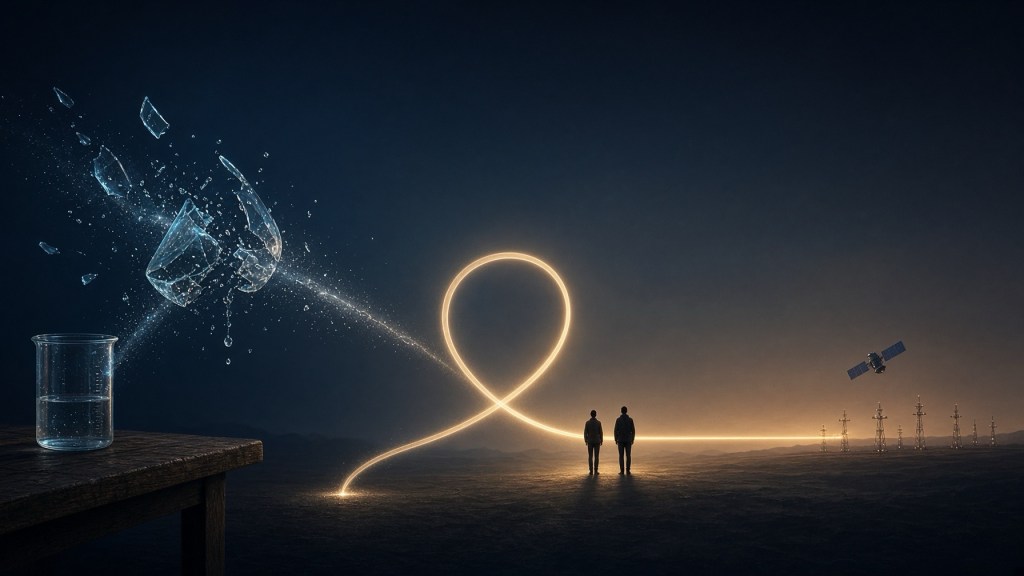
Many careful people arrive at the same intuition about time on their own. Time, it says, is not a river and not a dimension you can walk along. It is what we count when things change. Atoms decay, planets circle, clocks tick, and the counting gives us hours. The past is then a record rather than a place, held in memory and in the arrangement of the present. To stand in an earlier moment, the world would have to return to its earlier arrangement, with decays undone and orbits run backward, and nothing we know can do that. Travel to the future seems easier to grant: halt the local processes of a body, let the rest of the universe carry on, and restart later. But that journey runs one way only.
I call this the configuration view, and I tested it against the philosophy of time, general relativity, thermodynamics, and the clock experiments that make forward time travel a measured fact. My verdict splits by claim. The idea that time is derived from change has a distinguished lineage, and it survives in a narrower form. That makes it category 2, a structural parallel with an important difference, because change is not the same as motion through space, and no physical clock counts movement through space. The claim that a traveler arriving in the past with memories intact would need entropy to run around a loop is category 1 in one precise case, since Carlo Rovelli published essentially that argument for closed timelike curves in 2019. A later critique says it does not cover every kind of time-travel geometry. The leap from there to “all travel to the past is impossible, because the universe would have to be rewound” is where the argument overreaches. The time-travel proposals in physics do not rewind the world. They loop or twist spacetime and let the traveler coexist with a younger self. On the future side the view is right but understates the case: forward travel is measured, needs no removal from space, and is already routine engineering. This line of thought has been developed by philosophers and physicists for more than two thousand years, so what follows analyzes existing work rather than claiming a new discovery.
Scientific Foundation
Time as the count of change: an old idea
Aristotle gave the idea its classic wording. He defined time as the number of motion in respect of before and after, in Physics IV.11 at 219b1–2. The word “number” matters. The historian Richard Sorabji reads it as the countable, instantaneous stages of a motion, so that time exists wherever such stages can be counted. Aristotle’s word for motion also covers change in general, not only travel through space. One doctoral study of the text summarizes his position as time depending on motion for its existence while depending on a mind to exist fully as an actualized quantity. That last point anticipates the “memory or calculation” half of the configuration view.
Aristotle also opened the topic with a puzzle that the view echoes. Part of time has been and no longer is, part is yet to be and is not yet, and it seems impossible that something composed of non-existents could have being. He did not treat this as a settled conclusion, but it sets the terms for everything after.
Augustine took up the memory theme. In Book XI of the Confessions he says that neither future nor past things are, so it would be fitter to speak of a present of things past, which is memory, a present of things present, which is sight, and a present of things future, which is expectation, all existing in the soul. Yet he broke with the other half of the intuition. He rejected the idea that time is simply the motion of the heavenly bodies, noting that when the sun stood still in the biblical story, time flowed on. The oldest sources therefore split the two halves of the configuration view, and only one half, the mental status of the past, drew agreement from both.
Thomas Hobbes wrote in Leviathan that only the present has a being in nature, that things past have their being in memory only, and that things to come have no being at all. He added that belief about the past is a presumption drawn from other past things, just as expectation of the future is drawn from experience. Leibniz called time an order of successions, as space is an order of coexistences, and Ernst Mach wrote that it is beyond our power to measure the changes of things by time, since time is an abstraction we reach through the changes of things. Mach dismissed a time independent of change as an idle metaphysical conception. That passage comes from his 1883 history of mechanics, which proved influential in the development of general relativity.
The relational idea has modern technical versions. In the Page–Wootters mechanism, a static entangled state between a clock and the rest of the universe is perceived as evolving by internal observers who test the correlations between the two subsystems. A 2013 experiment implemented this with the polarization of two entangled photons, one serving as a clock for the other. That is an illustration of the mechanism, not proof that the universe works this way.
What clocks actually count
The definition of the second shows how far modern practice sits from anything like movement through space. The SI second fixes the frequency of a hyperfine transition of the cesium-133 atom at 9,192,631,770 hertz. A clock therefore counts cycles of an internal oscillation, not distance traveled. The metrology community approved a roadmap in 2022 aiming to redefine the second around optical transitions, with a formal redefinition targeted for 2030.
General relativity adds a further twist. In standard general relativity the elapsed proper time along a worldline is determined by the spacetime metric, with gravitational potential differences and relative velocities both changing clock rates, and both effects are well confirmed in the weak-field limit. Because different paths give different elapsed times, there is no single time to which every process reports. My gloss is that this is closer to Leibniz’s picture than to Newton’s, and closer to a family of local counts than to one master clock.
Why the past is not a movie you can simply run backward
The configuration view rests on a real asymmetry, though a subtler one than “decays cannot un-decay.” At the fundamental level, a movie of two particles scattering would look just as sensible in reverse. There is a known exception: the BaBar experiment made the first direct observation of time-reversal violation in 2012, finding certain B-meson transformations happening about six times more often in one direction than the other. That violation is real, but it is a fine-grained feature of weak interactions, and I know of no account that derives the everyday arrow of decay, friction, and memory from it.
The standard account is statistical. Loschmidt’s 1876 reversibility objection observed that if a process from non-equilibrium to equilibrium is allowed by the theory, the reverse process must be allowed too. Modern statistical mechanics answers with three ingredients: the deterministic dynamics, a Past Hypothesis, and a statistical postulate. The Past Hypothesis holds that the early universe had very low entropy, and a broad consensus has formed around grounding today’s entropic asymmetries in it, though its status is still debated.
The consequence for the configuration view is that un-decay is not forbidden by the microscopic laws. It is overwhelmingly improbable. Poincaré showed that a bounded system with conserved energy would, over infinite time, return infinitely often to states arbitrarily close to its initial state. That does not rescue time travel, and this point is my own synthesis: a spontaneous recurrence would restore the records and memories too, leaving no one who remembers the trip.
Small reversals can also be engineered. In 2019 a team ran an algorithm on IBM’s public quantum computer that reversed the evolution of a scattered electron in a two-level system, and it returned the initial state 85 percent of the time on a two-qubit machine. The authors note that in nature the complex conjugation needed for time reversal is exponentially improbable. Press coverage called it a time-travel feat. A fairer description, in my view, is a designed reversal of a tiny quantum state that required external control.
Cross-Domain Connection
Two things “travel to the past” can mean
The configuration view assumes one picture of backward travel, a rewind. The literature on time travel distinguishes several pictures, and it matters which one is meant. The Stanford Encyclopedia of Philosophy sorts scenarios into cases such as a machine that vanishes and reappears with no lapse for the traveler, a Gödel-style case in which an ordinary rocket ship arrives in its own past because of the overall structure of spacetime, and a high-speed round trip that returns to a future Earth.
One of those cases is the configuration view made vivid. In the case named after Hilary Putnam, a traveler steps into a machine and emerges in the past, and observers see the machine split into two copies, one of which shows what a film of the traveler played backwards would show: hair getting shorter, food leaving the mouth and returning to the lunch box uneaten. That is what un-decaying looks like. Even in this scenario, though, the rest of the world is not rewound. The backward-running region is the anomaly, and the world around it proceeds forward.
The most popular definition of time travel, from David Lewis, involves a discrepancy between external time and the traveler’s personal time, the time measured by the traveler’s wristwatch. Nothing in Lewis’s definition requires the world to be restored to an earlier state. The earlier moment is simply a stage of the world. That is why philosophers have argued about which metaphysics the picture presumes. William Godfrey-Smith wrote that the picture underlying time-travel talk is the block universe, and another author argued that a journey presupposes a real destination. Phil Dowe replied that the destination need only exist when the traveler arrives, and Keller and Nelson argued that a presentist can have the same patterns of events happening at the same times. Theodore Sider responds that presentists still have trouble reconciling their view with Lewis’s conception. The configuration view sits on the presentist side of this dispute, and it inherits the dispute’s unsettled status. The claim that presentism means there is nowhere to go is one position among several, not a consensus.
The entropy-and-memory argument
The strongest published cousin of the configuration view is a thermodynamic argument. Carlo Rovelli showed that a clock cannot count its own oscillations along a closed timelike curve, because a working clock needs dissipation, so entropy must grow everywhere along the loop. He generalizes the point: arriving in the past with memory of the future would require a device capable of memory, but memory is an irreversible process based on the second law, and no function can uniformly increase around a circle. General relativity allows closed timelike curves, he says, but entropy cannot grow monotonically along them, so they cannot be uniformly future-oriented in the sense of any phenomenon that distinguishes past from future. The Stanford Encyclopedia’s physics entry summarizes the implication: anything like a human, with memory and agency, cannot move along a closed timelike curve. The entry lists the paper as an unpublished preprint.
This argument has a limit that turns out to matter for the configuration view. A 2021 preprint by A. A. Nikitenko distinguishes two kinds of time travel. In the first, a traveler’s world line is a closed loop, so the traveler returns exactly to the original state, as when the particles of a broken glass beaker gather back into the glass on the table. In the second, a traveler returns to a neighborhood of an earlier point on a self-intersecting curve and can signal a younger version of themselves. In the second case Nikitenko argues that entropy along the traveler’s world line can increase monotonically, because the older traveler does not turn into the younger one; there are two different people at the crossing point. He says Rovelli’s analysis overlooks that possibility. I found this critique as a single-author preprint, so I treat it as a contested rebuttal rather than a settled result.
The broken-beaker example is the configuration view stated in one sentence. It corresponds to the closed-curve case, where everything must return to its earlier arrangement, and there the entropy argument is decisive. The self-intersecting case corresponds to the picture in most physics discussions of time machines, and there the argument is contested. That is why I classify the view’s core as precise in one case and a structural parallel in general: the mathematics of a closed loop really does forbid a memory-bearing traveler, but “time travel” in the physics literature is not restricted to closed loops.
What general relativity permits, and what it doesn’t
In one sense the answer is yes. Solutions of Einstein’s equations contain closed timelike curves, and in that sense time travel is physically possible. Closer analysis of the paradoxes has largely reversed the earlier consensus that such solutions should be rejected. In Gödel’s rotating universe the curves are not geodesics, so traversing them takes acceleration, and calculations of the minimal fuel required should discourage would-be time travelers.
The physical possibility of such geometries in our universe is a separate question, and here the configuration view’s skepticism finds support. Some black-hole solutions include closed timelike curves, but these arise in the maximal extensions of the solutions and can plausibly be regarded as extraneous to their successful applications. Many known solutions with such curves also have symmetries, so slight departures from symmetry might remove them. The notes I started from were right, in that respect, to distrust black holes as time machines.
The physics literature is also more specific than the science-fiction idea of a machine. It distinguishes Wellsian machines, in which the operator dials a date and time rewinds or fast-forwards, from Thornian machines, devices that create closed timelike curves where none existed. The entry’s authors set the Wellsian kind aside and note that Thornian machines do not carry a traveler to a time before the machine’s operation. That single constraint removes most of the popular picture. It also explains why “where are the time travelers?” is a weak argument, as the philosophy entry observes. If time travel works by creating a closed timelike curve in the future, travel to a time earlier than the curve’s creation is not possible.
Whether such machines can be built remains open. The encyclopedia’s entry on time machines concludes that for the time being there is no conclusive no-go theorem against them. Stephen Hawking’s 1992 chronology protection conjecture proposes that the laws of physics prevent closed timelike curves from appearing. The entry finds no convincing argument in classical general relativity or semiclassical quantum gravity that such a protection agency exists, and it notes that classical proofs rely on energy conditions that quantum fields are known to violate. My reading is that the burden of proof sits on the builders, but “impossible” is stronger than the evidence supports.
The consistency mathematics shows what looping physics looks like. In one example, a developed photographic negative is put into a time machine to emerge at the moment the picture is taken. The apparent paradox disappears because a uniform shade of gray that reproduces itself exists, a fixed point of the process. The typical trouble is not contradiction but underdetermination: the state before the machine may be consistent with many different histories inside the loop. Nothing in this rewinds the world. The solution is a self-consistent history that includes the loop.
Quantum and computational versions
David Deutsch’s quantum model shows that consistent solutions exist for any initial state, using mixed states. Interpreted through many worlds, however, the systems in it travel from one time in one world to another time in another world, and no system reaches an earlier time in the same world. A 2020 paper by Germain Tobar and Fabio Costa extends a framework of deterministic, reversible dynamics compatible with time travel to arbitrarily many regions, where observers can perform arbitrary local operations with no contradiction, and finds processes that can arise only from nontrivial time travel. News coverage summarized it as paradox-free time travel being theoretically possible. Both lines of work address logical consistency. Neither addresses the thermodynamic question that Rovelli raises, which is how a traveling system could keep records.
The forward direction: measured, and stranger than stasis
The future half of the configuration view says a body could skip ahead if all its matter and energy were placed in stasis or removed from local space. The measured version does not need either. The philosophy entry lists a high-speed round trip as one of its time-travel cases and notes that this future-directed kind has actually been observed at small scale, in the 1970s around-the-world atomic-clock experiments of Hafele and Keating. In 2010 NIST physicists observed time dilation at relative speeds below 10 meters per second by comparing two optical clocks joined by a 75-meter fiber, and they detected gravitational time dilation from a height change of less than a meter. Raising one aluminum-ion clock by 33 centimeters produced a measured fractional shift of about 4.1 parts in 10^17. The higher clock runs faster. These relativistic effects are now large enough to require correction in satellite navigation.
The largest human total is small. Cosmonaut Sergei Krikalev, who logged 803 days, 9 hours, and 39 minutes in orbit, effectively traveled about 0.02 seconds into his own future. Nothing was removed from space, and the trip was a matter of path and speed, which changes how many ticks accumulate relative to the ground.
Real stasis-like states exist in biology, and they support the view’s future clause without proving its mechanism. Radiocarbon dating indicates that nematodes of the species Panagrolaimus kolymaensis remained in cryptobiosis in Siberian permafrost for about 46,000 years. They were revived, moved, ate bacteria, and reproduced, and the state involves reducing metabolism to extremely low levels. The previous nematode record was 39 years, and a tardigrade has returned from 30 years frozen. Viable individuals turned up in two of more than 300 permafrost samples, so survival was the exception. The animals stayed in space the whole time, and their molecules did not stop moving. What paused was the chemistry of life. The philosophy entry treats a frozen person’s waking as a borderline case, noting that on the best definition of time travel cryogenics might count after all.
What Remains Undemonstrated
The premise underneath: is only the present real?
The configuration view’s deepest premise is that only “moment forward” is actual and the past is only record and calculation. Physics has not established that premise, and one major argument cuts against it. Relativity replaces absolute simultaneity with relative simultaneity, so extending an instant of time throughout space is not unique but depends on an observer’s state of motion. The Rietdijk–Putnam argument builds on this to conclude that events at all times are equally real, though the Stanford entry notes that a formal relation due to Howard Stein bears on the argument and that whether the block universe is thereby refuted is controversial. Defenders of presentism reply either that simultaneity is not a suitable criterion for reality or that simultaneity is relative to some preferred foliation of spacetime. So the view needs one of those replies, and neither is universally accepted.
Living dissenters from the block universe are serious scientists. Lee Smolin and Roberto Unger argue that time is real and is the most real feature of the world, the aspect that does not emerge from any other. George Ellis proposes an evolving block universe in which the past exists, the future does not yet exist, and the present separates them. Nicolas Gisin argues that formulating physics with intuitionist mathematics, built on time-evolving processes, would be closer to our experience of physical reality. These are not fringe positions, but they are minority positions, and they are not all friendly to the configuration view. Smolin’s time is fundamental and does not come from motion, while Rovelli’s thermal-time proposal treats the flow of time as a consequence of incomplete knowledge of the microstate. The view combines a derived time with a privileged present, a pairing its closest neighbors reject in one half or the other.
Gödel ran the argument in the opposite direction. He argued from the existence of relativistic solutions with closed timelike curves to the conclusion that there is no objective flow of time and no objective now. Responses have either disputed that his model universe lacks an objective flow or disputed transferring conclusions from a merely possible universe to ours. The relationship between time travel and the reality of the present therefore runs both ways in the literature.
Is spacetime “just a model”?
Caution about treating spacetime as a stage set for tourists is well founded. The stronger statement, that spacetime is merely a coordinate system for describing relations among events, is harder to defend. In general relativity the topology and geometry of spacetime depend on how matter is arranged. Coordinates are arbitrary labels, but the geometry has measurable effects. The Gravity Probe B gyroscopes found a frame-dragging drift of 37.2 ± 7.2 milliarcseconds per year against a predicted 39.2. The first gravitational-wave detection, GW150914, came from the merger of two black holes of 36 and 29 solar masses into one of 62, with the remaining 3 solar masses radiated as gravitational waves. Ripples in the metric carried away three solar masses of energy. Whether that makes spacetime a thing, a field, or a structure of relations among fields is still a live philosophical dispute, so the honest statement is that the geometry is physical enough to carry energy while its ontological status is open.
“Movement through space” is narrower than the evidence
The view defines time as the measurement of movement of matter and energy through space. That is narrower than Aristotle’s formula, which covers change generally, and narrower than what clocks count. A cesium clock counts cycles of an internal oscillation, and the proper time it registers depends on its path. The claim survives in a weaker form: time is what we count from processes of change. The stronger form, motion through space, is not what physics uses.
The reach of the entropy argument
Rovelli’s argument is strong for closed loops and contested beyond them. As noted above, a preprint by Nikitenko says it misses self-intersecting curves. The Stanford Encyclopedia lists Rovelli’s paper as unpublished, and I found no peer-reviewed venue for either the paper or the critique. The direct conclusion for the configuration view is that the memory argument supports the view exactly to the extent that time travel means returning to one’s own earlier state.
Silence from the future
The absence of visitors is weak evidence, as noted above. Hawking’s famous 2009 party tested it directly. He held a reception for time travelers at Cambridge on 28 June 2009 with balloons and champagne, and sent out the invitations only afterward. He later said he had experimental evidence that time travel is not possible, while allowing that a surviving invitation might one day draw a visitor by wormhole. By the encyclopedia’s own reasoning, a closed timelike curve created in the future cannot reach back before its creation, so a null result on one date tells us little.
Established, contested, and my synthesis
What is established: time in physics is accessed through clocks that count internal processes; forward time dilation is measured; general relativity admits solutions with closed timelike curves; consistent histories exist in toy models; and the thermodynamic arrow depends on initial conditions and statistics rather than on the microscopic laws. What is contested: whether the past and future are as real as the present, whether spacetime is a substance or a relational structure, whether wormhole-style time machines can be built, and whether entropy rules out memory-bearing travel on all time-travel geometries. What is my own synthesis: mapping the beaker example to the closed-curve case, treating a spontaneous recurrence as erasing the traveler’s memory, and judging that “impossible” outruns the evidence while “not on any known or proposed mechanism” does not.
Why It Matters
The distinction between “impossible” and “impossible on the rewind picture” is more than pedantry. Public discussion tends to treat time travel either as fantasy or as a solved engineering problem. The literature suggests a third position: the mathematics permits certain loops, the thermodynamics constrains what can happen inside them, and the machinery for creating them, if it exists, cannot reach before its own creation. That is a much narrower and stranger claim than either extreme, and it is the one that scientists actually debate.
For evaluating future claims, the entropy argument is a practical diagnostic. Any proposal for backward travel with memory intact should be asked what carries the records and how entropy behaves along the traveler’s path. This is my extrapolation, but it converts a philosophical intuition into a checklist that headlines about “paradox-free time travel” or “reversed time on a quantum computer” often fail: those results concern consistency or tiny quantum states, not records.
The forward direction is where the science is most consequential today. Optical clocks are approaching the point where height differences of centimeters become measurable as differences in the rate of time. A strontium optical lattice clock with a total uncertainty of 2.1 parts in 10^18 would show measurable gravitational time dilation across a height change of about 2 centimeters. NIST researchers suggest such comparisons could eventually serve geodesy, the measurement of Earth and its gravitational field. Optical clocks already beat cesium clocks in accuracy by a factor of about 100, and countries are expected to vote on a formal redefinition of the second by 2030. In that sense forward time travel is not fringe. It is the working principle of tomorrow’s height and gravity sensors.
The cryptobiosis results matter for a different reason, the preservation of living cells. Researchers have suggested that studying organisms that use it might one day reveal ways to preserve human cells. That is speculation, but it shows how stasis-like states can be studied in the lab without any appeal to exotic physics.
Human Dimension
Stephen Hawking’s empty party is the best-known thought experiment about the past ever staged as an event. The invitation read that it was to be held in the past, at Gonville and Caius College, and it added latitude, longitude, and the date, with no RSVP required. Hawking joked about the result, and the logic behind it was serious: if the past is reachable, the future has an opportunity to reach back, and the guest list would fill in after the fact. That the room stayed empty proves little, for the reasons given above, but the design shows what the question feels like from inside. We ask about the past because we cannot stop asking.
The other emblem is a man who did travel. Sergei Krikalev is sometimes called the last Soviet citizen, because the country that launched him ceased to exist while he was aboard Mir, and his return was delayed until he had stayed 311 days, twice as long as planned. He came home to a different map, and by the physics of his orbits he was 0.02 seconds ahead of the world he left. The cosmic joke is that the largest human leap into the future was a fraction of a heartbeat, delivered along with an abrupt change in the calendar of nations.
The intuition at the center of this article is worth respecting for how it was reached. Someone reasoning from first principles about decay, orbits, and memory ends up near Aristotle’s counting, Augustine’s memory, Hobbes’s insistence that the past lives only in the mind, and Rovelli’s clock that cannot count around a loop. That kind of convergence does not prove the view right. It shows that the observations behind it are old, stubborn, and shared, and that the disagreement is about what to build on them. Augustine, who put the past in memory, also refused to reduce time to the motion of the sun. Both halves of that instinct are still alive in physics, and the question of how they fit together is still open.
Sources
1. Stanford Encyclopedia of Philosophy, “Time Travel,” https://plato.stanford.edu/ENTRiES/time-travel/
2. Stanford Encyclopedia of Philosophy, “Time Travel and Modern Physics,” https://plato.stanford.edu/ENTRiES/time-travel-phys/
3. Stanford Encyclopedia of Philosophy, “Time Machines,” https://plato.stanford.edu/ENTRiES/time-machine/
4. Stanford Encyclopedia of Philosophy, “Being and Becoming in Modern Physics,” https://plato.stanford.edu/entries/spacetime-bebecome/
5. Stanford Encyclopedia of Philosophy, “Philosophy of Statistical Mechanics,” https://plato.stanford.edu/entries/statphys-statmech/
6. arXiv, “Can we travel to the past? Irreversible physics along closed timelike curves,” https://arxiv.org/pdf/1912.04702
7. arXiv, “Some thermodynamic features in space-times with violation of causality,” https://arxiv.org/abs/2110.13140
8. Hobbes, Leviathan, Chapter 3 (University of Adelaide eBooks), https://ebooks.adelaide.edu.au/h/hobbes/thomas/h68l/chapter3.html
9. Aristotle, Physics IV.10–14 (LSE course PDF), https://personal.lse.ac.uk/ROBERT49/teaching/ph103/pdf/Aristotle_PhysicsBookIV_Ch11-14.pdf
10. Aristotelica, “Discussing Natural Motion: Definition of Time and Verbal Usage in Aristotle,” https://aristotelica.cnr.it/ojs/index.php/A/article/view/792
11. History of Philosophy Without Any Gaps, “Richard Sorabji on Time and Eternity in Aristotle” (transcript), https://historyofphilosophy.net/transcript/aristotle-sorabji
12. Western University Electronic Thesis and Dissertation Repository, dissertation on Aristotle’s theory of time, https://ir.lib.uwo.ca/etd/7514
13. Bibliothek der Kirchenväter, Augustine, Confessions Book XI, Chapter XX, https://bkv.unifr.ch/works/cpl-251/versions/the-confessions-of-st-augustin-in-thirteen-books/divisions/209
14. Laikos blog, “The Threefold Present: How Augustine Re-invented Time,” https://laikosblog.org/2019/12/10/the-threefold-present-how-augustine-re-invented-time/
15. arXiv, “Symplectic Reduction of Classical Mechanics on Shape Space” (quotes Leibniz and Mach), https://arxiv.org/pdf/2203.07041
16. arXiv, “A Shape Dynamics Tutorial,” https://arxiv.org/pdf/1409.0105
17. arXiv, “Time from quantum entanglement: an experimental illustration,” https://arxiv.org/abs/1310.4691
18. arXiv, “On a definition of the SI second with a set of optical clock transitions,” https://arxiv.org/pdf/1911.05551
19. IOPscience (Metrologia), “Roadmap towards the redefinition of the second,” https://iopscience.iop.org/article/10.1088/1681-7575/ad17d2
20. Science, “Optical Clocks and Relativity,” https://www.science.org/doi/10.1126/science.1192720
21. NIST, “NIST Clock Experiment Demonstrates That Your Head is Older Than Your Feet,” https://www.nist.gov/news-events/news/2010/09/nist-clock-experiment-demonstrates-your-head-older-your-feet
22. NIST, “Second: The Future,” https://www.nist.gov/si-redefinition/second/second-future
23. arXiv, “Gravity in the Quantum Lab,” https://arxiv.org/pdf/1607.06666
24. Universe Today, “Cosmonaut Sergei Krikalev, the World’s Most Prolific Time Traveler,” https://www.universetoday.com/articles/cosmonaut-sergei-krikalev-the-worlds-most-prolific-time-traveler
25. Wikipedia, “Sergei Krikalev,” https://en.wikipedia.org/wiki/Sergei_Krikalev
26. PLOS Genetics, “A novel nematode species from the Siberian permafrost shares adaptive mechanisms for cryptobiotic survival with C. elegans dauer larva,” https://journals.plos.org/plosgenetics/article?id=10.1371%2Fjournal.pgen.1010798
27. Smithsonian Magazine, “Scientists Revive 46,000-Year-Old Roundworms From Siberian Permafrost,” https://www.smithsonianmag.com/smart-news/scientists-revive-46000-year-old-roundworms-from-siberian-permafrost-180982620/
28. ScienceAlert, “Ancient Worm Resurrected After 46,000 Years of Death-Defying Limbo,” https://www.sciencealert.com/ancient-worm-resurrected-after-46000-years-of-death-defying-limbo
29. Scientific Reports, “Arrow of time and its reversal on the IBM quantum computer,” https://www.nature.com/articles/s41598-019-40765-6
30. Argonne National Laboratory, “Researchers reverse the flow of time on IBM’s quantum computer,” https://www.anl.gov/article/researchers-reverse-the-flow-of-time-on-ibms-quantum-computer
31. SLAC National Accelerator Laboratory, “BaBar Experiment Confirms Time Asymmetry,” https://www6.slac.stanford.edu/news/2012-11-19-babar-trv.aspx
32. APS Physics, “Particle Decays Point to an Arrow of Time,” https://physics.aps.org/articles/v5/129
33. ScienceDirect (Studies in History and Philosophy of Modern Physics), “The ‘Past Hypothesis’: Not even false,” https://www.sciencedirect.com/science/article/abs/pii/S135521980600027X
34. Physical Review Letters, “Gravity Probe B: Final Results of a Space Experiment to Test General Relativity,” https://link.aps.org/doi/10.1103/PhysRevLett.106.221101
35. Zenodo, “Simulation of GW150914 binary black hole merger using the Einstein Toolkit,” https://zenodo.org/record/155394
36. Cambridge University Press front matter, The Singular Universe and the Reality of Time, https://assets.cambridge.org/97811070/74064/frontmatter/9781107074064_frontmatter.pdf
37. Euresis, “Time really exists! The evolving block universe” (George Ellis), https://euresis.org/wp-content/uploads/2019/06/EJv7id2_Ellis.pdf
38. Nature Physics, “Mathematical languages shape our understanding of time in physics,” https://www.nature.com/articles/s41567-019-0748-5
39. Etown faculty PDF, “Relativity of Simultaneity and Eternalism: In Defense of the Block Universe,” https://facultysites.etown.edu/silbermd/files/2011/11/RoSandBlockworld.pdf
40. IOPscience (Classical and Quantum Gravity), “Reversible dynamics with closed time-like curves and freedom of choice,” https://iopscience.iop.org/article/10.1088/1361-6382/aba4bc
41. Texas Standard/TSPR, “Paradox-Free Time Travel Is Theoretically Possible, Researchers Say,” https://www.tspr.org/science/2020-09-27/paradox-free-time-travel-is-theoretically-possible-researchers-say
42. Wikipedia, “Hawking’s time traveller party,” https://en.wikipedia.org/wiki/Hawking%27s_time_traveller_party
43. VinePair, “That Time Stephen Hawking Threw a Champagne Party for Time Travelers,” https://vinepair.com/articles/stephen-hawking-time-travel-party/
44. Euronews, “Culture Re-View: The day Stephen Hawking threw a time traveller party,” https://euronews.com/culture/2023/06/28/culture-re-view-the-day-stephen-hawking-threw-a-time-traveller-party
Idea originated at artificialideas.org. Article researched and written by Claude Sonnet 5, drawing on initial notes from Grok. Published at artificialideas.org.

