
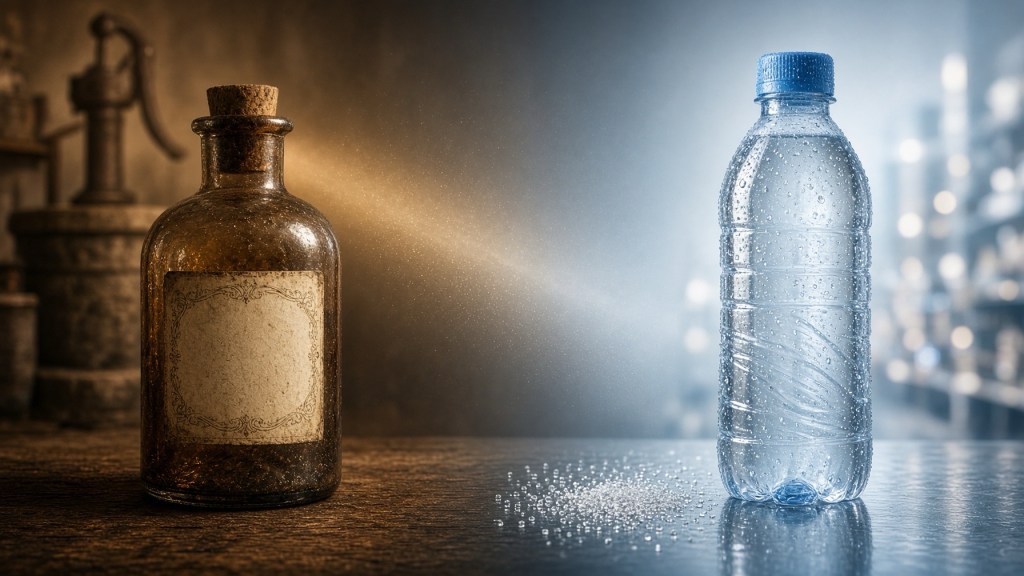
There is a genuine strangeness sitting at the center of the bottled water industry that’s easy to stop noticing once you’ve grown up inside it. It is, in the most literal sense, a business built on selling something that a huge share of its customers could get for functionally free by turning a handle a few feet away — and yet it has grown into an industry that market analysts now value somewhere between $130 billion and $450 billion a year worldwide, depending on which research firm’s methodology you trust, growing faster than almost any other category in the entire beverage industry, and more than a decade ago it quietly overtook soda as the single most-consumed packaged drink in the United States. Understanding how that happened requires tracing nearly 260 years of American history — medicine, public health engineering, French marketing genius, a DuPont chemist’s patent, two cola giants going to war over tap water, and, as it turns out, a genuine and fairly recent body of neuroscience research that finally explains, at the level of the actual human brain, why this entire industry was able to work in the first place.
Part One: Water as Medicine, Before It Was Water at All
Bottled water in America is considerably older than most people assume, and for nearly its first century and a half, nobody selling it was selling “water” in the sense we mean today. They were selling medicine.
The practice of transporting water in sealed containers stretches back to the Roman Empire, where mineral waters like Apollinaris were carried throughout the empire in clay vessels, and it persisted through medieval Europe’s tradition of pilgrims walking long distances to drink from holy wells believed to work miracles. That older religious and medicinal tradition became the cultural soil from which a distinctly commercial version grew once Europe’s spa culture, centered on famous mineral springs, crossed the Atlantic with colonial settlers. Jackson’s Spa in Boston is generally credited as the first commercial bottled water operation in what would become the United States, selling a quart of spring water for a copper coin starting in 1767 — the same year, coincidentally, that Joseph Priestley accidentally discovered how to carbonate water by suspending a bowl of it above a beer vat at a Leeds brewery, a discovery that would eventually give rise to the entire soft drink industry running parallel to bottled water’s own story.
America’s mineral springs quickly became fashionable destinations for the young country’s elite, and the Founding Fathers themselves were enthusiastic early customers. Thomas Jefferson, George Washington, and James Madison all took a serious interest in the health benefits attributed to mineral water, particularly at Saratoga Springs in upstate New York, which Washington visited in 1783 and wrote home about with real curiosity regarding the process of bottling its naturally effervescent water. What white settlers experienced as a new discovery, worth noting honestly, was land whose springs Indigenous peoples had already been using for generations before European colonization began. By the early 1800s, commercial bottling operations had spread: mineral water from a spring near Albany began being sold commercially around 1800, and Saratoga Springs itself started bottling its own water by around 1820, with sources differing slightly on the exact year — one detailed industry history puts the first Congress Spring bottling at 1822. Poland Spring, which would go on to become one of the most enduring names in the entire industry, traces its own founding to 1844 or 1845, when a Maine innkeeper, according to company lore recorded while he was on his deathbed, discovered what he believed were the remarkable therapeutic properties of water from a spring on his property; the inn grew into a full spa resort, and the family began selling the water commercially under the Poland Spring name. Mountain Valley Spring, still sold today, began bottling its Arkansas spring water in 1871. As glassmaking technology improved and production costs fell through the nineteenth century, the scale of this business grew dramatically — by the middle of the 1800s, Saratoga Springs alone was reportedly producing more than seven million bottles of water a year, an extraordinary figure for the era.
None of this success was really about thirst. It was about fear, and the fear was well justified. Nineteenth-century American cities had genuinely dangerous municipal water supplies, regularly contaminated with the pathogens behind cholera and typhoid fever, diseases that killed thousands of people in outbreaks throughout the 1830s and 1840s, particularly in dense urban centers like New York and Boston. Bottled mineral water, sourced from a spring rather than a city pipe, was marketed and genuinely perceived as a safer alternative — sold heavily through pharmacies as a health tonic rather than through anything resembling a modern grocery aisle. The category’s popularity was substantial enough that it attracted outright imitation almost immediately: in 1809, Joseph Hawkins received the first American patent for manufacturing “imitation” mineral water, artificially carbonating ordinary water to mimic the natural effervescence of a genuine spring, a business built entirely on faking the thing people already believed they needed.
Part Two: How Public Health Nearly Killed the Industry Before It Started
The single most consequential event in the entire history of American bottled water isn’t a marketing campaign or a product launch. It’s a decision made by a single water company engineer in Jersey City, New Jersey, in the late summer of 1908.
Dr. John L. Leal, working to address Jersey City’s alarming rates of typhoid fever and dysentery, proposed something his professional peers greeted with real hostility: deliberately adding chlorine to the city’s drinking water supply. There was, at the time, a genuine philosophical objection running through the water engineering profession — the conviction that “pure water” ought to be achieved by protecting the watershed at its source, not by chemically treating an already-polluted supply. Leal pushed forward anyway, under real legal pressure, since a court had given the Jersey City water company only ninety days to demonstrate it could purify its drinking water. On September 26, 1908, chlorinated water flowed into Jersey City homes, schools, and businesses for the first time on a permanent basis, and the results were immediate and dramatic — the local typhoid fever rate plummeted, and a 1928 sanitary engineering report found the resulting water quality compared favorably with the best water supplies anywhere in the country. There was an earlier, less-remembered test just weeks before, at Chicago’s Union Stockyards, where chlorinating a badly polluted creek used to water livestock unexpectedly produced water cleaner than the city’s own municipal supply — a strange, almost accidental proof of concept that arrived just before Jersey City’s more famous, deliberate demonstration.
Word traveled fast. Within a decade, chlorination had spread to nearly every large city in the country, and waterborne diseases that had killed thousands of Americans annually became, within a generation, genuinely rare. This was an unambiguous public health triumph — and it very nearly ended the American bottled water industry entirely. Once tap water stopped being a credible threat to your family’s life, the entire nineteenth-century commercial logic behind bottled mineral water evaporated. Bottled water in America collapsed from a booming public health necessity into a small, specialty trade, essentially disappearing from ordinary household life for most of the twentieth century’s early decades. Europe, notably, didn’t follow the identical trajectory — mineral water remained popular there, gradually spreading into cafes and grocery stores through the second half of the century in a way it simply didn’t in the newly chlorinated United States.
Part Three: The Jug in the Corner — Bottled Water’s Quiet Survival
What did survive America’s chlorination-driven collapse was a narrower, more specialized niche: the large water cooler jug, delivered directly to offices and, in certain regions, homes. This is the thread of the story that’s easiest to overlook, precisely because it never became a genuinely national household habit — it stayed concentrated in offices, and disproportionately in places, especially Southern California, where the local tap water simply tasted bad enough that people were willing to pay for an alternative even after chlorination had made that alternative unnecessary for safety reasons.
Sparkletts, founded in Los Angeles in 1925 by Burton N. Arnds Sr. along with partners Washburne and Bollinger, is one of the clearest examples of this surviving business model. Arnds, dissatisfied with the municipal water available to him, built a bottling plant near an artesian well in east Los Angeles and named the venture Sparkling Artesian Water Company, riding a natural underground water supply reliable enough that the plant needed no reservoir or holding tanks to keep operating. Arrowhead, whose heritage traces back even further, to 1894 and a naturally occurring rock formation resembling an arrowhead pointing toward a spring in the San Bernardino Mountains, built a similar regional delivery business. These companies, and others like them across the country, established the direct-delivery water cooler as a real, if modest, fixture of American office life for most of the twentieth century — heavy glass jugs, later replaced starting in the early 1970s by lighter, safer polycarbonate plastic bottles, hauled by dedicated delivery routes to businesses and a smaller number of residential customers who cared enough about their local water’s taste, or lacked enough trust in it, to pay a premium for an alternative.
This cooler-jug era matters for understanding the fuller history precisely because it’s so often conflated with what came later. It was a real, continuously operating business for the better part of a century, but it was never a mass consumer product in the way the plastic single-serve bottle would eventually become — by the mid-1970s, total American bottled water consumption, cooler jugs included, sat at roughly 350 million gallons a year, or about a gallon and a half per person, a figure that would look almost unimaginably small compared to what was coming.
Part Four: Perrier Teaches America to Pay for Water
If there’s a single moment where bottled water shifted from a niche institutional product into something resembling modern American consumer culture, it’s the mid-to-late 1970s arrival of Perrier, and the story behind that arrival involves a specific chain of individual salesmanship worth telling in some detail.
A New York grocer named Fred Sipper began buying and reselling pallets of imported Perrier and, as demand outgrew his original store, opened a dedicated wholesale distribution operation with the memorably domestic name Mootch and Muck — named, according to company lore, after his own parents’ pet nicknames for each other. Sipper brought on Bruce Nevins as the brand’s first U.S. chief executive and James Stevens as vice president of marketing, and the two of them, later also credited as the inventors of the Chipwich ice cream sandwich, built a genuinely sophisticated campaign aimed squarely at New York’s trendiest venues: Studio 54, Elaine’s, Régine’s, the exact kind of glamorous, image-conscious nightlife where a French import with a distinctive green bottle could plausibly become a status symbol rather than just a beverage. The campaign’s most famous piece of creative work was a series of television commercials voiced by Orson Welles, describing Perrier as “more quenching, more refreshing” and “naturally sparkling, from the center of the Earth,” paired with a deliberate strategy of sponsoring athletic events like the New York City Marathon specifically to link the product with fitness and health rather than indulgence. By 1978, Perrier was projecting sales of 75 million bottles for the year alone, and by the 1980s the brand had settled into its most enduring tagline: “Earth’s first soft drink,” a genuinely clever piece of positioning that reframed water itself as a category competing directly against Coke and Pepsi rather than something you drank only when you had nothing else. Perrier didn’t stay a single-product story for long, either — the company went on to acquire Poland Spring in 1980 and later Arrowhead and other regional American spring water brands, consolidating a scattered collection of century-old regional operations into something closer to a coordinated national business for the first time.
Evian followed a closely related playbook in the late 1970s and early 1980s, built around a similar pitch of European prestige and physical fitness rather than medicine or emergency safety, and by the decade’s end, bottled water had become genuinely fashionable in a way it hadn’t been since the nineteenth-century spa era — a status symbol carried by models and athletes, sold in gyms and upscale restaurants, but still very much a boutique product rather than something the average American household bought at the grocery store. One more event helped cement that lingering distrust of tap water into something more durable: in 1986, the Environmental Protection Agency released a report finding that tap water reaching roughly 36 million Americans contained elevated levels of lead. Cities scrambled to address the underlying infrastructure problems following congressional scrutiny, but the psychological damage lingered well past any actual fix, giving the bottled water industry a genuine, if narrower and more targeted, public health argument to lean on again for the first time since before chlorination.
Part Five: The Plastic Bottle That Changed Everything
None of what happened next — the transformation of bottled water from a boutique product into a genuine mass-market commodity sitting in every gas station cooler in America — would have been physically or economically possible without a specific 1973 patent filed by a DuPont mechanical engineer named Nathaniel Wyeth.
Wyeth, better known within his own family as “the other Wyeth” given that his father was the celebrated illustrator N.C. Wyeth and his brother was the painter Andrew Wyeth, spent years working on a genuinely difficult materials science problem: how to mold polyethylene terephthalate, a polyester resin that had existed since 1941 but had never been formed into a container strong enough to safely hold a pressurized, carbonated liquid, into a bottle. His solution, patented in 1973 as a biaxially oriented plastic bottle, solved that problem decisively, and the resulting PET bottle offered advantages over glass that were almost absurdly large by comparison — a PET bottle weighs roughly nine grams against a comparable glass bottle’s 200-plus grams, costs somewhere around a tenth as much to manufacture, and, unlike glass, survives being dropped without shattering into anything that needs to be cleaned up. Soda companies moved first, with Pepsi introducing PET packaging in 1977 and Coca-Cola following with its two-liter PET bottle in 1978, but the technology migrated into bottled water almost immediately afterward — a California company called Mountain Spring Water reportedly introduced the first commercial plastic water bottle in 1973, the very same year Wyeth’s patent was filed, and by the late 1980s the entire industry, including Perrier itself, had adopted single-serve PET packaging as the new standard. Water had, physically, become exactly as easy and cheap to package, ship, and sell as a can of soda — the single technological precondition that made everything about the next two decades possible.
Part Six: The Cola Wars Come for Water
Once the packaging technology existed to make bottled water a true commodity product rather than an imported luxury, it was only a matter of time before the two companies that already dominated American beverage distribution decided to compete directly, and the moment they did marks the true beginning of the mass market as we now understand it.
PepsiCo test-marketed Aquafina, purified municipal tap water run through a reverse osmosis filtration system rather than water sourced from a natural spring, starting in 1994, before rolling it out nationally. Coca-Cola followed with its own purified-water brand, Dasani, in 1999. The strategic logic behind both products was genuinely elegant: rather than needing to secure, transport, and protect a single, geographically fixed spring source the way Poland Spring or Arrowhead had to, Pepsi and Coke could simply take ordinary municipal tap water, wherever a given bottling plant happened to be located, and run it through the same reverse osmosis purification equipment they already used to produce soft drinks — allowing the creation of a strong, unified national brand that was, in practice, manufactured locally at dozens of different facilities using dozens of different underlying tap water sources. Both companies had something no spring-water competitor could match regardless of marketing budget: existing, deeply entrenched distribution relationships with every convenience store cooler, vending machine, and supermarket end-cap in the country, infrastructure built over decades of soda sales that could now be repointed at a completely different, and dramatically cheaper to produce, product.
The resulting growth curve, tracked through per-capita consumption data compiled by the USDA and Beverage Marketing Corporation, is genuinely one of the more striking adoption curves in modern consumer product history. Americans drank roughly 2.7 gallons of bottled water per person in 1980; that figure climbed to about 5.1 gallons by 1985, 8.8 gallons by 1990, 11.6 gallons by 1995, and 16.7 gallons by 2000, before accelerating still further to roughly 25.4 gallons per person by 2005 — an almost tenfold increase in per-capita consumption across a quarter century, with the single steepest jump occurring in exactly the years surrounding Aquafina’s and Dasani’s national launches. By the late 1990s, bottled water had genuinely arrived in every grocery aisle and gas station in the country, a total transformation from a product most Americans had never purchased a decade earlier. And the growth didn’t stop once bottled water became ordinary — between 1994 and 2017 alone, American bottled water sales grew by 284 percent according to Beverage Marketing Corporation data, and by 2016 or 2017, depending on which industry tracking source is cited, bottled water officially overtook carbonated soft drinks to become the single most consumed packaged beverage category in the United States by volume, a genuinely remarkable inversion of the entire twentieth-century American beverage hierarchy.
Part Seven: What the Neuroscience Actually Says — Why This Worked at All
Here is where this history intersects with something no purely economic or marketing-focused account of bottled water usually stops to examine carefully: a genuine, published body of neuroscience research explaining, at the level of measurable brain activity, why an industry built substantially on selling filtered tap water in a bottle was ever able to convince hundreds of millions of people it was buying something meaningfully different — even when, in study after study, it demonstrably wasn’t providing anything meaningfully different in the way people could actually taste.
The relevant research starts with a well-known behavioral economics finding from Baba Shiv, Ziv Carmon, and Dan Ariely, published in 2005 under a title that states its own conclusion plainly: “Placebo Effects of Marketing Actions: Consumers May Get What They Pay For.” Their work, and the substantial body of related research it opened up, established that price itself functions as a genuine informational cue capable of altering a person’s actual, subjectively experienced sensory pleasure — not merely their stated opinion of a product, but the felt experience of consuming it. A landmark follow-up study using functional MRI, led by researchers examining how price information affects the brain during a wine-tasting task, gave three identical wines to participants under three different price labels — 3 euros, 6 euros, and 18 euros — while the real-world price of all three samples was, without the participants’ knowledge, identical. The result, directly measured through brain scanning rather than self-report alone, found that the brain’s own valuation system, centered on the ventromedial prefrontal cortex and ventral striatum, along with the anterior prefrontal cortex, actively mediated the effect of the price label on how pleasant the identical wine was reported and neurally registered to taste — genuine, measurable brain activity shifting in response to a price tag alone, with no actual difference in what was physically entering anyone’s mouth. Perhaps the most striking detail in this entire line of research is what the study’s authors found when they looked for overlap between these price-driven brain regions and a completely different, well-established area of neuroscience research: the mechanism underlying placebo analgesia, the genuine, measurable pain relief a patient experiences after being given an inert treatment they believe is real medicine. The brain regions involved substantially overlapped. Price-driven taste enhancement and placebo-driven pain relief appear to run, at least in significant part, through the same underlying neural machinery — a real, physiological kinship between “this cost more, so it tastes better” and “I believe this pill will work, so it does.”
Applied specifically and directly to water, rather than wine, the pattern holds up with almost uncomfortable consistency. A study titled “Fine Water: A Blind Taste Test,” examining how novice tasters rated bottled water against ordinary tap water under blind conditions, found no meaningful positive association, and in some analyses a weak negative one, between a bottled water’s retail price and how highly it was actually rated once identifying labels were removed — some subjects, tasting blind, preferred the free tap water outright over every bottled competitor placed in front of them. A separate, directly relevant piece of research, published under the fitting title “Polarized but illusory beliefs about tap and bottled water,” combined consumer surveys with a genuine blind tasting experiment and found precisely the pattern its title promises: strong, confidently held, and often sharply divided beliefs about the superiority of one water source over the other, sitting on top of remarkably little actual ability to distinguish them once brand identity was removed from the equation.
None of this means bottled water’s success was somehow fraudulent or that the people buying it were foolish — quite the opposite, and this is the genuinely important, humane implication of the neuroscience. The pleasure people report from Perrier, or Fiji, or Smartwater, when they know what they’re drinking, is real pleasure, generated by real, measurable activity in the same brain systems that generate any other form of genuine sensory enjoyment. A blind taste test that fails to detect a difference doesn’t retroactively make that pleasure fake; it simply demonstrates that the pleasure was never primarily coming from the water’s chemical composition hitting the tongue in the first place. It was coming from the brand, the story, the bottle’s shape, the price paid, and the expectation all of that assembled before a single drop touched anyone’s mouth — a genuinely artificial ideas insight sitting quietly underneath the entire commercial history recounted above: Perrier’s green bottle and Orson Welles’s voice weren’t simply advertising a product. They were, in a scientifically literal sense, manufacturing a portion of the taste itself, inside the brain of everyone who believed the advertising.
Part Eight: The Reckoning
The same plastic bottle that made bottled water’s mass-market triumph physically possible has become, over the past two decades, the industry’s single largest and least resolved liability, and the scale of the resulting environmental and health picture is worth stating in specific, current terms rather than vague gesture. Current industry estimates put global production at roughly 600 billion plastic bottles a year, with recycling rates hovering around a mere 9 percent worldwide — meaning the overwhelming majority of everything the industry has ever produced has ended up as landfill waste, incinerated, or loose in the natural environment, where a standard PET bottle can take an estimated 450 years to fully decompose. Regulatory responses have accelerated meaningfully in recent years: more than 100 countries now maintain some form of restriction on single-use plastics, the European Union’s Single-Use Plastics Directive mandated that PET beverage bottles contain at least 25 percent recycled plastic content by 2025, and industry analysts now explicitly track the resulting shift toward “premiumization” strategies and alternative materials, including a genuinely fast-growing reusable stainless-steel bottle market, as companies adapt to regulatory pressure and a documented, measurable erosion of consumer trust — one recent industry survey found roughly 42 percent of consumers had already reduced their bottled water purchases specifically because of plastic waste concerns.
The most consequential and most recent scientific development, though, concerns what’s actually inside the bottle rather than what happens to it afterward. A January 2024 study published in the Proceedings of the National Academy of Sciences, conducted by researchers at Columbia and Rutgers, used a considerably more sensitive detection technique than any prior research had applied to the question and found an average of roughly 240,000 identifiable plastic particles per liter of bottled water — a figure 10 to 100 times higher than earlier nanoplastic estimates, though it’s important to be precise that this dramatic jump reflects a genuine improvement in measurement sensitivity rather than a sudden real-world increase in contamination levels. Separate industry tracking has also found PFAS, the so-called “forever chemicals” linked to a range of serious health concerns, detected in roughly 20 percent of tested U.S. bottled water brands. The scientific and regulatory conversation around what these findings actually mean for human health remains genuinely unsettled and actively developing — but their cumulative effect on the bottled water industry’s founding nineteenth-century promise, that a bottle offered a cleaner, safer, more trustworthy alternative to whatever came out of the tap, is a real and increasingly documented irony that the industry’s own market analysts are now openly grappling with in their growth forecasts.
Where This Leaves Things
Trace the full arc, and bottled water’s history turns out to be a story that keeps returning to the same underlying question, dressed in different historical costumes each time: is this water actually safer, or actually better, than the free alternative sitting a few feet away — and if the honest answer is often no, what exactly is being sold instead? In the nineteenth century, the answer to the safety half of that question was frequently yes, and cholera outbreaks made the case louder than any advertisement ever needed to. Chlorination made that same answer no for the better part of a century, and the industry nearly disappeared as a result. Perrier’s genius, and the entire mass-market industry built in its wake by Pepsi, Coke, and a hundred smaller competitors since, was discovering that the answer to the safety question no longer needed to matter nearly as much as it once did, as long as the answer to a different, quieter question — does this make me feel like I’m drinking something better — could be manufactured convincingly enough. The neuroscience confirms, in careful, peer-reviewed detail, that this manufactured feeling was never an illusion layered on top of a real experience; for a very long time, for a great many people, it substantially was the real experience, generated by the same brain machinery that turns a sugar pill into genuine pain relief. What the industry now faces, sixty years into its mass-market history and just beginning to reckon seriously with microplastics, PFAS, and its own enormous plastic footprint, is the possibility that the story is starting to run in reverse one more time — that the bottle itself, once the product’s greatest asset, may be quietly becoming the very safety concern the whole industry was originally built to sell people an escape from.
Sources:
1. HISTORY.com — “Bottled Water’s Surprisingly Long History” — https://www.history.com/articles/bottled-water
2. BCC Research Blog — “Birth of the Bottled Water Industry” — https://blog.bccresearch.com/birth-of-the-bottled-water-industry
3. HistoryOasis — “Timeline of Bottled Water” — https://www.historyoasis.com/tags/bottled-water
4. FineWaters.com — “Fine Bottled Water – USA” — https://finewaters.com/bottled-waters-of-the-world/usa
5. CustomWater.com — “History of Bottled Water: Who Invented It and When?” — https://customwater.com/blogs/water-info/bottled-water-history
6. Origin Trace — “The History of Bottled Water: From Spring Spas to a Global Beverage Industry” — https://origin-trace.com/article/history-of-bottled-water/
7. Wikipedia — “Saratoga Water” — https://en.wikipedia.org/wiki/Saratoga_Water
8. Water Expo China — “A Brief History of Bottled Water” — https://www.waterexpocn.com/en/IndustryNews/2020/01.14.html
9. Fancy Food & Beverages — “Bottled water History” — https://ffbassam.com/index.php/our-blog-posts/82-bottled-water-history
10. EBSCO Research Starters — “Chlorination of the U.S. Water Supply Begins” — https://www.ebsco.com/research-starters/history/chlorination-us-water-supply-begins
11. Washington State Department of Health — “Chlorination of Drinking Water” — https://doh.wa.gov/community-and-environment/drinking-water/disinfection/chlorination-drinking-water
12. Water Quality and Health Council — “A Public Health Giant Step: Chlorination of U.S. Drinking Water” — https://waterandhealth.org/safe-drinking-water/newsletter-may-2008/
13. ASDWA — “History of Chlorination” — https://www.asdwa.org/2018/09/26/history-of-chlorination/
14. World Chlorine Council — “Celebrating a Drinking Water Chlorination Public Health Anniversary” — https://worldchlorine.org/celebrating-a-drinking-water-chlorination-public-health-anniversary/
15. Wikipedia — “Sparkletts” — https://en.wikipedia.org/wiki/Sparkletts
16. ReadyRefresh — “Arrowhead Spring Water” — https://www.readyrefresh.com/en/products/arrowhead-spring-water-delivery/arrowhead-natural-spring-water-5-gallon-no-spill/p/1315
17. LinkedIn / Beverage Culture — “The History of the Beverage Industry (Part 4): How Bottled Water Changed the Industry” — https://www.linkedin.com/pulse/history-beverage-industry-part-4-how-bottled-water-changed-sipper
18. WYTV — “History of bottled water boom” — https://www.wytv.com/news/daybreak/history-of-bottled-water-boom/
19. HowStuffWorks — “Water Is Free. Why Do Americans Spend Billions on the Bottled Stuff?” — https://recipes.howstuffworks.com/why-americans-spend-billions-bottled-water.htm
20. Cascadia Managing Brands — “The History of the Beverage Industry (Part 1): How Bottled Water Changed the Industry” — https://cascadiafoodbev.com/the-history-of-the-beverage-industry-part-1-how-bottled-water-changed-the-industry/
21. Wikipedia — “Nathaniel Wyeth (inventor)” — https://en.wikipedia.org/wiki/Nathaniel_Wyeth_(inventor)
22. National Geographic — “How the plastic bottle went from miracle container to hated garbage” — https://www.nationalgeographic.com/environment/article/plastic-bottles
23. Wikipedia — “Two-liter bottle” — https://en.wikipedia.org/wiki/Two-liter_bottle
24. PATH Water — “A Return to Reuse, The Journey Through the History of Bottled Water” — https://drinkpathwater.com/blogs/news/a-return-to-reuse-the-journey-through-the-history-of-bottled-water
25. InventorSpot — “The Invention of Water Bottles” — https://inventorspot.com/water-bottles/
26. Straits Research — “Bottled Water Market Size, Share, Growth, Analysis, Report, 2034” — https://straitsresearch.com/report/bottled-water-market
27. Gitnux — “Bottled Water Industry Statistics: Market Data Report 2026” — https://gitnux.org/bottled-water-industry-statistics/
28. Mordor Intelligence — “Bottled Water Market Size & Growth, Segments Outlook 2031” — https://www.mordorintelligence.com/industry-reports/bottled-water-market
29. Market Data Forecast — “Bottled Water Market Size, Share, Trends and Analysis, 2034” — https://www.marketdataforecast.com/market-reports/bottled-water-market
30. Grand View Research — “Bottled Water Market Size, Growth Report, 2026-2033” — https://www.grandviewresearch.com/industry-analysis/bottled-water-market
31. Global Growth Insights — “Bottled Water Market Size Share & Trends 2026–2035” — https://www.globalgrowthinsights.com/market-reports/bottled-water-market-114911
32. Research Nester — “Bottled Water Packaging Market” — https://www.researchnester.com/reports/bottled-water-packaging-market/4502
33. CompaniesHistory.com — “Reusable Water Bottle Market Statistics 2026” — https://www.companieshistory.com/reusable-water-bottle-market-statistic
34. bioRxiv — “How context alters value: Price information recruits the brain’s valuation and affective regulation system for shaping experienced taste pleasantness” — https://www.biorxiv.org/content/10.1101/097915v1.full
35. PNAS — “Marketing actions can modulate neural representations of experienced pleasantness” (Plassmann, O’Doherty, Shiv, Rangel) — https://www.pnas.org/doi/10.1073/pnas.0706929105
36. PMC (National Institutes of Health) — “How context alters value: The brain’s valuation and affective regulation system link price cues to experienced taste pleasantness” — https://www.ncbi.nlm.nih.gov/pmc/articles/PMC5556089/
37. ResearchGate — Capehart, K.W. & Berg, E.C., “Fine Water: A Blind Taste Test” — https://www.researchgate.net/publication/324784813_Fine_Water_A_Blind_Taste_Test
38. ScienceBlogs — “The Essence of Pleasure” — https://scienceblogs.com/cortex/2010/06/14/the-essence-of-pleasure
39. ScienceDirect — “Polarized but illusory beliefs about tap and bottled water: A product- and consumer-oriented survey and blind tasting experiment” — https://www.sciencedirect.com/science/article/abs/pii/S0048969718322666
40. PMC (National Institutes of Health) — “A randomized, double-blind water taste test to evaluate the equivalence of taste between tap water and filtered water in the Taipei metropolis” — https://www.ncbi.nlm.nih.gov/pmc/articles/PMC7414208/
Historical notes and initial research by Grok. Researched, verified, and substantially expanded by Claude Sonnet 5. Published at artificialideas.org.

