
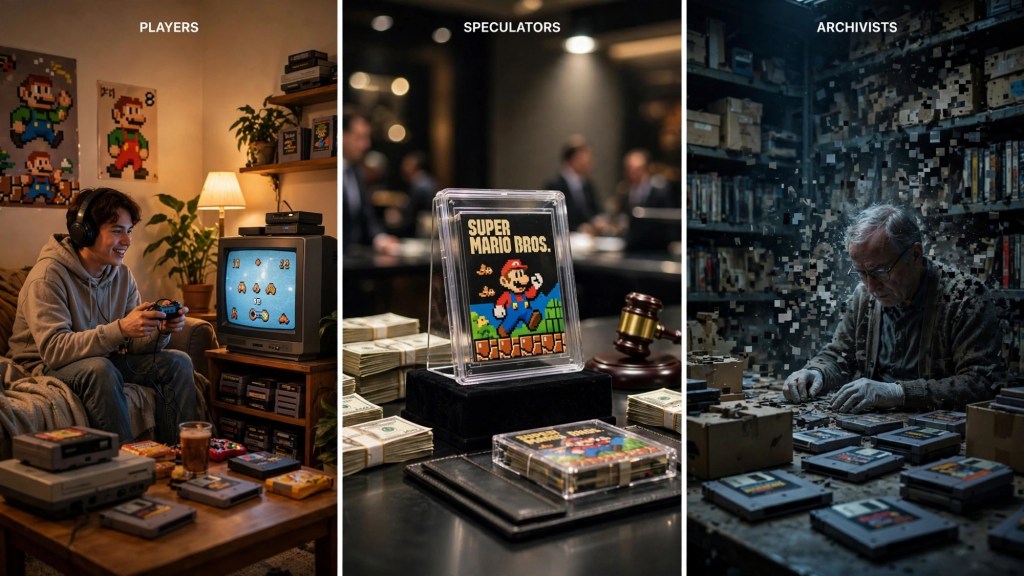
Somewhere in a climate-controlled storage unit, or a spare bedroom with the blinds permanently drawn, or a converted garage lined floor to ceiling with plastic shelving, sits a hobby that has quietly become one of the strangest corners of the collectibles world. Video game collecting started, like most hobbies, as an act of simple nostalgia — people wanting to hold onto the things that mattered to them as kids. It has since split into at least three distinct, sometimes openly hostile, subcultures: people who just want to play old games on real hardware, people who treat sealed cartridges as an emerging asset class worth millions of dollars, and a small, embattled community of archivists trying to keep the entire medium from disappearing before either of the other two groups notices it’s happening. Understanding video game collecting in 2026 means understanding all three of these communities at once, because they increasingly don’t agree on what the hobby is even for.
Where This Actually Started
The first video game, by most historical accounts, was “Tennis for Two,” built in 1958 by physicist William Higinbotham on an oscilloscope at Brookhaven National Laboratory as a visitor demonstration, not a commercial product. The first true home console arrived a decade later with the Magnavox Odyssey in 1968, and the medium didn’t reach mainstream cultural penetration until Atari’s Pong hit arcades in 1972. But the collecting hobby, as a distinct, self-aware community with its own infrastructure, didn’t really begin until nearly two decades after that.
The commonly cited origin point is 1991, when a New Jersey collector named Joe Santulli began publishing a newsletter called Digital Press — its first issue included a checklist of Atari 7800 games, a column of forgotten classics called “Closet Classics,” reviews, and a classifieds section for buying and selling. That same year, another collector, Sean Kelly, launched the first dedicated bulletin board system for classic game discussion, hosted on his own Amiga — for the first time, collectors scattered across the country had a shared electronic meeting place to compare notes on rarity, condition, and value. In 1999, Kelly and a collaborator, Joe Hardie, organized the first in-person gathering of this community: the Classic Gaming Expo in Las Vegas, which drew nearly a thousand collectors, vendors, and exhibitors in its inaugural year. Santulli joined the organizing team the following year. This was the hobby’s founding infrastructure — flea markets, garage sales, newsletters, a shared informal sense of which games were genuinely scarce and which were merely old, built by and for people who wanted to play the games they’d grown up with, or discover the ones they’d missed.
For most of the 2000s and into the 2010s, that’s largely what the hobby remained: a relatively low-stakes pursuit built around eBay auctions, regional swap meets, and a gradually developing collective understanding of rarity, driven by print run sizes, regional exclusivity, and pure survivorship — how many copies of a given game were still floating around decades after release. Prices climbed steadily as each console generation aged roughly fifteen to twenty years and acquired “retro” status among the adults who’d grown up with it, but the numbers involved were, by later standards, almost quaint. A complete, boxed copy of a beloved but common game might run into the hundreds of dollars. A handful of genuinely scarce titles, low print runs, late-console-life releases nobody bought at the time, commanded four figures among serious specialists. Nobody was buying a sealed video game as a hedge against inflation.
The Grading Era, and What It Did to Everything
That changed, decisively and quickly, starting around 2019 and accelerating hard through 2020 and 2021. The catalyst was the arrival of third-party grading services — companies explicitly modeled on the trading card and comic book grading industries, which encapsulate a collectible in a hard plastic case alongside a numerical condition score, theoretically removing subjectivity from buying and selling. Wata Games, founded in 2017 and grading games from early 2018 onward, became the dominant player, alongside a smaller rival, VGA. Once auction giant Heritage Auctions began prominently featuring Wata-graded games in its sales, the effect on prices was immediate and dramatic. A sealed copy of The Legend of Zelda sold for $870,000 in July 2021. Two days later, a Super Mario 64 cartridge became the first video game to break the million-dollar mark, selling for $1.56 million. A month after that, a sealed copy of the original Super Mario Bros. sold for $2 million, a 33 percent jump on a record that had stood for barely thirty days. Outside sports memorabilia and fine art, nothing in the collectibles world had moved this fast, and it pulled in exactly the kind of buyer the original 1990s Digital Press crowd had never anticipated: outside investors and speculators with no particular attachment to gaming history, chasing an asset class that seemed to only go up.
The Scandal That Followed the Boom
It did not take long for the retro gaming community’s own investigators to start asking uncomfortable questions about why prices were rising quite this fast. In the summer of 2021, journalist and YouTuber Karl Jobst published an extensively researched investigation alleging that Wata’s leadership had financial ties to Heritage Auctions that were never disclosed to the collectors sending in their games, and that the two companies’ interests were directly aligned in pushing valuations as high as possible: higher graded values meant higher grading fees for Wata and higher commissions for Heritage. Jobst also documented that a former Wata board member, Jeff Meyer, had resigned in early 2021 after being accused of selling a large personal collection of Wata-graded games for substantial sums — a direct conflict of interest, given the company’s own stated policy against employees selling graded games. Wata issued a categorical denial, calling the allegations “completely baseless and defamatory.”
The evidence kept accumulating anyway. Jobst’s follow-up reporting found that games with nearly identical Wata grades were selling for wildly divergent prices across different auction houses within months of each other — a Super Mario 64 copy that had brought $1.56 million at Heritage sold for just $800,000 at a rival auction house two months later, and a similarly graded copy from a competing grading service went for only $240,000 the following month. In May 2022, a class action lawsuit was filed in the Central District of California against Wata, accusing the company of “engaging in affirmative acts to manipulate the retro video game market,” making false statements about grading turnaround times, and colluding with an auction house to inflate values it then profited from through its own fee structure. The lawsuit’s estimated class of affected customers, everyone who had paid for Wata’s grading and encapsulation services during the relevant period, potentially numbered in the tens of thousands.
What’s genuinely notable, and a little strange, is what happened to the market after all of this became public. It didn’t collapse. It corrected, sharply, at points — but the underlying appetite for record-setting sales of the rarest, best-documented pieces never really went away, even while the lawsuit remained unresolved for years afterward.
The Market Today: Records Keep Falling, the Lawsuit Keeps Grinding On
That tension defines the collecting market in 2026 about as clearly as anything can. On June 12, 2026, at Heritage Auctions’ Video Games Signature Auction in Dallas, a sealed copy of Super Mario Bros., graded PSA 9.6 A++, sold for $3 million — smashing the previous $2 million record set five years earlier, and doing so while the Wata class action lawsuit from that same earlier controversy remained an active, unresolved legal cloud over the entire grading ecosystem. This specific copy carried real, well-documented rarity credentials: it came from the earliest confirmed sealed example of the game’s second production run, distinguished by a specific gloss sticker variant, discovered inside a still-sealed NES Control Deck bundle after sitting untouched for roughly forty years. No sealed copies from the game’s first production run are known to have survived at all. Heritage’s video game consignment director, Evan Masingill, framed the sale as fitting — “the most significant video game in the world” commanding “the most impressive result in the history of the hobby.” The buyer’s identity was not disclosed, though reporting on the sale noted the item was already being offered onward at $3.75 million with no negotiation — a detail that says a great deal about how differently the top tier of this market now behaves compared to the flea-market culture it grew out of. For context on just how much a single grading point can move a price: that same June 2026 Heritage sale window included a Wata 8.0-graded sealed Super Mario Bros., a meaningfully lower grade, that sold for just $26,108. In nine years, the all-time record price for a single video game climbed from roughly $30,000 to $3 million — a hundredfold increase, driven almost entirely by grading infrastructure, auction-house marketing, and a concentrated collector obsession with a small handful of iconic Nintendo titles, mostly involving Mario.
Japan: The Same Hobby, an Entirely Different Culture
Cross the Pacific and the collecting hobby looks recognizably related but culturally distinct in almost every important way. Japan has a genuinely deep well of retro gaming history to draw on — the Famicom and Super Famicom, Nintendo’s domestic versions of the NES and SNES, were released under different names, with different, often more colorful hardware designs, than their Western counterparts, which means Western collectors visiting Japan regularly encounter entire product lines they’d never seen before, a phenomenon video game historian Hiroyuki Maeda has described as directly stimulating “the collector’s soul.” Akihabara’s Super Potato, spread across three cramped floors of Game Boy cartridges, shrink-wrapped Dreamcasts, and functioning arcade cabinets, has become something close to a pilgrimage site for foreign collectors — by some retailer estimates, 70 to 80 percent of the shop’s customers are now foreign tourists rather than domestic Japanese buyers, a dynamic accelerated by a historically weak yen that made Japanese retro hardware unusually cheap for dollar- and euro-holding visitors throughout the mid-2020s.
But the domestic Japanese collecting culture underneath that tourist-facing storefront operates on genuinely different logic. Japan has no real equivalent of the Wata-and-Heritage grading-and-auction ecosystem that transformed the American market — there is, as of this writing, no major domestic institution treating sealed Famicom cartridges as speculative financial instruments the way American auction houses treat sealed NES games. Prices for common, mass-produced titles, a boxed Super Mario Bros., a complete Pokémon Game Boy cartridge, games that were manufactured by the millions, generally remain modest, because Japan’s collecting culture, shaped partly by smaller living spaces that discourage hoarding and a robust, long-established secondhand retail infrastructure (chains like Book Off and Surugaya have been reselling used media for decades), never developed the same instinct to treat ordinary abundance as scarcity. Where Japanese prices do get genuinely eye-watering is for titles that are legitimately, provably scarce — games like Gimmick! for the Famicom or Magical Chase for the PC Engine, which had small print runs to begin with and never sold in anything like Mario-scale volumes. That’s a meaningfully different pricing logic than the American market’s tendency, visible in the WATA-era boom, to occasionally treat even mass-produced blockbusters as scarce simply because a sealed, high-grade example happened to survive.
The Physical Objects Themselves Are Quietly Dying
Underneath all of the market drama sits a less glamorous but more consequential problem: the actual physical media collectors are fighting over is not stable, and much of it has a real, calculable expiration date. Cartridges and discs fail through entirely different mechanisms, and neither is fully avoidable through careful storage alone.
Cartridge-based games that include a battery-backed save feature — a huge share of SNES and Game Boy role-playing games, most famously — rely on small batteries to keep save data alive continuously, since the memory chips used were never truly powered off. When those batteries eventually die, typically after two to three decades depending on the specific chemistry, the save data is lost permanently unless someone physically opens the cartridge and replaces the battery, a repair increasingly common in dedicated restoration communities but one requiring real technical skill and desoldering equipment most casual owners don’t have. Beyond batteries, cartridges are vulnerable to corrosion on their contact pins, moisture intrusion leading to mold growth on internal circuit boards, and a well-documented failure mode where surface-mount electrolytic capacitors on the cartridge’s internal circuit board degrade over time, sometimes to the point of causing total functional failure — a problem repair technicians report seeing with increasing frequency across NES, SNES, and even later handheld cartridges like DS and 3DS cards as those systems themselves age into their second and third decades. Even the underlying storage technology has a rated shelf life: flash memory and EPROM chips, the kind used in cartridge-based storage, are generally rated for somewhere between ten and twenty years of reliable data retention, though mask ROM chips, which physically encode data into the chip’s structure at manufacture rather than storing it electrically, are considered effectively permanent by comparison.
Disc-based media has its own, unrelated failure mode, commonly called disc rot: a slow chemical breakdown of the reflective metallic layer and the protective lacquer coating sandwiched around it, which can eventually render a disc unreadable regardless of how carefully it was stored, though poor manufacturing quality control during specific production runs has historically made some discs far more susceptible than others. Neither problem has a universal fix. The honest, if unglamorous, guidance from digital preservation specialists is that physical media degrades considerably faster than most casual owners assume, and that a cartridge or disc stored under genuinely ideal conditions, stable temperature between 60 and 70 degrees Fahrenheit, controlled humidity, no direct sunlight, might last for decades longer than one left in a garage or attic — but “decades longer” is not the same as “forever,” a distinction the sealed-game market, built on the premise that pristine condition can be preserved indefinitely inside a plastic wrapper, has generally been reluctant to reckon with directly.
A Market This Valuable Attracts Counterfeiters
Where genuine scarcity meets genuine dollar value, fraud reliably follows, and video game collecting has developed a real, ongoing counterfeiting problem over the past decade. Reproduction cartridges — physically convincing fakes built to mimic an original’s shell, label, and internal circuit board — have become sophisticated enough that experienced collectors report needing to check multiple, non-obvious physical details before trusting a purchase: whether a small embossed batch-code stamp is present on the back label or shell (authentic Nintendo cartridges typically have one, pressed rather than printed; reproductions frequently omit it or print a fake version instead), whether the cartridge’s weight matches known authentic specifications to within a tenth of an ounce, whether the screws holding the shell together match original hardware, and whether serial numbers and regional formatting printed on the label are internally consistent. Counterfeiters, predictably, concentrate their efforts on the games worth the effort to fake — high-demand, high-value titles like Chrono Trigger, EarthBound, and especially anything in the Pokémon line, rather than wasting production costs replicating an ordinary sports title nobody’s paying a premium for. The problem has grown severe enough that dedicated authentication guides, cartridge-by-cartridge and system-by-system, have become a genuine subgenre of collector content, and professional grading services now serve, whatever their other controversies, a real secondary function of authenticating that a submitted item isn’t a fake in the first place.
The Fight Nobody’s Winning: Can Video Games Actually Be Preserved?
Running parallel to, and largely separate from, the market drama is a quieter, more consequential fight over whether video games as a medium will actually survive in any accessible form for future historians, researchers, and players. The numbers here are genuinely stark. A 2023 study by the nonprofit Video Game History Foundation examined 1,500 games released in the United States between 1960 and 2009 and found that only 13 percent remained commercially available through any official channel — a digital storefront re-release, a modern port, anything a person could legally obtain without hunting down decades-old physical media or turning to unauthorized emulation. The other 87 percent exist, if they exist accessibly at all, almost entirely outside legal commercial channels.
The organization has spent years trying to change that through the U.S. Copyright Office’s periodic DMCA exemption process, specifically requesting a narrow legal allowance for libraries and archives to provide remote, monitored access to out-of-print games for research purposes — not unrestricted public downloading, but something closer to how academic libraries already handle other historically significant but commercially unavailable media. The Entertainment Software Association, the games industry’s primary trade and lobbying group, has opposed this at every turn. In a 2024 hearing, ESA legal representative Steve Englund told the Copyright Office directly that there was “no combination of limitations” the ESA’s members would support for remote access under any circumstances, arguing preservation organizations hadn’t demonstrated sufficient safeguards around valuable intellectual property. The Copyright Office ultimately sided with the ESA that year, rejecting the exemption and, in a detail the Foundation’s director Frank Cifaldi later called almost darkly ironic, citing a 2016 conference talk by Cifaldi himself — originally delivered to argue that emulation shouldn’t be stigmatized as inherently tied to piracy — as evidence that emulation carries preservation risk, apparently missing his actual argument entirely. The Foundation’s public response was blunt: the industry’s absolutist position, they argued, does nothing to stop piracy that’s already happening outside legal channels, and instead simply denies legitimate researchers a lawful path to material that’s otherwise unavailable by any means.
The Crisis Is About to Get Considerably Worse
If the preservation fight already looked difficult in an era dominated by physical cartridges and discs, the industry’s accelerating shift away from physical media entirely threatens to make the underlying problem categorically harder, not just incrementally so. In mid-2026, Sony announced it would stop producing physical disc versions of PlayStation games entirely starting in January 2028, alongside closing the PlayStation 3 and PS Vita digital storefronts — meaning games in both formats will, within a few years, exist for most people only insofar as someone thought to make an unauthorized backup before the servers went dark. Cifaldi’s response to the announcement laid out the deeper structural problem plainly: the vast majority of games released over the past two decades were never built for a single, self-contained piece of hardware to begin with, and even physical disc releases have, for years, typically required a mandatory day-one digital patch to be playable in their intended, complete form — meaning that even a disc, physically preserved perfectly forever, may not actually represent the game as it was ever really played, since a meaningful portion of the actual code and content only ever existed on a server that can be switched off without warning. Games reliant on always-online servers for multiplayer or core functionality face an even starker version of the same problem: once the server goes dark, no amount of careful physical preservation of a disc or cartridge brings the game back to functional life.
What the Hobby Looks Like Going Forward
Taken together, these threads point toward a hobby that’s less a single coherent community than three overlapping and increasingly distinct pursuits sharing the same shelf space. There’s the collector chasing playable, functional childhood favorites, increasingly reliant on a growing cottage industry of cartridge and console repair specialists just to keep decades-old hardware operational as batteries die and capacitors fail on a predictable schedule. There’s the high-end speculative market, now regularly setting seven-figure records for the rarest sealed Nintendo titles even as the grading and auction infrastructure underpinning those sales remains under unresolved legal challenge for the very practices that helped inflate the market in the first place. And there’s a small, chronically under-resourced preservation movement fighting a legal and technical battle against an industry trade group that has shown no willingness to compromise, racing against a transition to digital-only, server-dependent games that will make the current preservation crisis look, in retrospect, like the easy version of the problem.
None of these three communities is going away, and none of them is likely to fully reconcile with the other two anytime soon. The market will probably keep setting records for the rarest sealed Nintendo cartridges, because scarcity, mythology, and a compelling backstory reliably move money regardless of what a class-action lawsuit alleges about how that scarcity got priced. The preservation fight will probably keep losing ground at the Copyright Office, because the ESA’s institutional incentives point firmly toward control rather than access, and nothing about that has changed in years of advocacy. And somewhere in between, quietly, without much fanfare, a genuinely enormous share of the medium’s actual history — the 87 percent of pre-2010 games with no legal way to access them, plus every digital-only release still to come — will keep slipping further out of reach, one dead battery and one shuttered storefront at a time, whether or not anyone paid three million dollars for the one still sitting sealed in its box.
Sources:
1. Medium (Collins Joseph) — “The History and Evolution of Video Games” — https://medium.com/@collins.joseph/the-history-and-evolution-of-video-games-323f7d689615
2. Wikipedia — “History of video games” — https://en.wikipedia.org/wiki/History_of_video_games
3. PriceCharting Blog — “The History of Video Game Collecting” — https://blog.pricecharting.com/2012/02/history-of-video-game-collecting.html
4. Wikipedia — “Video game collecting” — https://en.wikipedia.org/wiki/Video_game_collecting
5. Ultimate Pop Culture Wiki (Fandom) — “Video game collecting” — https://ultimatepopculture.fandom.com/wiki/Video_game_collecting
6. Nintendo Life — “Lawsuit Brought Against Game Grading Firm, WATA, Alleging Market Manipulation” — https://www.nintendolife.com/news/2022/05/lawsuit-brought-against-game-grading-firm-wata-alleging-market-manipulation
7. GGRecon — “Video Game Grading Company Accused Of Fraud” — https://www.ggrecon.com/articles/gaming-auction-site-denies-fraud-over-record-breaking-sales/
8. Video Games Chronicle — “Grading firm Wata is facing a lawsuit for allegedly ‘manipulating the retro game market’” — https://www.videogameschronicle.com/news/grading-firm-wata-is-facing-a-lawsuit-for-allegedly-manipulating-the-retro-game-market/
9. Kotaku — “Skyrocketing Retro Game Price ‘Manipulation’ Controversy Goes To Court” — https://kotaku.com/wata-games-lawsuit-classic-nintendo-retro-collecting-sc-1848923457
10. Nintendo Life — “Co-Founder Of Game Grading Service WATA Accused Of Selling Company’s Games On eBay” — https://www.nintendolife.com/news/2021/09/co-founder_of_game_grading_service_wata_accused_of_selling_companys_games_on_ebay
11. Time Extension — “‘Not Touched For Nearly 40 Years’ – Rare Copy Of Super Mario Bros. Sells For $3 Million” — https://www.timeextension.com/news/2026/06/not-touched-for-nearly-40-years-rare-copy-of-super-mario-bros-sells-for-usd3-million
12. GamerMarkt — “Super Mario Bros. Sells For $3 Million | Record Game Sale” — https://www.gamermarkt.com/blog/super-mario-bros-3-million-record-sale-heritage-auctions/
13. Player.One — “Sealed ‘Super Mario Bros.’ Copy Sells for $3 Million, Sets New Record For Most Expensive Video Game Ever” — https://www.player.one/sealed-super-mario-bros-copy-sells-3-million-sets-new-record-most-expensive-video-game-ever-163350
14. Malay Mail — “‘Super Mario’ cartridge sold for video game record US$1.5m” — https://www.malaymail.com/news/tech-gadgets/2021/07/12/super-mario-cartridge-sold-for-video-game-record-us1.5m/1989114
15. The Daily Star — “Japan is next level for retro game collectors” — https://www.thedailystar.net/tech-startup/news/japan-next-level-retro-game-collectors-3694031
16. T3 — “Made in Japan: the TRUTH about the retro gaming and technology market in Japan” — https://www.t3.com/features/made-in-japan-the-truth-about-the-retro-gaming-and-technology-market-in-japan
17. Time Extension — “The Truth About Retro Game Hunting In A Post-Pandemic Japan” — https://www.timeextension.com/features/best-of-2024-the-truth-about-retro-game-hunting-in-a-post-pandemic-japan
18. Video Game History Foundation — “Statement on the DMCA 2024 triennial review ruling” — https://gamehistory.org/dmca-2024-statement/
19. Time Extension — “The Video Game History Foundation Wants ‘Meaningful Solutions’ From The ESA For ‘Preserving Digital-Only Content’” — https://www.timeextension.com/news/2026/07/the-video-game-history-foundation-wants-meaningful-solutions-from-the-esa-for-preserving-digital-only-content
20. Techdirt — “ESA Once Again Comes Out Against Video Game Preservation Efforts” — https://www.techdirt.com/2024/04/30/esa-once-again-comes-out-against-video-game-preservation-efforts/
21. Video Games Chronicle — “Video Game History Foundation calls on the ESA to find a way to ‘legally preserve’ digital-only games for research” — https://www.videogameschronicle.com/news/video-game-history-foundation-calls-on-the-esa-to-find-a-way-to-legally-preserve-digital-only-games-for-research/
22. Game Developer — “U.S. Copyright Office rejects DMCA exemption to support game preservation” — https://www.gamedeveloper.com/business/u-s-copyright-office-rejects-dmca-exemption-to-support-game-preservation
23. Grokipedia — “Video game preservation” — https://grokipedia.com/page/Video_game_preservation
24. Alibaba Product Insights — “How To Safely Store Vintage Video Games To Prevent Disc Rot And Cartridge Damage” — https://www.alibaba.com/product-insights/how-to-safely-store-vintage-video-games-to-prevent-disc-rot-and-cartridge-damage.html
25. Nintendo Life — “PSA: Yes, Your DS And 3DS Cartridges Will Eventually Deteriorate, But Don’t Panic” — https://www.nintendolife.com/news/2021/05/psa_yes_your_ds_and_3ds_cartridges_will_eventually_deteriorate_but_dont_panic
26. Hackaday — “Game Cartridges And The Technology To Make Data Last Forever” — https://hackaday.com/2020/12/03/game-cartridges-and-the-technology-to-make-data-last-forever/
27. Time Extension — “Your Beloved Games Console Is Slowly But Surely Dying” — https://www.timeextension.com/features/your-beloved-games-console-is-slowly-but-surely-dying
28. Wikipedia — “Disc rot” — https://en.wikipedia.org/wiki/Disc_rot
29. PowerUp Gaming — “How to Spot Fake Retro Games Before You Buy” — https://www.powerupgaming.ca/blogs/retro-gaming-guides/how-to-spot-fake-retro-games
30. Retro Regen — “How to Spot Reproduction Video Game Cartridges” — https://retroregen.com/authentic-vs-reproduction-game-cartridges/
31. Retro Gaming Junkie — “How to Spot Fake Retro Game Cartridges” — https://retrogamingjunkie.com/how-to-spot-fake-retro-game-cartridges/
Researched and written by Claude Sonnet 5. Published at artificialideas.org.

