
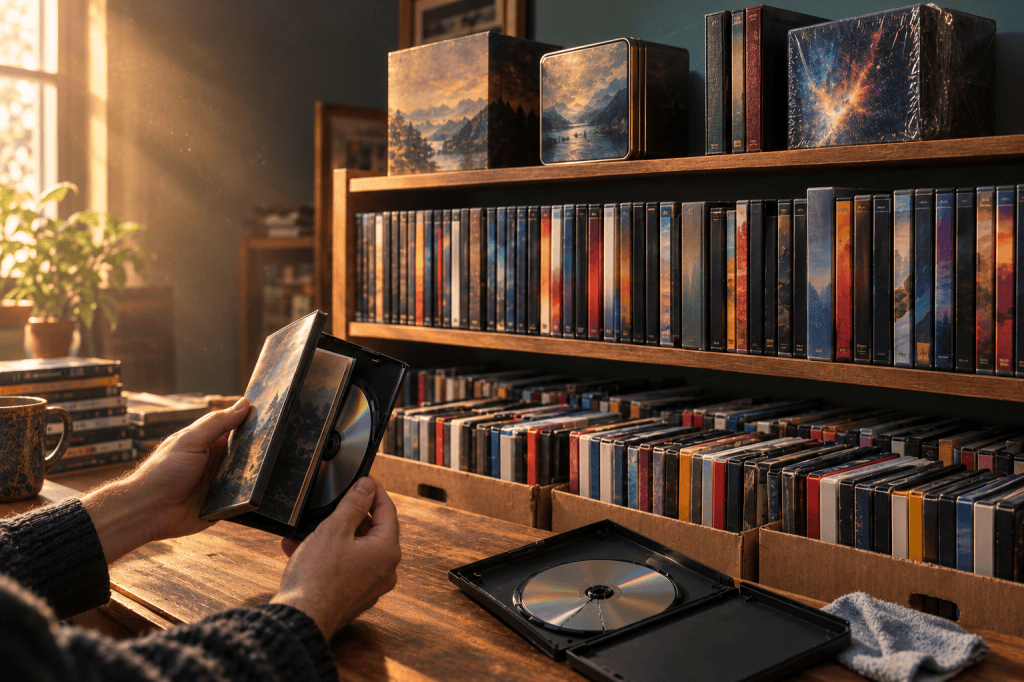
A DVD collector’s Tuesday in 2026 might look like this: check the week’s new releases, scroll Gruv for a $9 catalog set, hit a Savers on color-tag day, check eBay sold listings before paying $18 for something that last moved for $6, and decide whether a 2003 widescreen special edition is “the one” because the Blu-ray dropped the isolated score. None of that reads like a format in its death throes. It reads like a format that has settled into something stranger and more durable: not a mass-market business anymore, but a working archive that a specific, overlapping set of people still depend on.
The numbers, honestly
Physical video — DVD, Blu-ray, and 4K UHD combined — was a $870 million U.S. business in 2025, down 9.3% from 2024. That is a real decline, but it’s the smallest one in years. Physical sales fell more than 20% in both 2023 and 2024; 9.3% is, relatively, a plateau. 4K UHD spending actually rose about 12% over the same period, and the Digital Entertainment Group’s own reporting frames the DVD’s trajectory as flattening rather than collapsing — the kind of pattern that shows up when a format finishes shedding its casual buyers and stabilizes around the people who actually want it.
That stabilization has a visible retail face. Barnes & Noble — one of the last major chains still treating physical media as a real department rather than an end-cap — reported “mid-double-digit” growth in DVD and Blu-ray sales over the past year, and Criterion’s president has publicly credited younger buyers for a measurable sales increase. Vidiots, a video rental store in Los Angeles, hit its busiest month ever in January 2026, averaging 170 rentals a day after loaning out roughly 50,000 discs total in all of 2024. None of this adds up to a revival on the scale of vinyl. It adds up to a niche finding its floor.
New, sealed, and why shrinkwrap doesn’t mean much
Studios haven’t stopped pressing DVD — they’ve just stopped treating it as the format that matters. New DVD output today skews toward family and kids titles, mid-budget theatrical films, TV season sets, and “Collector’s Edition” SKUs that are mostly a nicer keep-case and a digital code, typically running $15–$25 at Amazon or Walmart, the two retailers that still anchor new-disc sales at scale.
Sealed-as-investment is a weak strategy for almost all of this. A factory-sealed copy of a mainstream 2000s Special Edition — the kind that sold in the millions — still trades for single digits to low teens, because shrinkwrap doesn’t create scarcity when the print run was enormous. Sealed matters when the edition itself is scarce: early Criterion spine numbers, limited tin sets, complete anime boxes that lost their U.S. license and will never be reprinted. Criterion’s continued DVD output alongside its Blu-ray and 4K lines isn’t nostalgia packaging, either — it’s the accessibility tier for people who own a DVD player and nothing higher-end.
The tribes
The people still buying discs aren’t one market. They’re several, and they only partly overlap:
• Ownership people — buyers, increasingly Gen Z, who treat a physical copy as the one version a platform can’t quietly delete. They don’t always care about resolution; they care that the film is theirs.
• TV-on-DVD people — one of the healthiest corners of the market. A complete series that vanished from a streaming library, or never made it to Blu-ray at all, regularly outsells a current theatrical DVD.
• Catalog and “never upgraded” people — collectors treating DVD-only titles as the last official edition of a film that rights complications will likely keep off Blu-ray or 4K permanently.
• Horror, cult, and anime people — loyal, price-insensitive relative to mainstream titles, chasing out-of-print ADV and Geneon anime sets and early horror special editions where extras or cuts differ from later reissues.
• Thrift hunters — the largest group by headcount, working the $1–$3 bins at Goodwill, Savers, and library sales, where the hunt itself is most of the point.
• Completists and format hoarders — people who keep the DVD after buying the upgrade because it has different commentary, a different cut, or just because they already owned it.
• Resellers — not collectors in the romantic sense, but a real market force: they skim thrift stores for the $15+ titles and dump the rest, and chains like Goodwill have gotten better at pulling obvious high-value stock for their own online shops, which has made in-store hunting measurably harder over the last five years.
The used market is the real economy
New DVD retail is a shrinking sideshow. The used market — eBay, thrift, library sales, Facebook Marketplace lots — is where most actual collecting activity happens, and it’s a market with a very specific shape: most discs are worth almost nothing, and a minority carry real value. Complete TV series with weak streaming presence, out-of-print editions, boutique early DVD runs, horror and anime, and correct-edition or region-specific versions are what clears above junk price. Everything else — the wall of identical mid-2000s comedies, last week’s rom-com — settles at $1–$3, which is exactly the price point that keeps thrift hunting viable as a hobby rather than a business.
Condition standards among serious buyers are practical, not aspirational: a disc that plays, original artwork rather than a printed substitute, booklets and inserts present, no names written on the case. Sealed copies of common titles carry only a small premium over open ones. Sealed copies of scarce editions are a different market entirely — the Criterion “Essential Art House: 50 Years of Janus Films” 50-disc box, a 2006 out-of-print set bundling fifty films with a hardcover book, still moves for real money among collectors specifically because Criterion never kept it in print.
Why DVD, when better formats exist
Nobody collecting DVD in 2026 thinks it looks better than 4K. The reasons people still buy it are almost entirely practical: price and volume (a few hundred titles for the cost of one boutique 4K box), catalog coverage that Blu-ray and 4K never matched title-for-title, early-2000s special editions stuffed with commentary tracks and featurettes that later HD reissues sometimes dropped, and cut/version differences — theatrical vs. unrated, widescreen vs. fullscreen — that in some cases only exist on DVD. And there’s a durability argument that has nothing to do with the format’s fans: almost anything still plays DVD, from a $20 USB drive to an old laptop, while 4K UHD requires a compliant player and often a compliant TV/AVR chain behind it.
What’s underexamined: preservation, and the grading market that doesn’t exist yet
Two things about this hobby haven’t caught up with how seriously some of its participants are starting to take it.
The first is preservation. DVD collectors have historically worried less about physical decay than VHS collectors worried about sticky-shed syndrome, and for a while that made sense — the format is newer. But the earliest DVD pressings are now old enough, at 25-plus years, that hub cracking, edge damage, and delamination between the disc’s polycarbonate layers are documented, recurring failure modes, not edge cases. As recently as August 2026, optical-disc collectors began reporting a distinct new problem on social media: CDs and DVDs cracking or shattering after exposure to certain cleaning chemicals or off-gassing storage foam — a failure mode nobody had catalogued before this year. The University of Illinois’s own Preservation Self-Assessment Program guidance for optical media — vertical storage, away from heat and direct light, handled by the hub and edge rather than the data surface — was written for archivists, but it’s exactly the practice a serious DVD collector now needs, whether or not they think of themselves as one.
The second is grading. Sealed VHS and imported games have real third-party grading markets (WATA, CGC) because enough individual items are worth hundreds or thousands of dollars to justify the fee. DVD doesn’t have that, and probably won’t get it — the economics don’t work when 95%+ of the market caps out around $3. But the vocabulary is already showing up informally: eBay listings for the handful of titles that do carry real value increasingly specify “factory sealed” or “original shrink intact,” borrowing grading-market language without any of its infrastructure. That’s collector behavior arriving ahead of the market built to support it — worth watching as more DVD-only titles age permanently out of print.
Why it matters
DVD’s story in 2026 isn’t really about DVD. It’s a live case study in what happens to a mass-market physical format after the mass market leaves: it doesn’t vanish, it stratifies. A small number of titles become genuinely scarce cultural artifacts — the last complete, uncut, or only edition of something rights holders will never bother reprinting — while the overwhelming majority becomes functionally free, filling thrift-store shelves as a kind of ambient cultural sediment. That’s the same shape vinyl took after CDs, and the same shape physical books have taken against e-readers: not survival through resistance to newer technology, but survival through settling into the specific jobs — permanence, completism, access to things the winning format left behind — that the newer technology structurally can’t do.
The human dimension
What holds this hobby together isn’t nostalgia in the simple sense — it’s closer to distrust, earned distrust, of a media landscape where ownership was quietly redefined as a rental you don’t control. Every tribe in this piece, from the Gen Z buyer “putting a claim down on a piece of culture” to the thrift hunter working a $2.99 bin, is responding to the same underlying fact: a streaming license can disappear on a licensing renegotiation nobody told you about, and a disc on a shelf cannot. That’s not really a story about picture quality. It’s a story about who gets to decide whether you still have the thing you thought you owned.
Sources
1. Luminate — Is DVD the New Vinyl? The Silver Lining to Spiraling Disc Spend
3. Film Threat — The Resurgence of 4K UHD, Blu-ray, and DVD in 2026
4. Media Play News — Retail Rebirth: The Disc Is Not Dead
5. University of Illinois PSAP — Optical Media storage guidance
6. Engadget — Your CD and Blu-Ray Collection Won’t Last Forever
7. Notebookcheck — CD collections face a strange epidemic
8. Criterion Collection — Essential Art House: 50 Years of Janus Films
Idea generated by Grok. Article expanded with Grok, substantially rewritten with Claude Sonnet 5. Published at artificialideas.org.

