
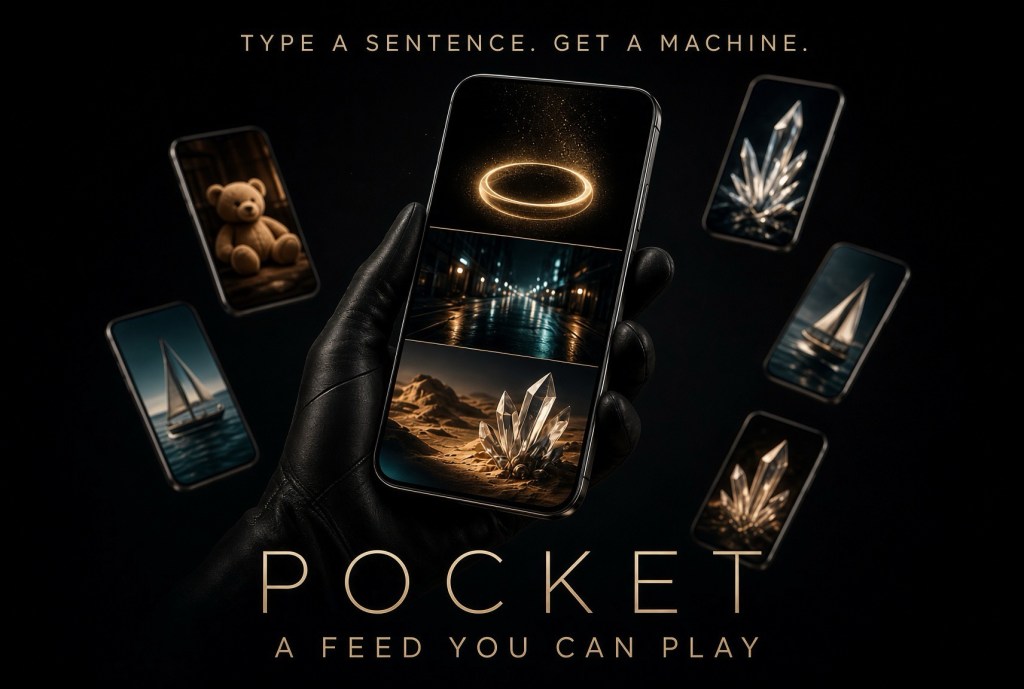
On August 20, 2026, Meta rolled out an app called Pocket to every phone in the United States. Type a sentence, wait a couple of minutes, and you have something you can tap, tilt, and post — not a photo, not a fifteen-second clip, but what Meta calls a “gizmo”: a small, AI-generated interactive program. The feed looks like TikTok. The unit of content is not a clip anymore. It’s a little piece of software with state, logic, and a save file. That’s the entire pitch, and it’s also the whole problem, because Meta has tried a version of this idea at least three times before, and every previous version eventually got shut down.
What Pocket Actually Is
Pocket is not a resurrection of Mozilla’s old read-it-later app — the name is a coincidence, or possibly a small joke. It’s the shipped, commercial descendant of Gizmo, a prompt-to-play app built by a startup called Atma Sciences, founded by engineers who had previously worked at Snap. Meta announced an acqui-hire of the Atma Sciences team in early 2026, bringing the engineers into Meta Superintelligence Labs while taking a non-exclusive license to the underlying technology. Pocket first appeared quietly on app stores on June 29, 2026, restricted to Brazil as a test market. On August 20, Meta lifted that restriction and rolled the app out nationwide in the U.S. The timing wasn’t subtle: the original Gizmo app shut down the same week the wider rollout landed, and its co-founder, Josh Siegel, posted a farewell on X calling it “bittersweet to shut down Gizmo, a labor of love by so many people for the last couple years,” while saying he was “excited for Pocket and what’s next.” According to Appfigures data cited by TechCrunch, Gizmo had accumulated roughly 635,000 lifetime installs with 98 percent positive sentiment before it closed — a real, if modest, base of goodwill that Meta effectively acquired along with the team.
The loop itself is almost insultingly simple. Describe what you want. Wait while the model assembles an interface, logic, sound, and motion. Nudge it with another sentence and watch it rebuild. Publish to a scrollable feed, where other users can like, comment, repost, or remix, depending on what the creator allows. Gizmos can respond to touch, swipe, drag, and phone tilt; they can request the camera, the microphone, photos from a camera roll, and can incorporate sound effects and song clips. Meta’s own marketing copy claims some gizmos can “reason about the world around them” — in practice, this means the model can bind a text prompt to whatever sensors the phone already has.
What Pocket conspicuously lacks is almost as informative as what it has. There are no direct messages. There’s no public monetization program for creators. There’s no official way to export a finished gizmo as a standalone app that lives outside Meta’s servers — a share link can open in a browser, but anything relying on tilt or multitouch simply breaks on a laptop. Meta’s own help documentation is blunt about the data trade involved, stating plainly that a user’s “interactions with gizmos on Pocket will be used to improve AI at Meta.” Pocket sits alongside Meta’s other 2026 experiments — Vibes for AI video, Forum, Instants — as pieces of a broader strategy Mark Zuckerberg has described in earnings calls as being accelerated by AI-assisted app development. If 2024 was the year of AI images and 2025 the year of AI video inside Meta’s product family, 2026 is shaping up to be the year of AI interaction.
Meta Has Run This Experiment Before — Repeatedly
The framing of Pocket as some unprecedented leap — the feed learning to play — undersells how many times Meta and its predecessor, Facebook, have already tried to fuse games with the social feed, and how consistently those experiments have ended in shutdown notices.
The clearest precedent is FarmVille. Launched by Zynga in 2009, it became the most popular game on Facebook by daily active users between August 2009 and December 2010, peaking at 83.76 million monthly active users and 34.5 million daily active users in March 2010. FarmVille and its “Ville” siblings — CityVille, CastleVille, Mafia Wars — turned Facebook’s News Feed into a genuine games platform for a period, complete with viral mechanics, gifting, and the beginnings of what would later be called free-to-play monetization. It also generated real friction: Facebook renegotiated and eventually ended its special platform agreement with Zynga in 2012, and the games themselves were gradually retired through the 2010s as engagement declined and Facebook tightened its notification and platform policies. The original FarmVille shut down completely on December 31, 2020, killed off in large part because Adobe was discontinuing Flash Player and Facebook was pulling support for Flash-based games entirely. A mobile-only FarmVille 3 followed in 2021.
The second precedent is Instant Games, a more direct architectural ancestor of Pocket than FarmVille ever was, because it embedded lightweight, playable games directly inside the feed and inside Messenger conversations rather than routing users to a separate app. Instant Games launched in 2016 and took off specifically because of its social mechanic — friends could jump into a quick match of something like Pac-Man or Space Invaders from inside a chat thread. By 2019, Facebook was pulling Instant Games out of Messenger on iOS entirely, migrating the format into a new Gaming tab inside the main Facebook app in the name of keeping Messenger “faster, lighter, simpler.” A standalone Facebook Gaming app, launched in April 2020 to compete with Twitch during the pandemic, was itself shut down on October 28, 2022, barely two and a half years after launch, with Meta folding whatever remained of the effort back into the core Facebook app.
The pattern across all three precedents is consistent: Meta and Zynga built real, substantial user bases for games-in-the-feed, generated real cultural moments, and then dismantled the infrastructure within a small number of years, usually citing platform performance, technical debt, or a changing corporate priority rather than a lack of user interest. Pocket is Meta’s fourth attempt at roughly the same underlying bet — that the feed itself can be the games platform — and the first to make generative AI, rather than professional game studios, the source of the content. Whether that changes the ending is the open question the rest of this piece is really about.
Why This Round Is Different
What makes 2026’s version of the bet structurally new isn’t the feed mechanic — it’s the removal of production cost. Social networks spent roughly fifteen years training people to publish finished surfaces: a photo, a caption, fifteen seconds of motion. Games were always the opposite of that. A game is a system with state; it breaks; it needs a store listing, a build pipeline, and someone who can read a crash log. Vibe coding — using natural language prompts to generate working software — had already started collapsing that distance for prototypes well before Pocket existed. What Pocket adds is collapsing the distribution distance too. There’s no App Store submission, no Unity seat license, no need to learn Godot. You post, the way you’d post anything else.
Pocket is not remotely alone in racing toward this model. Astrocade, co-founded by Amir and Ali Sadeghian with Stanford AI researcher Fei-Fei Li serving as Chief Scientist, has built a prompt-to-casual-game platform that automates art, animation, music, and gameplay mechanics from a natural-language description. The company raised $56 million across Series A and Series B rounds in May 2026, led by Sea Limited and Sequoia Capital with participation from Google’s AI Futures Fund and Nvidia, on the strength of genuinely startling growth: over 20 million engaged users and roughly 5 million monthly active users within eight months of public launch, generating around 140 million game plays a month across more than 75,000 creator-built games from 80 countries. Astrocade has also done something Pocket has not: it committed $10 million to a creator fund, unlocking monetization for creators whose games reach 100,000 significant plays within a 30-day window. Rosebud AI takes a different technical approach, generating playable 2D games on the open-source Phaser framework that creators can take off-platform, with export paths to Steam via Windows builds on paid tiers — a direct contrast to Pocket’s server-locked gizmos. And Roblox, rather than building a separate prompt-to-play app, has been embedding generative AI directly into its existing platform through Cube 3D, a mesh-generation model that had produced more than 1.8 million game assets since its March 2025 launch, with a 4D creation mode — generating not just static meshes but interactive, animated systems — reaching public beta in February 2026.
The industry these platforms are racing into is itself visibly splitting in two, and the data on that split is sharper than the loose “AI is changing games” narrative usually suggests. A comprehensive census of roughly 53,600 Steam releases between mid-2023 and mid-2026, conducted by developer Sulka Haro and corroborated independently by outlets including PC Gamer, found that games disclosing generative AI content grew from 10.9 percent of releases in 2024, to 19.9 percent in 2025, to 30.8 percent in the first half of 2026 — meaning 60 to 90 percent of the recent growth in monthly Steam releases is coming from AI-flagged titles, not traditional development. But that growth is a volume story, not yet a quality one: AI-flagged games account for roughly a third of new releases but only somewhere between 10 and 27 percent of estimated sales in the same period, and controlling for time-on-market, an AI-flagged game reaches even a modest success tier — around 100 reviews, roughly 3,000 sales — at only about 55 percent the rate of a non-AI game, a ratio that hasn’t improved in two years. The data suggests a meaningful split in how AI gets used: among AI-flagged games that failed to find an audience, 72 percent used AI specifically for visuals, the most visible and most resented application; among the more successful AI-flagged games, usage skewed toward voice work, localization, and text — places players don’t stare directly at the seams.
What Developers Actually Think
It’s worth correcting a figure that’s been softened in some coverage of this moment. Sentiment inside the professional game industry toward generative AI hasn’t settled at “roughly a third negative” — it has moved sharply past that. The GDC Festival of Gaming’s 2026 State of the Game Industry survey, based on responses from more than 2,300 industry professionals, found that 52 percent now say generative AI is having a negative impact on the industry, up from 30 percent in the 2025 survey and just 18 percent in 2024 — one of the sharpest sentiment swings the survey has recorded in its history. Only 7 percent called AI’s impact good. That opposition isn’t evenly distributed: visual and technical artists are the most hostile at 64 percent, followed by game designers and narrative writers at 63 percent, and programmers at 59 percent — precisely the roles closest to the creative core of making a game, and precisely the roles a tool like Pocket is most directly built to route around. And yet 36 percent of surveyed professionals report using generative AI tools in their own work regardless, concentrated heavily in productivity applications like coding assistance, research, and prototyping rather than final shipped assets — a distinction the industry conversation, per multiple analyses of the same survey data, has largely failed to make. Developers, in other words, are using the tools while telling pollsters the trend is bad for their profession, which is less a contradiction than a distinction between “this helps me personally” and “this threatens what I do for a living.”
What Changes If the Feed Becomes a Runtime
If the default unit of a social feed becomes something playable rather than something watched, several things change that Meta hasn’t fully addressed yet, publicly or in product design.
Time-on-post stops cleanly meaning “watch.” A video clip is done when it ends; a gizmo is done whenever the player decides to leave, which could be five seconds or forty minutes. That’s a fundamentally different engagement shape than anything Meta’s ranking systems were built around — closer to a 2006-era Flash portal than to Instagram’s Reels feed — and Meta hasn’t disclosed whether its ranking model currently rewards a quick, disposable toy or a sprawling, deeply prompted fake operating system someone spent a week building.
Remix functions as the new share button, and it comes with a real authorship problem. Pocket lets any user fork a published gizmo the way TikTok lets someone stitch a sound, and Meta’s own materials note remixes can travel “across and off Meta Products.” Deleting the original gizmo does not delete its forks. That’s generous to remix culture and correspondingly rough on whoever did the original creative work: the person who spent real effort prompting a coherent, functioning world doesn’t own that world in any durable sense. They own a post.
Moderation stops being a question about static content and becomes a question about executable behavior. The relevant question for a gizmo isn’t “is this image allowed” — it’s whether a small, AI-generated program is requesting camera access, playing a specific song, remembering a user’s name across sessions, or prompting a child to type something. Meta points to its existing Community Standards and reporting tools, but has not published a Pocket-specific moderation framework or audit, even though interactive, stateful, sensor-accessing content carries a different risk profile than a caption or a photo ever did.
And prompt-built software, unlike a video or a photo, has no fixed, stable “true copy” the way traditional software has a repository and a diff history. There’s no source of truth a creator can point back to. A rebuild triggered by a follow-up prompt can silently wipe a save state, and there is no guarantee that a published build and a subsequently edited build are the same underlying object. Anyone who invests real time in a gizmo — building a running score, a persistent world, a month of accumulated fictional progress — is investing in a host they don’t actually control, one edit-and-rebuild cycle away from losing continuity entirely.
The Honest Ceiling
None of this makes Pocket a studio replacement, and it isn’t marketed as one, whatever the more breathless coverage implies. These are not Unreal-caliber experiences; industry assessments of prompt-to-game tools in 2026 consistently land on some version of the same verdict — genuinely excellent toys, with a hard ceiling well below anything resembling commercial 3D production. Pocket is a phone-native runtime wrapped in a social feed. That’s a real, novel thing. It is not a game engine, and Meta has not claimed otherwise.
Where it does threaten something real is the bottom of the catalog — the one-button high-score toy, the small theme park of minigames, the kind of project that used to require at minimum a weekend and often a contractor. That layer no longer needs either. Roblox has already proven that a games-as-content economy can produce real money for tens of thousands of independent creators. Pocket, as of this writing, has said nothing about paying anyone at all — a stark contrast to Astrocade’s $10 million creator fund launched in the same general window. Until that changes, the economics of Pocket are straightforward and asymmetric: Meta spends inference, creators spend nights, and the feed keeps whatever surplus that trade generates.
Where the Industry Actually Stands
As of this writing, in early September 2026, a few things are true simultaneously. User-generated content platforms — Roblox, and now a growing cluster of prompt-and-play apps including Astrocade, Rosebud, and Pocket — remain the only place AI-native games have real users at scale. Traditional publishers are pouring resources into internal AI tooling for art, QA, and NPC behavior, and drawing real criticism whenever a marketing trailer looks visibly generated. Steam has become the industry’s disclosure battlefield rather than its generation battlefield, tracking a fast-growing but still commercially underperforming wave of AI-flagged releases. Meta is trying to own the interactive post the way it already owns the photo and the video clip, moving before some other company becomes “TikTok for play” first. And nobody — not Meta, not its competitors — has yet solved the three questions that will actually determine whether this becomes a durable format or another entry in the same graveyard as FarmVille, Instant Games, and the standalone Facebook Gaming app: moderation of executable, sensor-accessing posts; fair creator compensation; and a real path to exporting what you build.
The honest forecast isn’t that everyone is about to make a game. It’s that the default object in a social feed is quietly acquiring a state machine — a thing that remembers what you did last time, at least until the host that’s running it changes its mind. Some of those state machines will be forgettable. A few, if this format survives longer than its three predecessors did, might end up being the kind of thing someone spends a real year building inside — a fake phone, a garden that only opens at a certain hour, a small world that remembers you back. Meta has shown, three separate times now, that it’s willing to build that kind of thing and then quietly take it away. The interesting question this time is whether generative AI has actually changed the economics enough to make the fourth attempt the one that sticks — or whether it’s just made the next shutdown notice faster and cheaper to write.
One Gizmo, Closely Read
Most of what’s circulating on Pocket right now matches the platform’s own marketing: a maze you tilt, a paintbrush, a ninety-second score attack. Meridian Phone, built by a creator going by junkmagnet, is a useful test case for the platform precisely because it refuses that shape entirely.
It’s not a minigame. It’s a whole phone that isn’t yours, set in Berkeley in the fall of 2026, and it asks for something Pocket’s format was never designed around: a two-month commitment, running from September 1 to November 1 in-fiction. You type a first name, sit through a few welcome screens, and land on a dark home screen in gold type — Phone, Messages, Mail, Notes, Calendar, Clock, Weather, Maps, Settings, Store — with a battery indicator in the corner and, next to it, a second, longer bar that is very deliberately not the same thing. Figuring out which one actually matters is part of the game.
Time doesn’t pass because you’re sitting there watching it. It moves when you open Clock and choose Sleep, or when an evening simply runs its course. Each in-game day takes a few minutes of real time, unless you want to temporarily pause to use an app. Early September is quiet by design — Mail nags about rent, a banking app wants a thumbprint and shows you an account draining faster than the credit card backing it up, the dialer works but almost nobody answers. The Store inside the fiction sells small installable games of its own — falling blocks, tile-matching, a sliding puzzle — competent little diversions that are clearly not the point of the piece.
The point arrives at night, in the form of dreams written like short fiction: a kitchen window that’s too large, a gate that should be shut. By October, the dreams sharpen and the notifications start arriving alongside them, dressed as ordinary alerts. They aren’t ordinary. Something on the other end of the phone talks as though it’s been living in the house the whole time, using the vocabulary of demons without any wink to the player that it’s just a bit. Ignore enough of those alerts and the night goes badly. Open one and you’re in a conversation you didn’t sign up for — though there’s a Bible app buried in the phone, and material read there in daylight can be put to use if the conversation turns. Win enough of these exchanges and the long bar at the top of the screen eases. Lose enough, and it doesn’t. November 1 is the end of the year the phone is willing to keep; you can linger on the device afterward with the nights over, or wipe it and start September again, with a reset prompt that pointedly asks if you’re sure.
What actually works here is the texture. It reads like borrowing a stranger’s phone, not opening a game menu — Berkeley rendered specifically, the bay, the hills, the main library, rather than a generic haunted-house backdrop. The dread is domestic and ordinary: rent, insomnia, a device that seems to know more about you than it should. The nightly ritual of putting the phone to sleep, rather than any jump-scare, is where the tension actually lives. It rewards someone who likes reading and poking at an interface more than someone chasing a leaderboard, and it will frustrate anyone who wanted something finishable on a train ride — Meridian Phone wants you to come back tomorrow, which is exactly the kind of ask this format, and this platform, isn’t built to sustain.
That’s what makes it worth citing directly. Everything this piece has said about Pocket’s structural limits — no export path, a save state that’s one rebuild away from vanishing, a design language optimized for something you leave rather than something you inhabit — is precisely the terrain Meridian Phone is quietly testing itself against. A gizmo asking to be revisited across sixty in-fiction days, inside a platform whose own predecessors rarely survived past a couple of years, is either an outlier proving the format has more range than its marketing suggests, or an early data point in exactly the kind of story this article has been tracing all along: something genuinely worth returning to, built on infrastructure that has never yet promised to still be there when you do.
Meridian Phone, by junkmagnet, is playable at https://madewithpocket.com/p/E5MRtdLPn
Click the link above to try Meridian Phone free in your browser. Note: the in-browser preview may be slightly cropped or have some non-functioning features. If you hit a bug, refresh — it won’t erase your save. For the full experience with constant auto-save, install Pocket and open Meridian Phone there.
Sources:
1. TechCrunch — “Meta brings Pocket, an app that lets you vibe-code and share games, to US users” — https://techcrunch.com/2026/08/20/meta-brings-pocket-an-app-that-lets-you-vibe-code-and-share-games-to-us-users/
2. TechCrunch — “Meta quietly launches vibe-coded gaming app Pocket” — https://techcrunch.com/2026/07/02/meta-quietly-launches-vibe-coded-gaming-app-pocket/
3. Engadget — “Meta’s app for creating generative AI minigames is now available in the US” — https://www.engadget.com/2241098/meta-pocket-app-for-creating-generative-ai-minigames-available-in-us/
4. MLQ News — “Meta rolls out Pocket AI game-making app to U.S. users” — https://mlq.ai/news/meta-rolls-out-pocket-ai-game-making-app-to-us-users/
5. gHacks Tech News — “Meta Tests Pocket, an Experimental App for AI-Generated Mini-Games Called ‘Gizmos’” — https://www.ghacks.net/2026/07/05/meta-tests-pocket-an-experimental-app-for-ai-generated-mini-games-called-gizmos/
6. Technology.org — “Meta’s Pocket AI Minigame App Arrives in the US” — https://www.technology.org/2026/08/21/meta-pocket-ai-minigames-app-us-launch/
7. TechMyMoney — “Meta Pocket App Quietly Turns Text Prompts Into Playable AI Games” — https://techmymoney.com/2026/07/02/meta-pocket-app-quietly-turns-text-prompts-into-playable-ai-games/
8. Fortune — “Sequoia-backed Astrocade raises $56 million to let everyone build games” — https://fortune.com/2026/05/05/astrocade-raises-56-million-series-b-sequoia-video-games-platform-ali-amir-sadeghian/
9. PocketGamer.biz — “Astrocade raises $56m to expand AI-powered games creation platform” — https://www.pocketgamer.biz/astrocade-raises-56m-to-expand-ai-powered-games-creation-platform/
10. Dentsu Group — “Dentsu Ventures Invests in U.S.-based Astrocade” — https://www.group.dentsu.com/en/news/release/001671.html
11. Nilo — “How Rosebud AI Works: What It Does and Where It Falls Short” — https://nilo.io/articles/how-rosebud-ai-works
12. Wikipedia — “Cube 3D” (Roblox) — https://en.wikipedia.org/wiki/Cube_3D
13. Sulka Haro / Substack — “Three years of AI on Steam” — https://fragwyz.substack.com/p/three-years-of-ai-on-steam
14. PC Gamer — “Steam Week in Review: …more than half of new Steam games will have an AI-disclosure by 2027-2028” — https://www.pcgamer.com/gaming-industry/steam-week-in-review-take-cover-because-it-looks-like-more-than-half-of-steam-games-will-have-an-ai-disclosure-by-2027-2028/
15. Cinevva — “One in three new Steam games now discloses AI, and the revenue tells a harder story” — https://app.cinevva.com/news/2026-07-20-steam-ai-disclosure-study
16. GDC — “GDC 2026 State of the Game Industry Reveals Impact of Layoffs, Generative AI, and More” — https://gdconf.com/article/gdc-2026-state-of-the-game-industry-reveals-impact-of-layoffs-generative-ai-and-more/
17. Game Developer — “One third of game workers using genAI, but half think it’s bad” — https://www.gamedeveloper.com/business/one-third-of-game-workers-use-generative-ai-but-half-think-it-s-bad-for-the-industry
18. Ziva — “Generative AI in Game Development: Data Shows Productivity Dominates, Creative Replacement Doesn’t” — https://ziva.sh/blogs/gdc-2026-generative-ai-game-development-data
19. AI:Productivity — “52% of Game Developers Now Say Generative AI Harms Their Industry” — https://aiproductivity.ai/news/gdc-2026-game-developers-generative-ai-opposition-grows/
20. TheWrap — “Zynga to Shut Down Original ‘Farmville,’ Once Facebook’s Most Popular Game, At End of 2020” — https://www.thewrap.com/farmville-shut-down-december-2020/
21. Goodreads/Author Blog — “What happened to FarmVille?” — https://www.goodreads.com/author_blog_posts/22474540-what-happened-to-farmville?tab=book
22. PhoneArena — “It’s game over for Facebook’s Instant Games platform on Messenger” — https://www.phonearena.com/news/Facebook-Instant-Games-removed-Messenger_id117773
23. TechCrunch — “Facebook is shutting down its standalone Gaming app in October” — https://techcrunch.com/2022/08/30/meta-shutting-down-facebook-gaming-app
24. Techsnostalgia — “Reliving the Golden Age: The Complete History of Flash Games” — https://techsnostalgia.com/flash-games-history/
Idea and initial draft originated with Grok. Researched, fact-checked, and substantially expanded by Claude Sonnet 5. Featured gizmo review by Grok and Claude Sonnet 5. Published at artificialideas.org.

