
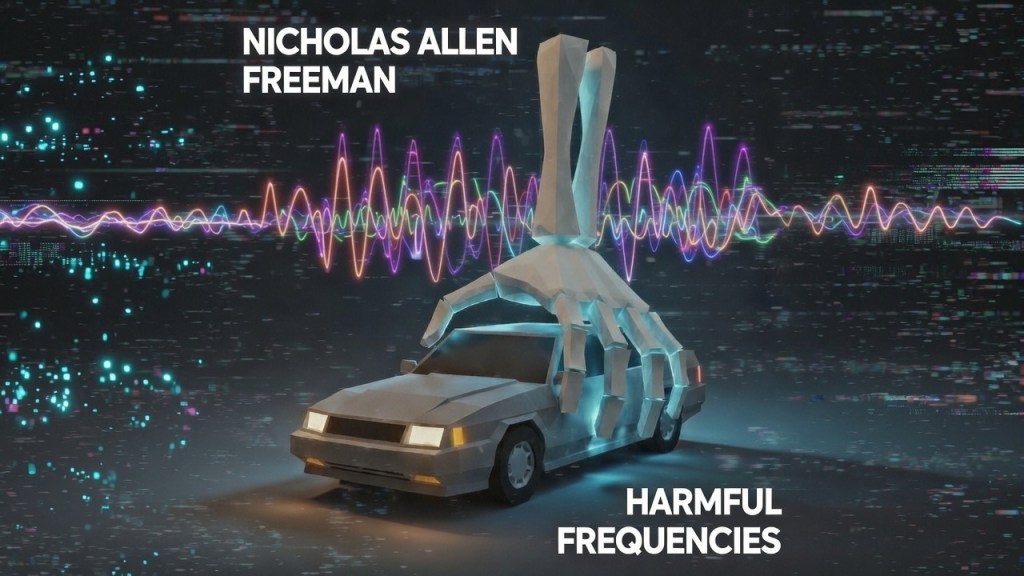
What happens when you strip music-making down to its most primitive, unstable tools — and then push those tools to their breaking point?
In the mid-1990s, inside a small Berkeley apartment, that question was answered not with a grand studio or expensive gear, but with a miniature Casio PT-1 keyboard and two Radio Shack walkie-talkies. The result is Harmful Frequencies, a visceral work of experimental noise and Casiocore tied to the Junk Magnet zine and website era — a live transmission from a malfunctioning reality.
Find it at Apple Music, Spotify, YouTube, Bandcamp, or your favorite streaming service. Watch the Space Patrol Pt. 1 music video.
The Creative Constraint That Forged Something Unique
Most experimental music is made inside powerful DAWs with endless plugins and post-production polish. Harmful Frequencies was created by Nicholas Allen Freeman under extreme limitations during his Junk Magnet period:
• A humble miniature Casio PT-1 keyboard
• Two inexpensive Radio Shack walkie-talkies used for live feedback and distortion
• One walkie-talkie feeding audio into a speaker while the other was moved dynamically through three-dimensional space — treated almost like a handheld “bow” or antenna to sculpt interference patterns in real time
• Simple room mics capturing everything live, with no pedals, no overdubs, no safety net
This wasn’t circuit-bending as hobby. It was performance as composition — a real-time negotiation with electromagnetic chaos. The feedback wasn’t tamed; it was listened to, shaped, and allowed to misbehave. What emerged were textures that digital emulations rarely capture: unpredictable, organic, sometimes frightening, sometimes strangely beautiful.
This is the philosophy of creative constraint in action. Severe limitations don’t just restrict — they force invention. The same principle that drove the broader 90s underground noise scene (and Junk Magnet’s own DIY ethos) now lives in these recordings. The “harmful” in the title isn’t just edgy branding. It’s an acknowledgment that these frequencies were designed to disrupt clean listening, to resist easy consumption, and to evoke something primal.
Horror, Noise, and Sonic Worldbuilding
Harmful Frequencies sits comfortably alongside the great Japanoise and experimental traditions (Boredoms, OOIOO, and the broader 90s underground noise scene that Junk Magnet chronicled) while carving its own path through toy-instrument subversion. The Casio’s limited, cheerful tones get warped into something darker — dissonant clusters, rhythmic glitches, and howling feedback that feel like psychological horror rendered in sound.
Yet there’s also a futuristic, almost sci-fi undercurrent. The AI-generated visuals accompanying the project on YouTube — mecha forms and space patrol imagery rendered in low-poly neon — suggest these frequencies could be transmissions from a dystopian tomorrow, or signals harmful to mental “bubbles” of comfort.
In an age obsessed with perfect sound and algorithmic safety, Harmful Frequencies is deliberately dangerous to the status quo. It reminds us that noise has always been a form of communication — sometimes the most honest one.
Analog Soul in the Age of AI Collaboration
Here’s where this project resonates deeply with the mission of Artificial Ideas: the music was born from pure analog rebellion during the Junk Magnet era, yet its visual and promotional life now thrives through thoughtful collaboration with AI tools. The same creator who once hacked consumer electronics for sonic disruption is now using neural networks to extend that disruption into visual storytelling and cross-media worlds.
This isn’t “AI music.” This is human creativity amplified. The raw, imperfect analog heart remains untouched. AI serves the vision — generating consistent low-poly neon aesthetics, mecha/space patrol sequences, and teaser content that draws new listeners into the sonic experience.
It’s a powerful model for creators: honor your analog or DIY roots (Junk Magnet style – http://www.junkmagnet.com) while intelligently partnering with new tools to reach audiences who would never discover underground noise otherwise.
Where to Listen & Support
Harmful Frequencies is now available across major platforms:
• Bandcamp: https://nicholasallenfreeman.bandcamp.com/album/harmful-frequencies
• Apple Music: https://music.apple.com/us/album/harmful-frequencies/1881705614
• Spotify: https://open.spotify.com/album/6PTHsd5YVoT2IYHXIAUbat?si=n_yADuzfRyCtj-2tfyyJ-g
• YouTube (full album playlist with AI-generated visuals): https://youtube.com/playlist?list=OLAK5uy_mwhiaDSO3GSqO_P9hgjE2APdFMiMF6-Uo&si=vaY9dmPn5sa2pIEo
• Space Patrol Pt. 1 Music Video – https://youtu.be/n_2oXL1846s?si=pTOnerf1lhF6gl4w
• TikTok – https://www.tiktok.com/@junkmagnet?_r=1&_t=ZT-98CRmhZ64Bp
This isn’t background music for scrolling. Put on good headphones or speakers, turn it up, and let the feedback loops and toy-keyboard distortions do their work. It rewards attention. Support independent experimental music tied to the real Junk Magnet underground spirit.
A Question for You
What do these frequencies stir in you — unease, catharsis, nostalgia for the 90s underground, or ideas for your own constrained creations?
The best underground art doesn’t just entertain; it transmits. Harmful Frequencies is one of those transmissions.
 Artificial Ideas